
Yes, a landscaped front yard can affect property value, but the size of the effect depends on design quality, maintenance, local buyer preferences, climate, and how well the yard fits the home. Research reviewed by Virginia Tech found that moving from little or no landscaping to a more sophisticated landscape was associated with roughly 5.5 percent to 11.4 percent higher perceived home value in a multi-state study, while other research cited by the extension service found premiums around 10 percent to 12 percent when landscapes improved from average to excellent. Those figures are not guaranteed appraisal increases. In practice, front yard landscaping often creates value by improving curb appeal, signaling that the property is well cared for, helping listing photos stand out, and reducing the amount of work buyers think they must do after moving in. The best returns usually come from thoughtful, healthy, low-maintenance landscaping rather than expensive or overly elaborate projects.
That distinction matters.
A beautiful front yard does not automatically add a fixed percentage to every home’s selling price. Landscaping works through several channels at the same time. It affects curb appeal, buyer perception, marketability, property condition, listing photography, maintenance expectations, and, in some cases, the price buyers are willing to pay.
Understanding those connections can help homeowners spend money where it actually matters.
How Front Yard Landscaping Influences Property Value
Front yard landscaping affects property value because the front of the home is both a physical space and a marketing tool.
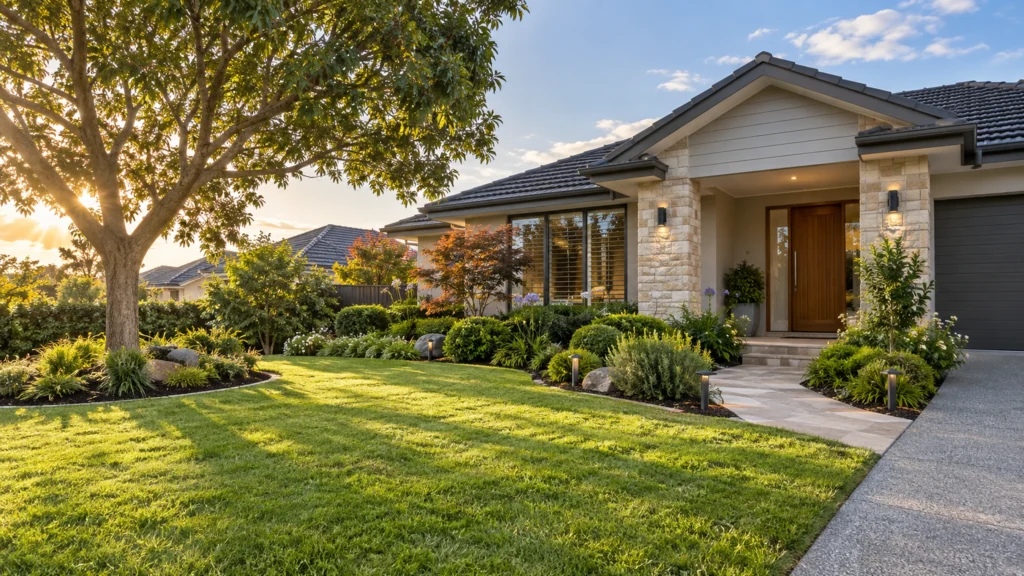
Before a buyer examines the kitchen countertops, bathroom fixtures, flooring, or storage space, they have already seen the driveway, lawn, trees, flower beds, walkway, porch, and front entrance.
Increasingly, that first impression happens online.
Real estate professionals have pointed out that buyers often begin forming an opinion of a property through listing photos before arriving for a showing. Good landscaping therefore influences both traditional curb appeal and what might be called digital curb appeal.
The National Association of REALTORS reported in its 2023 Remodeling Impact Report that 97 percent of REALTORS considered curb appeal important when attracting buyers, while 98 percent believed curb appeal was important to potential buyers. Ninety-two percent had recommended improving curb appeal before listing a home.
That does not mean buyers consciously calculate how many dollars a row of shrubs is worth.
The effect is subtler.
A cared-for landscape can make a property feel complete, established, maintained, and move-in ready.
A neglected front yard can create the opposite reaction.
Overgrown shrubs, dead grass, broken edging, weeds, dying plants, damaged walkways, and bare beds may encourage buyers to mentally subtract the cost and effort required to correct them.
How Much Value Can Landscaping Add to a Home?
There is no universal percentage.
Claims that landscaping automatically increases every property’s value by a certain amount should be treated cautiously because home prices depend on location, comparable sales, market conditions, property condition, lot size, architecture, neighborhood expectations, and buyer demand.
Still, research provides useful evidence.
Virginia Tech’s review of a multi-state landscaping study found that the difference in perceived home value between homes with little landscaping and homes with sophisticated landscaping ranged from approximately 5.5 percent to 11.4 percent depending on location.
An earlier Michigan study found a 12.7 percent difference between the least-valued and most-valued landscapes.
Virginia Tech also cited research showing price premiums of around 6 percent to 7 percent when landscaping moved from good to excellent and around 4 percent to 5 percent when it moved from average to good.
These figures are best interpreted as evidence that landscaping quality can influence market perception and sale value, not as a guaranteed formula.
A 500,000 dollar home does not automatically become worth 550,000 dollars simply because someone spends a weekend planting shrubs.
What matters is the difference the landscaping makes to the property as a whole.
Landscaping ROI Is Not the Same as an Increase in Home Value
This is where landscaping statistics are often misunderstood.
Return on investment and property value increase are not identical.
The National Association of REALTORS estimated in 2023 that standard lawn care service could recover approximately 217 percent of its cost, landscape maintenance about 104 percent, and an overall landscape upgrade about 100 percent.
The landscape upgrade evaluated in that research included features such as a natural flagstone walkway, stone planters, flowering shrubs, a tree, and landscaping improvements.
A 217 percent cost recovery figure does not mean lawn care raises the entire value of a home by 217 percent.
It means the estimated value recovered from that particular improvement exceeded its estimated project cost.
That is one reason inexpensive improvements can sometimes produce stronger landscaping ROI than ambitious transformations.
Cleaning, trimming, edging, mulching, repairing, and restoring what already exists may produce more financial impact per dollar than redesigning the entire property.
What Front Yard Landscaping Features Add the Most Value?
Research suggests that buyers respond to the overall composition of the landscape rather than a single magical plant or feature.
Virginia Tech found that design sophistication had the greatest influence among the landscape characteristics studied, followed by plant size and then plant diversity.
In practical terms, a cohesive landscape generally has more impact than a collection of expensive plants placed without a clear plan.
Here is how common front yard improvements can contribute to value.
| Front Yard Improvement | Potential Value Contribution | What Buyers May Notice |
|---|---|---|
| Healthy lawn | Strong curb appeal and clean appearance | Regular maintenance and usable outdoor space |
| Defined garden beds | Makes the landscape feel intentional | Order, structure, and visual appeal |
| Mature trees | Shade, scale, privacy, and established character | Long-term landscape maturity |
| Foundation planting | Connects the house visually to the landscape | Balanced architecture and softer exterior lines |
| Fresh mulch | Quickly improves neglected planting areas | Cleanliness and maintenance |
| Front walkway | Improves access and visual direction | A welcoming route to the entrance |
| Low-maintenance plants | Reduces perceived upkeep | Easier ownership |
| Native plants | Can suit local climate and reduce unnecessary maintenance | Climate-appropriate landscape design |
| Landscape lighting | Improves nighttime presentation and usability | Safety, visibility, and atmosphere |
| Healthy shrubs | Frames entrances and windows | Established landscaping |
| Seasonal color | Adds visual interest to listing photos | Freshness and personality |
| Drainage improvements | Protect landscape and structures | Practical property management |
The important word is balance.
More landscaping is not necessarily better landscaping.
Design Sophistication Matters More Than Plant Quantity
One of the most useful findings in the Virginia Tech research is that design sophistication mattered more than simply having many different types of plants.
That makes intuitive sense.
Imagine two comparable homes.
The first has twelve expensive shrubs, several flowers, decorative stones, two ornamental grasses, and a young tree. Everything was purchased individually and planted wherever space was available.
The second has fewer plants, but they are arranged to frame the entrance, soften the foundation, create visual layers, and guide the eye toward the front door.
The second landscape can easily look more valuable despite containing fewer individual elements.
Good landscape design creates hierarchy.
Trees provide scale.
Shrubs create structure.
Perennials and flowers introduce texture and color.
Ground covers or mulch create visual continuity.
Walkways provide direction.
The front door becomes the focal point rather than disappearing behind vegetation.
That is why successful front yard landscaping should complement the architecture instead of competing with it.
A Well-Maintained Yard Can Be More Valuable Than an Expensive Yard
Homeowners sometimes assume that increasing property value requires installing premium hardscaping, elaborate irrigation systems, large specimen trees, or extensive new planting beds.
Often, maintenance is the better starting point.
The NAR research is especially revealing here because relatively straightforward lawn care and landscape maintenance produced strong estimated cost recovery.
A front yard may simply need:
- Lawn mowing and edging.
- Weed removal.
- Shrub pruning.
- Fresh mulch.
- Removal of dead plants.
- Repair of broken edging.
- Pressure washing of walkways.
- Tree trimming where appropriate.
- A few healthy flowering plants.
- Cleaning around the front entrance.
These improvements are not glamorous.
They are effective because buyers notice signs of neglect quickly.
A simple yard that looks healthy and deliberately maintained can outperform a more expensive landscape that looks complicated or tired.
The Hidden Value of Landscaping Is Reduced Buyer Friction
One useful way to think about landscaping is not simply as decoration but as friction reduction.
Buyers often perform mental calculations while viewing a house.
How much will this cost to fix?
How difficult will this be to maintain?
Will I need to hire someone?
Is that tree dangerous?
Will those shrubs have to be removed?
Does this lawn need to be replaced?
Does water drain toward the foundation?
Every visible problem creates another small objection.
Good landscaping removes those objections.
A maintained lawn requires no immediate rescue.
Healthy trees feel like assets rather than liabilities.
A clear walkway feels safe.
Proper drainage reduces concerns about standing water.
Pruned shrubs allow light through windows.
Low-maintenance planting beds make the yard feel manageable.
In that sense, front yard landscaping can protect value by reducing reasons for buyers to discount the property.
Does Front Yard Landscaping Affect an Appraisal?
It can, but not in the simplistic way homeowners sometimes expect.
An appraiser does not generally assign a fixed dollar amount to every hydrangea, tree, flower bed, or strip of lawn.
Appraisal involves the overall property, its condition, relevant improvements, market evidence, and comparable properties.
Current Fannie Mae guidance, for example, describes property condition ratings as being based on a holistic view of the property and its improvements.
The Appraisal Institute has also stated that positive landscaping changes can enhance price and potentially reduce time on the market, while negative landscaping may have the opposite effect.
The practical takeaway is important.
Landscaping may contribute to how your property competes with similar homes, but spending 20,000 dollars on a front yard does not guarantee that an appraiser will increase the valuation by 20,000 dollars.
Market reaction matters.
Front Yard Landscaping and Buyer Perception
People do not buy homes as spreadsheets alone.
Emotion plays a role.
A shaded walkway, attractive tree, clean lawn, healthy foundation planting, and inviting front entrance can make buyers imagine arriving home every evening.
That emotional response can increase interest in the property.
At the same time, buyers also notice maintenance.
A highly intricate landscape may look spectacular to an enthusiastic gardener while appearing exhausting to someone who wants a low-maintenance yard.
This creates what could be called the maintenance tax.
The landscape may be visually beautiful, yet buyers mentally attach hours of pruning, watering, weeding, fertilizing, mowing, and seasonal cleanup to it.
The most market-friendly landscape therefore sits between two extremes.
It should not look empty.
It should not look demanding.
What Homeowner Forums Reveal About Landscaping and Resale
Real-world homeowner discussions add an important perspective that formal ROI studies cannot always capture.
A recurring theme in landscaping and real estate forums is that homeowners preparing to sell are often advised not to undertake major landscape redesigns immediately before listing.
In one 2025 real estate discussion, commenters commonly recommended inexpensive visual improvements such as fresh flowers, drought-tolerant plants, and better presentation rather than substantial new planting.
Another landscaping discussion focused on whether landscapes should be designed with resale in mind. A concern raised there was that extremely dense or elaborate landscaping can discourage buyers who expect considerable maintenance.
A more recent 2026 discussion raised another overlooked issue: seasonality. A landscape dominated by plants that disappear or look dormant during the selling season may photograph very differently from the same yard during peak bloom.
These discussions are anecdotal rather than controlled research, but they reveal a useful principle.
Landscaping value depends partly on how buyers experience the property at the moment it is marketed.
The Season You Sell Can Change the Value of Your Landscaping
Landscaping is unusual among home improvements because its appearance changes throughout the year.
Granite countertops look largely the same in January and July.
A garden does not.
If nearly every plant in a front yard is deciduous or herbaceous, the landscape may look full and vibrant during summer but sparse during winter or early spring.
Homeowners who expect to sell within a year can plan for this.
Evergreen structure can provide year-round interest.
Trees can create architectural form even without leaves.
Ornamental grasses can contribute winter texture where appropriate.
A clean walkway and defined planting beds remain visible throughout the year.
Container plants can provide quick seasonal color before photographs and showings.
This does not mean filling every yard with evergreens.
It means considering what the property will look like during the actual marketing period.
Digital Curb Appeal Now Matters Almost as Much as Street Curb Appeal
The modern home search often starts on a phone.
That changes landscaping strategy.
Buyers scrolling through dozens of listings may spend only a short time looking at the first exterior photograph before deciding whether to continue.
A front yard therefore needs to work at two scales.
It needs to look attractive when someone is standing at the curb.
It also needs enough structure and contrast to read clearly in a listing photograph.
Strong shapes usually photograph better than visual clutter.
Defined lawn edges.
Visible pathways.
Balanced planting.
A clear entrance.
Healthy greenery.
A focal point near the front door.
This is another reason homeowners preparing to sell should think beyond adding more flowers.
The goal is visual clarity.
Does a Lawn Increase Property Value?
A healthy lawn can contribute to property value and curb appeal, particularly in neighborhoods where lawns are the local norm.
The NAR’s 2023 outdoor remodeling research found particularly strong estimated cost recovery for standard lawn care service.
But a traditional lawn is not automatically the best solution everywhere.
Climate matters.
Water availability matters.
Local landscaping expectations matter.
A thirsty lawn in an arid region may create more maintenance than value, while drought-tolerant landscaping may feel more appropriate.
The best landscape is usually one that looks intentional within its environment.
Do Trees Increase Property Value?
Healthy, properly placed trees can be among the most valuable components of an established landscape.
Trees provide scale, shade, privacy, seasonal interest, and visual maturity that small plants cannot immediately reproduce.
Virginia Tech notes that mature trees can contribute meaningfully to landscape and property value, while its landscape research found plant size to be one of the strongest factors affecting perceived value.
However, tree condition matters.
A healthy shade tree and a declining tree leaning toward the roof do not produce the same buyer reaction.
Trees too close to structures, trees with obvious damage, or branches interfering with roofs and power lines may create perceived costs rather than benefits.
Tree health should therefore be considered separately from simple tree quantity.
Does Hardscaping Increase Home Value?
Hardscaping can increase usability and give a landscape permanent visual structure.
Front yard hardscaping may include:
- Walkways.
- Steps.
- Retaining walls.
- Driveway borders.
- Stone edging.
- Planters.
- Porches.
- Landscape walls.
- Path lighting.
A well-designed walkway can be particularly valuable because it serves both aesthetic and practical purposes.
It directs visitors toward the entrance, creates visual structure, and makes the home feel more welcoming.
NAR’s outdoor project research included a broader landscape upgrade featuring a flagstone walkway, stone planters, shrubs, and a tree, with REALTORS estimating full recovery of the project cost in that specific scenario.
Again, that figure should not be treated as a guarantee for every property.
Can Landscaping Ever Lower Property Value?
Yes.
Landscaping becomes a liability when it creates problems rather than solving them.
Common examples include:
- Overgrown shrubs blocking windows.
- Trees planted too close to the house.
- Plants obscuring the front entrance.
- Dead or diseased vegetation.
- Broken retaining walls.
- Cracked or uneven walkways.
- Poor drainage.
- Extremely high-maintenance planting schemes.
- Excessive decorative features.
- Landscaping that feels out of scale with the property.
- Thorny or hazardous plants beside walkways.
- Planting that makes the home look dark or hidden.
- Large investments that dramatically exceed neighborhood standards.
The point of diminishing returns matters.
A modest house in a neighborhood of simple landscapes may not recover the cost of an extremely elaborate front garden.
Landscaping should support the property rather than become the property.
Low-Maintenance Landscaping Can Improve Market Appeal
Maintenance has become an important part of landscape design.
Many buyers want attractive outdoor spaces without inheriting a second job.
Low-maintenance landscaping may include climate-appropriate shrubs, native plants, perennial beds, efficient irrigation, manageable lawn areas, ground covers, mulch, and appropriately sized trees.
The key is not necessarily eliminating maintenance.
Every landscape requires some care.
The objective is making that care feel reasonable.
This is especially useful when designing with resale value in mind.
At Front Yard Landscaping Ideas, a practical principle is to think about the future buyer’s first question after admiring the yard.
Not only, “Does this look good?”
But also, “Can I comfortably take care of this?”
If both answers are yes, the landscape is doing its job.
Native Plants and Property Value
Native plants can support a low-maintenance landscape when they are well matched to local soil, rainfall, temperature, and growing conditions.
They may also support local pollinators and wildlife.
From a resale perspective, however, native landscaping should still look intentional.
A naturalistic garden can appeal strongly to some buyers while confusing others if it appears unmanaged.
Defined edges, pathways, repeated plant groupings, and visible structure can communicate that the landscape is deliberate rather than neglected.
This principle applies to almost every landscaping style.
Intentionality creates value.
Should You Landscape the Front Yard Before Selling?
Usually, basic improvements make sense.
Major redesigns require more caution.
If you are preparing to sell, start with defects rather than upgrades.
Remove dead plants.
Trim overgrown shrubs.
Repair obvious hardscape damage.
Clean walkways.
Address weeds.
Refresh mulch.
Improve lawn health where appropriate.
Make the entrance visible.
Then step back.
If the yard already looks clean, balanced, and maintained, additional spending may produce diminishing returns.
A few containers with seasonal plants may accomplish more than installing an entirely new garden.
Best Front Yard Improvements Before Listing a Home
For homeowners focused specifically on resale value, prioritize improvements in this order.
First, Fix Neglect
Correct anything that makes the yard look abandoned or difficult.
Weeds, dead plants, broken edging, damaged walkways, fallen branches, and neglected lawn areas deserve attention first.
Second, Improve the Entrance
The landscape should visually guide people toward the front door.
Trim anything hiding the entrance.
Clean steps.
Repair the walkway.
Make sure exterior lighting works.
Third, Create Clear Landscape Structure
Define beds.
Edge the lawn.
Group plants rather than scattering them.
Maintain clear lines between lawn, planting areas, and hardscape.
Fourth, Add Selective Color
Flowers can be effective, particularly around the entry.
But color should accent the landscape rather than overwhelm it.
Fifth, Think About Maintenance
Avoid adding features that require extensive upkeep immediately before selling.
Buyers should see an appealing yard, not a long weekend maintenance schedule.
Front Yard Versus Backyard Landscaping
Front and backyard landscaping influence value in different ways.
The front yard is primarily about presentation, arrival, neighborhood context, and curb appeal.
The backyard is more closely connected with privacy, recreation, entertaining, outdoor living, and functional space.
For that reason, a front yard often has disproportionate influence over first impressions, while a backyard may become more important once buyers begin imagining daily life in the home.
Neither should be ignored.
But when preparing a property for sale on a limited budget, repairing visible front yard neglect can be especially important because buyers encounter it first.
The Best Landscape Is the One That Fits the Property
Perhaps the biggest mistake in discussions about landscaping and property value is searching for a universal list of features.
There isn’t one.
A desert home, suburban colonial, coastal cottage, modern townhouse, rural farmhouse, and Mediterranean-style house should not necessarily have the same front yard.
Strong landscape design responds to context.
Consider:
- Climate.
- Architecture.
- Neighborhood character.
- Lot size.
- Sun exposure.
- Water availability.
- Drainage.
- Local plant performance.
- Maintenance requirements.
- Typical buyer expectations.
A landscape that belongs to the property generally looks more valuable than one built around whatever plants happened to be trending that year.
A Better Way to Think About Landscaping Value
Instead of asking only, “How much money will landscaping add to my house?” ask four questions.
First, does the landscaping improve the home’s first impression?
Second, does it make the property look properly maintained?
Third, does it remove problems or maintenance concerns for buyers?
Fourth, does it fit the architecture, neighborhood, and climate?
When all four answers are yes, landscaping is more likely to contribute positively to marketability and resale value.
This is the unique advantage of front yard landscaping.
Its value is not confined to flowers, grass, trees, or stone.
It changes how buyers interpret everything behind the front door.
Conclusion
So, does a landscaped front yard affect property value?
Yes, but landscaping should not be treated as a guaranteed mathematical increase in appraisal value.
Research shows that well-designed landscapes can improve perceived home value, while real estate professionals consistently regard curb appeal as important to attracting buyers. NAR research has also shown strong estimated cost recovery for lawn care, landscape maintenance, and certain broader landscaping upgrades.
The biggest lesson, however, is that more spending does not automatically create more value.
Healthy plants, clear design, good maintenance, an inviting walkway, appropriate trees, clean landscape beds, functional lighting, and low-maintenance planting can often produce greater impact than an elaborate renovation.
Think of the front yard as the handshake of the property.
It introduces the house before anyone walks through the door.
For homeowners planning improvements, the goal should therefore be neither the cheapest landscape nor the most expensive one. It should be a landscape that feels healthy, intentional, attractive, manageable, and appropriate for the home.
That is where curb appeal becomes real estate value.
Frequently Asked Questions
Does landscaping increase home value?
Landscaping can increase perceived home value, marketability, curb appeal, and potentially resale value. The exact impact varies by location, design quality, maintenance, buyer preferences, and the overall property. Research reviewed by Virginia Tech found meaningful differences in perceived value between minimally landscaped and sophisticated landscapes.
How much can front yard landscaping increase property value?
There is no guaranteed percentage. Virginia Tech reported approximately 5.5 percent to 11.4 percent differences in perceived value between no landscaping and well-designed landscaping in a multi-state study. Other research cited by the university found approximately 10 percent to 12 percent improvement when landscapes moved from average to excellent. These figures describe particular research findings rather than guaranteed returns for every home.
What landscaping adds the most value to a home?
Healthy lawns where appropriate, mature trees, balanced foundation planting, defined beds, attractive walkways, healthy shrubs, fresh mulch, low-maintenance plants, functioning landscape lighting, and good overall maintenance can contribute to curb appeal and marketability. Cohesive landscape design is generally more important than simply adding more plants.
Is landscaping worth doing before selling a house?
Basic landscape maintenance is often worth considering before selling because it improves the property’s presentation without necessarily requiring a large investment. NAR reported that 92 percent of REALTORS had recommended improving curb appeal before listing a home.
Does landscaping affect home appraisal value?
Landscaping can influence the overall condition and market appeal of a property, but appraisers do not normally assign a simple fixed dollar value to every landscaping feature. Comparable sales, location, property condition, improvements, and market evidence remain important components of valuation. The Appraisal Institute has stated that positive landscaping can enhance price while poor landscaping may negatively affect marketability.
Can too much landscaping hurt resale value?
Yes. Extremely elaborate landscaping can create perceived maintenance costs, reduce usable space, hide architectural features, or appeal to a narrower group of buyers. Overgrown or poorly maintained landscaping can also become a liability. Homeowner discussions frequently raise maintenance concerns when considering highly elaborate landscapes for resale.
Do mature trees increase home value?
Healthy mature trees can contribute shade, privacy, scale, and established character. Virginia Tech research has found plant size to be an important factor in perceived landscape value. The condition, species, location, and maintenance requirements of the tree still matter.
Are native plants good for resale value?
Native plants can support a climate-appropriate, lower-maintenance landscape, which may appeal to buyers. They are most likely to support curb appeal when the planting looks deliberate and well maintained rather than unmanaged.
Does a front walkway add value?
An attractive, safe front walkway can contribute to both functionality and curb appeal. NAR’s 2023 landscape upgrade example included a natural flagstone walkway alongside planters, shrubs, and a tree, with REALTORS estimating full recovery of the project cost in that specific scenario.
Should I replace my entire front yard before selling?
Usually not unless the existing landscape has significant problems. Cleaning, pruning, edging, mulching, repairing damaged hardscaping, improving lawn health, and adding limited seasonal color may provide a stronger return than a complete redesign immediately before listing.
Is low-maintenance landscaping better for home value?
Low-maintenance landscaping can broaden buyer appeal because it combines attractive outdoor space with manageable upkeep. However, the ideal landscape still depends on climate, neighborhood norms, lot size, and local buyer preferences.
Does curb appeal really matter when selling a home?
Yes. NAR’s outdoor remodeling research found that 97 percent of REALTORS considered curb appeal important in attracting buyers and 98 percent believed it was important to potential buyers.
Does front yard landscaping help a home sell faster?
Good landscaping can improve marketability, and the Appraisal Institute has stated that positive landscaping changes can enhance price and reduce time on the market. Actual selling time still depends on pricing, location, inventory, demand, property condition, and broader real estate market conditions.
What is the best landscaping investment for resale?
For many sellers, the strongest starting point is maintenance rather than major construction. Lawn care where appropriate, pruning, weed removal, clean edging, fresh mulch, healthy planting beds, visible walkways, and an attractive entrance can improve curb appeal without requiring an expensive landscape renovation.

Sara Bendrick believes your yard should be a place you actually look forward to coming home to. A licensed and bonded design-build contractor (C-27 #1006161), she founded Sarita Landscape Designs and has spent over twelve years designing residential outdoor spaces across Southern California with a real soft spot for curb appeal and low-water, no-lawn designs.
When she’s not on a job site, Sara’s on camera or on stage. She’s hosted yard-renovation shows including I Hate My Yard, Build It Like Bendrick, and Lawn & Order, written Big Impact Landscapes, given two TEDx talks, and serves as a spokesperson for Stihl. Her mission is simple, help people see the potential in the yard they already have.