
To landscape a small front yard, start with a simple plan that improves the route to your front door, frames the house with correctly scaled plants, and leaves enough open space for the yard to feel calm rather than crowded. Choose one focal point, repeat a limited group of plants, define beds with clean edging, and use mulch, ground cover, or a modest lawn to connect the design. The best small front yard is not the one with the most features. It is the one in which every plant, path, and material has a clear purpose.
A compact outdoor space can still deliver strong curb appeal. In fact, a small yard often becomes more memorable because its design has to be disciplined. This guide from Front Yard Landscaping Ideas explains how to assess the site, create a practical layout, select plants, control maintenance, work with a limited budget, and avoid the mistakes that make a narrow yard feel even smaller.
Table of Contents
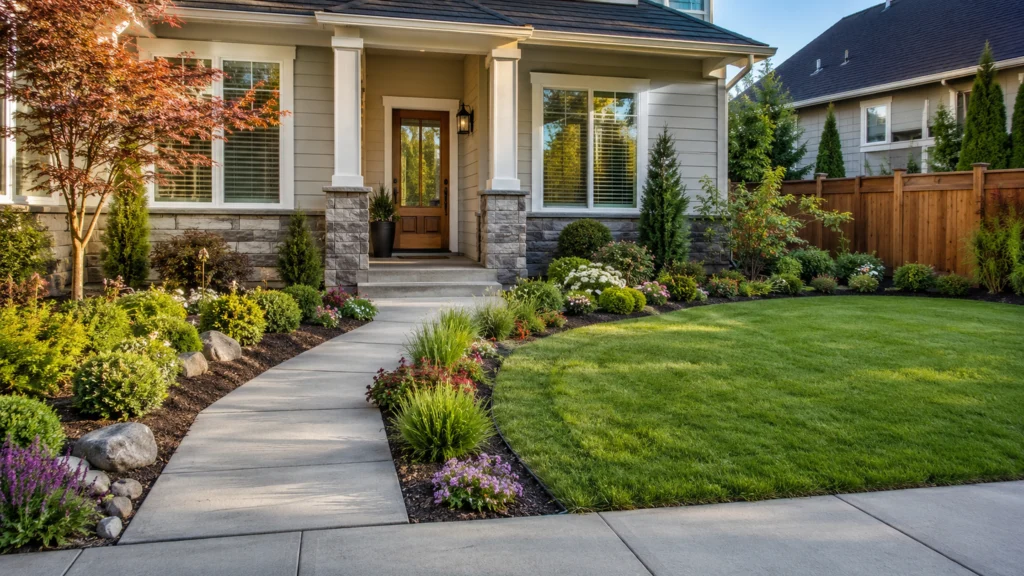
Start With the Site, Not the Shopping Cart
Before buying plants or gravel, spend time observing the space. A successful landscape design for a small front yard begins with conditions that already exist. Sunlight, soil, drainage, wind, access, and the architecture of the house should guide the design.
Walk outside at different times of day and note where the sun falls. A bed that receives six hours of direct light needs different plants from a shaded strip under an overhang. Watch what happens after rain. Water collecting beside the foundation or across the walkway is a drainage issue, not a planting opportunity.
Record the following details:
- The width and depth of the usable yard.
- The location of the driveway, walkway, porch, steps, utility boxes, and property lines.
- Areas of full sun, partial shade, and deep shade.
- Existing trees, slopes, downspouts, and drainage paths.
- Views you want to highlight and features you want to soften.
- The amount of time you can realistically spend on maintenance.
This short site review prevents expensive mistakes. It also helps you distinguish between attractive small front yard landscaping ideas and ideas that will actually work on your property.
Create a Simple Small Front Yard Landscaping Plan
A small yard benefits from a clear structure. Sketch the house, driveway, front walk, porch, and planting beds on paper. The drawing does not need to be technical. Its purpose is to establish proportion and movement.
Begin with the route from the sidewalk or driveway to the front door. That path should feel direct, visible, and comfortable. Then decide where planting beds will frame the house without swallowing the walkway or blocking windows. Finally, identify one area for visual emphasis, such as a small ornamental tree, a pair of containers, a sculptural shrub, or a colorful bed near the entrance.
Keep the plan simple by limiting the number of major zones. Most small front yard landscaping plans need only three:
- An arrival zone that includes the path, steps, and porch.
- A foundation zone that connects the house to the ground.
- An open zone made from lawn, ground cover, gravel, or a restrained garden bed.
A plan with clear zones feels intentional. A yard filled with disconnected features feels smaller because the eye has nowhere to rest.
Choose One Strong Focal Point
Every compact yard needs a visual anchor, but it rarely needs more than one. The focal point should support the front door and the architecture rather than compete with them.
Good focal points for tiny front yard ideas include a dwarf flowering tree, an evergreen topiary, a specimen shrub, a large planter, a bench near the porch, or a neat island bed. Position the feature where it naturally draws attention toward the entrance.
Avoid placing several bold objects in different corners. Multiple statues, bright planters, dramatic rocks, and high-contrast plants can turn a small landscape into a display shelf. Choose one lead feature and let the rest of the design play a supporting role.
Make the Front Walk Easy to Read
The walkway is one of the most important pieces of front yard hardscape. It guides visitors, creates the first close view of the garden, and visually connects the street to the house.
A straight path suits formal homes and very narrow yards. A gently curved path can soften a rectangular space, but the curve should have a reason. Avoid tight bends that make the route inconvenient or consume planting space.
Materials should relate to the home. Brick can echo a traditional facade. Concrete pavers suit many modern and transitional houses. Gravel can work in informal gardens when it is contained by solid edging and does not spill onto steps or pavement.
Keep plants beside the path low enough that they do not catch clothing, hide the edge, or make visitors feel squeezed. Fragrant herbs, low ornamental grasses, compact perennials, and tidy ground covers can make the walk feel welcoming without narrowing it.
Frame the House With Layered Foundation Planting
Foundation planting should soften the line where the building meets the soil. It should not hide the house behind a wall of foliage.
Use three simple layers where space allows:
- Taller anchor plants near blank walls or outer corners.
- Medium shrubs beneath windows, kept below the sill.
- Low perennials or ground covers along the front edge of the bed.
Choose plants according to their mature size, not their size at the garden center. A shrub that looks modest in a nursery pot may become wider than the bed within a few seasons. Constant pruning is usually a sign that the plant is too large for the location.
Dwarf evergreens, compact hydrangeas, small boxwoods, low spireas, ornamental grasses, heucheras, sedges, lavender, salvia, and creeping ground covers are common choices, but suitability depends on climate, soil, sunlight, and local growing conditions. Native plants are often valuable because they can support pollinators and adapt well when matched to the right site.
Repeat Plants to Make the Yard Feel Larger
Repetition is one of the simplest ways to create order. Instead of planting one of everything, choose a restrained palette and repeat it across the yard.
A useful planting palette might include:
- One compact evergreen for year-round structure.
- One flowering shrub for seasonal color.
- One ornamental grass or fine-textured plant for movement.
- Two or three perennials that bloom at different times.
- One ground cover to knit the bed together.
Repeating the same plants helps the eye move smoothly through the space. It also makes maintenance easier because plants with similar needs can be grouped together. This is a central principle behind simple front yard landscaping because fewer plant varieties, used confidently, usually look better than a crowded collection.
Use Dwarf Trees and Compact Shrubs
A small front yard can still have a tree. The key is choosing a species with a mature height, canopy width, and root habit that fit the available space.
Look for dwarf conifers, compact Japanese maples, serviceberries, redbuds, dogwoods, or other small ornamental trees suited to your region. Before planting, check the expected mature spread and keep the tree clear of overhead wires, foundations, sidewalks, and driveways.
Compact shrubs can provide structure without overwhelming the facade. Place them where they can grow naturally. A shrub should not require monthly cutting simply to stay out of a window or walkway.
For small house front yard landscaping, plant scale matters as much as color. Oversized shrubs make the building look cramped. Properly scaled plants make both the house and yard appear more generous.
Decide Whether the Lawn Deserves the Space
A lawn can create valuable open space, but it should not remain by default. In a very small front yard, a patch of grass may be awkward to mow, difficult to irrigate, or too shaded to thrive.
Keep a lawn when it creates a clean visual foreground, provides a useful play or sitting area, and grows well in the site conditions. Reduce or replace it when it consists of narrow strips, steep slopes, isolated corners, or thin grass beneath trees.
Alternatives include ground cover, a low meadow planting, gravel with planted pockets, broad garden beds, or permeable paving. Small front lawn landscaping ideas work best when the lawn has a clear shape. A simple rectangle or gentle curve is easier to maintain and looks more deliberate than a collection of leftover grass fragments.
Combine Rocks, Mulch, and Plants Carefully
Low-maintenance front yard landscaping ideas with rocks and mulch are popular because they can reduce exposed soil and give beds a finished appearance. They work best when the materials are used with restraint.
Mulch helps conserve soil moisture, reduce weeds, and moderate soil temperature. Apply it in a tidy layer and keep it away from trunks, stems, siding, and the foundation. Organic mulch gradually breaks down and improves the soil, although it needs periodic renewal.
Decorative rock lasts longer and can suit dry climates, modern homes, drainage channels, and narrow side strips. However, stone can absorb heat, collect debris, and become difficult to remove. Landscape fabric beneath rock may slow weeds for a time, but soil and organic matter eventually accumulate above it.
For a balanced design, use one dominant ground material. Mixing several colors of gravel, multiple mulch types, and random boulders often creates visual clutter. Clean edging between beds, lawn, and pavement does more for curb appeal than an expensive assortment of materials.
Add Vertical Interest Without Blocking the House
When ground space is limited, use vertical surfaces thoughtfully. A narrow trellis, porch column, wall-mounted planter, or upright plant can add height without occupying much soil area.
Climbing plants can soften a blank wall or frame a porch, but choose species that are appropriate for the structure. Some vines become heavy, invasive, or damaging when allowed to attach directly to siding or masonry. A freestanding trellis creates separation and makes maintenance easier.
Vertical elements should remain narrow and controlled. The goal is to add depth, not create a green barrier across the front of the home.
Use Containers Near the Entrance
Containers are especially effective in front porch landscaping ideas because they add color where visitors see it most. They are also flexible. Plants can be changed seasonally, and pots can be moved when the arrangement feels crowded.
Choose containers large enough to remain visually stable and hold moisture. One substantial pot often looks more polished than several tiny ones. For a symmetrical entrance, use a matching pair. For a relaxed design, group two or three pots of different heights while repeating the same material or color family.
Use a simple planting formula: one upright plant, one rounded filler, and one trailing plant. In very narrow spaces, a single architectural evergreen or ornamental grass may be enough.
Design for Year-Round Curb Appeal
A front yard is visible in every season, so the planting plan should not depend on one short burst of flowers.
Build year-round interest with a mix of:
- Evergreen foliage for winter structure.
- Spring bulbs or early-flowering shrubs.
- Summer perennials and ornamental grasses.
- Autumn foliage, berries, or seed heads.
- Bark, branching form, and durable hardscape for the dormant season.
Color matters, but form and texture last longer. Broad leaves beside fine grasses, rounded shrubs beside upright perennials, and dark evergreens behind lighter flowers create contrast without requiring dozens of species.
A limited color palette also makes a small garden feel coherent. Select two or three recurring flower colors that complement the house. Repetition gives seasonal displays more impact.
Plan Low Maintenance From the Beginning
Small front yard landscaping ideas that are low-maintenance depend more on design decisions than on any single plant. Maintenance falls when plants fit the site, beds have simple edges, and watering is efficient.
Use these principles:
- Match plants to sunlight, soil, moisture, and climate.
- Space plants for their mature width.
- Group plants with similar water needs.
- Cover open soil with mulch or ground cover.
- Use drip irrigation where practical.
- Choose slow-growing or naturally compact shrubs.
- Keep bed shapes simple enough to edge and mow.
- Avoid plants that spread aggressively or require frequent staking.
Low maintenance does not mean no maintenance. Every landscape needs occasional weeding, pruning, watering, and renewal. The goal is to make those tasks predictable rather than constant.
Budget-Friendly Landscaping for a Small Front Yard
A beautiful front yard does not require a complete renovation. The best cheap, simple landscaping ideas for a small front yard improve the most visible parts first.
Start with cleanup. Remove dead plants, prune overgrown shrubs correctly, wash hard surfaces, repair edging, and clear the path. These jobs cost little but immediately sharpen the space.
Then work in stages:
- Define the walkway and front door as the main arrival point.
- Reshape one foundation bed with a clean edge.
- Add a small number of healthy anchor plants.
- Divide existing perennials and repeat them elsewhere.
- Apply fresh mulch after planting.
- Add one container or a simple porch feature.
- Replace struggling plants gradually rather than all at once.
Spend money on elements that are difficult to change, such as drainage, paths, steps, soil preparation, and a well-chosen specimen tree. Save on seasonal color, decorative accessories, and plants that can be divided or grown from smaller sizes.
Ideas for Different Types of Small Front Yards
Given are the ideas for the different types of small front yards:
A Small Front Yard With a Porch
Use the porch as part of the composition. Repeat a material or color from the porch in the path, containers, or edging. Keep shrubs below railings and windows. Place taller plants near porch corners rather than across the entire front.
Good landscaping ideas with a front porch often include a clear walkway, paired containers, low foundation planting, and one taller accent near the outer edge. This frames the entrance without hiding it.
A Narrow Townhouse Front Yard
Townhouse yards need strong lines and careful privacy. Use a direct path, narrow planting beds, upright shrubs, and vertical accents. A small hedge or screen can define the property, but it should not make the entrance feel boxed in.
For small front yard landscaping ideas for a townhouse, repetition is especially useful. One hedge type, one ground cover, and a small group of flowering plants can create a sophisticated result in very little space.
A Small Front Garden Without a Lawn
Small front garden landscaping ideas often work beautifully without grass. Use a clear path surrounded by layered beds, ground covers, and a few structural shrubs. Leave visible areas of mulch, gravel, or paving so the design has breathing room.
A lawn-free front garden should still have open space. Do not fill every inch with plants. A small gravel court, widened path, or low ground cover can provide visual calm.
A Sloped Small Front Yard
On a slope, address erosion and access before decoration. Steps should be stable, paths should drain safely, and soil should be held with deep-rooted plants or properly built retaining structures.
Terracing can create usable planting levels, but retaining walls must be designed for the load and local conditions. On gentle slopes, masses of ground cover, grasses, and shrubs can stabilize soil while making the grade feel intentional.
A Modern Small Front Yard
Modern small front yard landscaping ideas rely on clean geometry, restrained materials, and strong plant forms. Use broad planting masses instead of scattered specimens. Pair simple concrete or large pavers with ornamental grasses, clipped evergreens, or drought-tolerant plants.
Keep the palette controlled. One gravel color, one paving material, and a concise plant list will look more modern than a collection of trendy details.
Common Small Front Yard Landscaping Mistakes
Here are the common small front yard landscaping mistakes to avoid:
Planting Too Close to the House
Plants need room for mature growth, air circulation, inspection, and maintenance. Crowding shrubs against siding can trap moisture and hide problems.
Blocking Windows and Walkways
Tall plants beneath windows and wide shrubs beside paths create ongoing pruning work. Choose plants by mature size and place them where their natural form can remain intact.
Using Too Many Materials
Brick, gravel, river rock, colored mulch, timber, metal edging, and concrete can all work, but not necessarily together. Limit the material palette so the yard feels unified.
Creating Beds That Are Too Small
Thin strips of soil force plants into cramped rows and dry out quickly. One generous bed is usually more attractive and easier to plant than several narrow fragments.
Ignoring Drainage
Never direct water toward the foundation or create a bed that holds runoff against the house. Correct grading, downspout discharge, and path drainage before adding decorative features.
Copying a Photograph Without Checking the Site
Landscaping photos of small front yards are useful for identifying styles, plant combinations, and layouts. They are not planting plans for every climate. A design that thrives in a cool, coastal region may fail in a hot, dry, or humid location. Use photographs for inspiration, then adapt the concept to local conditions.
A Practical Order for Completing the Project
Landscaping a small front yard becomes easier when the work follows a sensible sequence.
- Measure the space and assess sunlight, soil, and drainage.
- Decide on the path, bed shapes, focal point, and open area.
- Resolve grading, drainage, utilities, and structural repairs.
- Install hardscape, steps, edging, and irrigation.
- Improve the soil where planting will occur.
- Plant trees and large shrubs first.
- Add smaller shrubs, perennials, grasses, and ground covers.
- Apply mulch or the selected surface material.
- Add containers, lighting, and restrained decorative details.
- Review the design from the street and remove anything that feels unnecessary.
That final step matters. Editing is part of design. In a compact yard, taking one item away can improve the whole landscape.
Conclusion
Learning how to landscape a small front yard is largely an exercise in thoughtful restraint. Start with the route to the door, respect the scale of the house, choose plants for their mature size, and repeat a limited palette. Use hardscape to create structure, planting to soften the architecture, and open space to keep the yard from feeling crowded.
The strongest front yard landscaping ideas for small yards do not depend on extravagant features. They depend on clear priorities, suitable plants, good drainage, and a design that can be maintained without becoming a weekly burden. Front Yard Landscaping Ideas encourages homeowners to build the yard in layers, starting with access and structure before adding color and personality. When every element earns its place, even the smallest front yard can feel polished, welcoming, and complete.
Frequently Asked Questions
What Is the Best Way to Landscape a Small Front Yard?
The best approach is to create a clear path to the front door, use one focal point, frame the house with correctly scaled plants, and repeat a limited plant palette. Keep bed shapes simple and preserve some open space so the yard does not feel crowded.
How Can I Make a Small Front Yard Look Bigger?
Use fewer plant varieties, repeat colors and textures, keep shrubs below windows, and create a visible path that draws the eye toward the entrance. Clean edges and a consistent material palette also make the space feel more expansive.
What Plants Work Well in a Small Front Yard?
Compact shrubs, dwarf evergreens, small ornamental trees, low ornamental grasses, perennials, and ground covers are often suitable. The final choice should match local climate, sunlight, soil, drainage, and the mature size available in the planting bed.
How Do I Landscape a Small Front Yard With Low Maintenance?
Choose plants suited to the site, group them by water needs, space them for mature growth, and cover exposed soil with mulch or ground cover. Use simple bed shapes, durable edging, and drip irrigation where practical.
How Can I Landscape a Small Front Yard on a Budget?
Begin with cleanup, pruning, fresh edging, and mulch. Improve one high-visibility area at a time, divide existing perennials, buy smaller healthy plants, and invest first in drainage, soil preparation, paths, and structural plants.
Should a Small Front Yard Have a Lawn?
A lawn is useful when it creates a clean open area and grows well in the available light. Replace it when it is too narrow to mow, too shaded to thrive, or divided into awkward fragments. Ground cover, gravel, garden beds, or permeable paving may use the space more effectively.
Are Rocks or Mulch Better for a Small Front Yard?
Mulch is generally helpful around plants because it supports soil health and moisture retention. Rock can work in dry climates, modern landscapes, and drainage areas. Choose the material that fits the site and design, and avoid mixing too many surface treatments.
How Can I Add Privacy to a Tiny Front Yard?
Use a low hedge, narrow upright shrubs, a small ornamental tree, or a trellis placed where screening is needed. Keep the entrance visible and avoid creating a tall solid barrier that makes the yard feel enclosed.
How Deep Should Front Yard Planting Beds Be?
Beds should be deep enough to accommodate the mature spread of the selected plants and allow layered planting. Avoid narrow strips that force shrubs against the house or walkway. The appropriate depth depends on the plant palette and available space.
What Should I Landscape First in a Small Front Yard?
Start with drainage, grading, the walkway, steps, and bed layout. Then install trees and structural shrubs before adding perennials, ground covers, mulch, containers, and decorative details.

Sara Bendrick believes your yard should be a place you actually look forward to coming home to. A licensed and bonded design-build contractor (C-27 #1006161), she founded Sarita Landscape Designs and has spent over twelve years designing residential outdoor spaces across Southern California with a real soft spot for curb appeal and low-water, no-lawn designs.
When she’s not on a job site, Sara’s on camera or on stage. She’s hosted yard-renovation shows including I Hate My Yard, Build It Like Bendrick, and Lawn & Order, written Big Impact Landscapes, given two TEDx talks, and serves as a spokesperson for Stihl. Her mission is simple, help people see the potential in the yard they already have.