
To landscape a large front yard, divide the open space into purposeful zones, create a clear route to the front door, anchor the design with trees and broad planting beds, and connect everything through repeated plants, colors, and hardscape materials. Keep the scale generous, choose plants suited to your climate, and leave enough open space for the yard to feel calm rather than crowded.
A large front yard may look like a dream on paper. In reality, all that space can quickly become a design puzzle. A few small flower beds disappear into the lawn. Random shrubs feel disconnected. Long driveways dominate the view. Maintenance can also become expensive and exhausting.
The solution is not to fill every corner. It is to give the yard structure.
A successful front yard landscape design guides the eye, welcomes visitors, complements the house, and creates curb appeal throughout the year. The following steps explain how to turn a wide, empty, or awkward front lawn into a balanced landscape that feels established and intentional.
Table of Contents
Start With a Complete Front Yard Assessment
Before buying trees, digging flower beds, or ordering gravel, study the property as a whole. Good landscaping begins with observation.
Walk through the yard at different times of day. Notice where sunlight falls, where water collects, which areas feel exposed, and how people naturally move from the street or driveway to the front door.
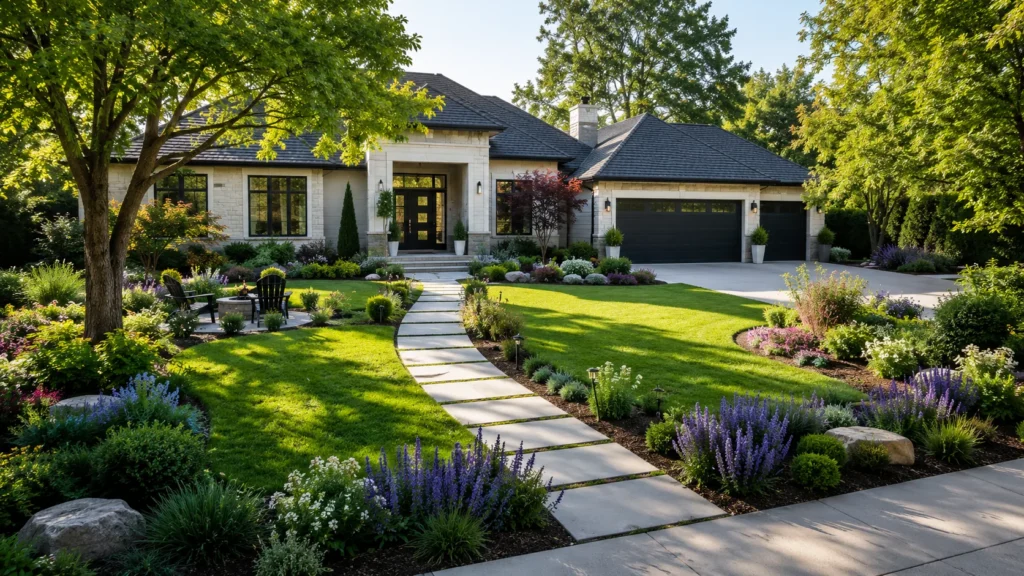
Record the following details:
- The total size and shape of the front yard
- The location of the house, driveway, sidewalk, porch, and property lines
- Sunny, partly shaded, and deeply shaded areas
- Existing trees, shrubs, utility boxes, drains, and outdoor structures
- Slopes, low spots, erosion, and drainage patterns
- Views you want to highlight or screen
- Local soil conditions and average rainfall
- Underground utility lines and neighborhood restrictions
This assessment helps you avoid expensive mistakes. A flowering plant that needs full sun will struggle beneath a mature shade tree. A patio placed in a drainage path may become unusable after heavy rain. A large tree planted too close to the house can create future problems with branches, roots, and foundations.
The yard should respond to the site you have, not the perfect garden you saw in a photograph.
Divide the Large Front Yard Into Functional Zones
One of the most effective large yard landscaping ideas is to break the property into smaller visual and functional areas.
Without zones, a large front yard often looks like one broad sheet of lawn. With zones, it begins to feel like a designed landscape.
Possible front yard zones include:
- An arrival zone around the driveway and parking area
- A welcoming entrance near the front door
- A foundation planting area beside the house
- A lawn or open play area
- A shade garden beneath mature trees
- A front yard seating area
- A pollinator garden or meadow section
- A privacy buffer along the property line
- A decorative garden near the street
- A utility zone for bins, meters, and equipment
Each zone should have a purpose, but the entire landscape must still feel connected. Repeat the same edging material, plant varieties, mulch, or color palette across multiple areas. Repetition creates rhythm and stops the yard from looking like a collection of unrelated projects.
At Front Yard Landscaping Ideas, we recommend giving every major area a clear role before choosing individual plants. Purpose creates order. Plants then bring that order to life.
Create a Strong Front Yard Landscape Plan
A landscape plan does not need to be a professional architectural drawing. A simple sketch can prevent poor placement and unnecessary spending.
Draw the house and the main boundaries first. Add the driveway, sidewalks, front steps, porch, existing trees, and utility features. Then sketch the proposed planting beds, paths, lawn areas, seating spaces, and focal points.
Think in terms of large shapes rather than individual flowers.
Broad curves, deep beds, and generous plant groupings usually work better in a large front yard than tiny borders and scattered specimens. Small features can feel lost when viewed from the road.
A good plan should answer five questions:
- Where should visitors look first?
- How will they reach the front door?
- Which areas should remain open?
- Where is shade, privacy, or screening needed?
- How much maintenance can the household realistically manage?
Your landscaping plans for the front of the house should also match the architecture. A formal brick home may suit symmetrical beds and clipped evergreens. A cottage-style house may look better with curved borders and loose flowering plants. A modern home often benefits from clean lines, ornamental grasses, structured shrubs, and a limited material palette.
Make the Front Door the Main Focal Point
The front door should be easy to find. In a large yard, however, it can disappear behind an oversized lawn, wide driveway, or dense planting.
Use the landscape to direct attention toward the entrance.
A front walkway, matching planters, low hedges, porch lighting, or a pair of small ornamental trees can frame the approach. Plants near the entrance should enhance the doorway rather than block it.
You can create a stronger entrance by:
- Widening the planting beds near the porch
- Repeating the front door color in flowers or containers
- Using a clear walkway material
- Adding layered lighting along the route
- Placing taller plants beside the entrance rather than directly in front of it
- Using symmetrical elements when they suit the house
- Keeping overgrown shrubs away from windows and steps
The front door does not need to be the largest feature. It simply needs enough visual support to become the natural destination.
Design a Walkway That Feels Generous
A narrow path can look timid in an expansive landscape. The main walkway should feel comfortable, visible, and proportional to the house.
It should also connect logical points. A beautiful path that begins in the middle of the lawn will confuse visitors. Connect it to the driveway, street sidewalk, parking area, or gate.
Common walkway materials include:
- Brick
- Natural stone
- Concrete pavers
- Poured concrete
- Compacted gravel
- Stepping stones
- Permeable paving
Choose a material that relates to the house. Brick can echo a brick facade. Natural stone works well with rustic and traditional homes. Large concrete slabs often complement modern front yard landscaping.
Curves can soften a wide property, but avoid unnecessary twists. A path should feel natural rather than theatrical. Gentle movement is elegant. Constant zigzagging becomes inconvenient.
Add low plants, ornamental grasses, ground covers, or subtle landscape lighting along the route. Keep mature plant size in mind so the walkway does not become cramped after a few growing seasons.
Balance the Driveway With Landscaping
In many large front yards, the driveway is the biggest visible feature. Ignoring it allows concrete or asphalt to control the entire view.
Driveway landscaping can soften hard edges and connect the parking area with the garden.
Consider adding:
- Wide planting beds along selected driveway sections
- Small trees placed far enough from vehicles and pavement
- Low shrubs that will not block sightlines
- Repeated ornamental grasses
- A planting island near a circular driveway
- Stone edging or a contrasting paver border
- A decorative gate or entrance planting
- Permeable surfaces where appropriate
Do not line the entire driveway with identical tall shrubs unless you want a formal effect. Long, rigid rows can make a residential property feel severe. A mixture of repeated plant groups, open sections, and carefully positioned trees usually feels more natural.
Keep plants low near the street and driveway exit so drivers can see pedestrians, cyclists, and approaching vehicles.
Use Large Planting Beds Instead of Scattered Plants
One of the most common mistakes in big front yard landscaping is planting individual shrubs far apart across the lawn.
From the road, those plants look like dots. They do not create enough visual weight to balance the open space.
Large planting beds are more effective. They can sweep around the house, extend into the lawn, surround mature trees, or define the edges of the property.
Deep beds allow you to create plant layers:
- Tall trees or large shrubs at the back
- Medium flowering shrubs in the middle
- Perennials and ornamental grasses in front
- Ground covers or low annuals along the edge
This layered approach creates depth, seasonal color, and a more natural transition between the house and lawn.
Use broad groups of the same plant instead of buying one of everything. Repeated masses are easier to see, easier to maintain, and more visually calming.
For example, a group of ornamental grasses will have more impact than one grass surrounded by unrelated flowers. A sweep of ground cover will look more polished than scattered patches of several competing varieties.
Choose Front Yard Plants for Structure and Seasonal Interest
A strong planting design does not rely on flowers alone. Blooms are temporary. Structure carries the landscape through every season.
Build the plant palette in layers.
Trees
Trees provide shade, height, privacy, and long-term character. They can frame the house, soften a large roofline, or divide an expansive lawn into smaller spaces.
Choose tree species according to your climate, soil, mature size, and available space. Avoid planting a tree based only on how it looks at the garden center. A young tree may appear modest but eventually spread far beyond its original planting area.
Use canopy trees where shade is needed and smaller ornamental trees near entrances, patios, or garden beds.
Evergreen Shrubs
Evergreen shrubs provide year-round form. They can anchor foundation beds, mark an entrance, or create a privacy screen.
Choose varieties that naturally mature at an appropriate size. Constantly cutting a large shrub into a tiny shape creates extra work and often damages its natural beauty.
Flowering Shrubs
Flowering shrubs bring seasonal color without requiring the same level of care as large annual beds. They work well in mass plantings, along property lines, and around seating areas.
Select varieties with different blooming periods to extend color through the growing season.
Perennials
Perennials return year after year and can fill broad garden beds economically over time. Use them in groups rather than scattering individual plants.
Combine plants with different flowering seasons, foliage textures, and mature heights.
Ornamental Grasses
Ornamental grasses add movement, texture, and a relaxed architectural quality. They are especially useful in modern front yard landscaping ideas and large naturalistic gardens.
Place them where their mature size will not block paths, windows, or driveway views.
Ground Covers
Ground covers can reduce bare soil, suppress some weeds, and create a finished edge beneath trees or shrubs. They are useful on slopes, in shaded areas, and in sections where grass grows poorly.
Choose noninvasive varieties suited to local conditions.
Native Plants
Native plants are often well adapted to regional weather and can support local insects and wildlife. They are not automatically maintenance-free, but the right native plant in the right location can be a practical choice.
Use regional plant resources to identify trees, shrubs, grasses, and flowers suited to your soil and climate.
Frame the House With Foundation Landscaping
Foundation planting connects the house to the surrounding land. Without it, even an attractive home can look as though it was dropped onto an empty lawn.
The goal is not to hide the foundation behind a solid wall of shrubs. It is to soften the transition while keeping windows, vents, paths, and architectural details visible.
Use taller plants near blank walls or corners. Place lower plants beneath windows. Leave breathing room around steps and doors.
A successful foundation bed may include:
- Evergreen anchors at major corners
- Flowering shrubs beneath larger wall sections
- Perennials near the front edge
- Ground covers or mulch to finish the soil surface
- Repeated plants that connect both sides of the entrance
Avoid creating a thin strip that follows the exact outline of the house. In a large yard, deeper beds with gentle curves or strong geometric lines look more proportional.
Build Front Yard Flower Beds With Year-Round Appeal
Front yard flower bed ideas should begin with structure, not a shopping cart full of colorful blooms.
Start with the bed shape and permanent plants. Then add seasonal color.
A balanced flower bed may contain:
- One or two structural shrubs
- A repeated group of medium perennials
- Low plants along the front edge
- Spring bulbs between established plants
- A limited number of annuals for extra color
Choose a controlled color palette. Two or three main colors, supported by varied foliage, often look more sophisticated than every color competing at once.
For a soft garden, combine white, pale pink, lavender, and silver foliage. For a lively entrance, use warm reds, oranges, and yellows. For a modern look, focus on green texture with a few bold seasonal accents.
Plant for succession so one season hands the spotlight to the next. Spring bulbs can be followed by summer perennials, autumn grasses, and evergreen winter structure.
Decide How Much Lawn You Actually Need
A large lawn creates open space and gives the eye somewhere to rest. It can also require frequent mowing, watering, feeding, and edging.
You do not have to remove all the grass. Instead, decide which lawn areas serve a purpose.
Keep grass where it provides:
- A play area
- A clean foreground for the house
- Space for outdoor activities
- A visual break between garden beds
- A practical connection between landscape zones
Reduce lawn in awkward corners, steep slopes, deep shade, or narrow strips that are difficult to mow.
No lawn front yard landscaping ideas can include native meadow planting, ground covers, gravel gardens, expanded flower beds, low-growing shrubs, and permeable patios. The best option depends on climate, local rules, water availability, and how the space will be used.
The goal is not to eliminate lawn for the sake of a trend. It is to keep only the lawn that earns its place.
Add a Front Yard Seating Area or Patio
A large front yard can support more than decoration. It can become a social space.
Front yard seating area ideas work especially well when the property has a pleasant view, a shaded corner, a broad porch, or enough distance from the street.
A simple seating zone may include:
- A small gravel patio
- A bench beneath a tree
- Two chairs beside the porch
- A paved terrace surrounded by planting
- A low wall that doubles as seating
- A garden table near a pollinator bed
Place the area where it feels protected but not hidden. A small tree, low hedge, decorative fence, or group of shrubs can create a sense of enclosure.
Front yard patio ideas should still support the main entrance. The patio must not confuse visitors about which path leads to the front door.
Use materials already present in the walkway, porch, or house exterior to make the seating area feel like part of the original plan.
Introduce Privacy Without Building a Fortress
Front yard privacy landscaping requires restraint. Homeowners often want separation from the road or neighboring houses, but a solid wall of tall plants can make the property feel closed and unsafe.
Layered screening usually feels more welcoming.
Combine small trees, evergreen shrubs, flowering plants, ornamental grasses, and open fencing. Allow some filtered views rather than blocking everything.
Privacy can be concentrated around the places that need it most, such as a porch, seating area, bedroom window, or side entrance.
Avoid planting tall shrubs near driveway exits, pedestrian paths, or street corners. Visibility matters for safety.
Use Hardscaping to Give the Yard Permanent Structure
Plants change through the seasons. Hardscape provides a stable framework.
Front yard hardscape ideas may include:
- Walkways
- Retaining walls
- Garden steps
- Stone borders
- Gravel areas
- Low seating walls
- Decorative columns
- Patios
- Driveway edging
- Raised planting beds
Limit the number of materials. Too many different stones, pavers, bricks, and edging styles can make the yard look busy.
Choose one main material and one supporting material. Repeat them across the landscape.
For example, a brick house may use brick accents along a concrete walkway. A stone foundation may inspire matching garden walls. A modern home may use large concrete pavers with gravel joints.
Hardscape should solve a problem as well as look attractive. A retaining wall manages a slope. Steps improve access. Permeable paving may help water move into the soil. A low wall can define a garden while providing extra seating.
Plan Drainage Before Decorative Features
Water will shape the success of the landscape long after the first planting day.
Watch how rain moves across the property. Identify areas where water runs toward the foundation, collects beside the driveway, or washes soil from slopes.
Possible drainage solutions include:
- Regrading selected areas
- Extending downspouts away from the house
- Installing appropriate underground drainage
- Creating a rain garden
- Using permeable paving
- Planting deep-rooted vegetation on slopes
- Building shallow swales that direct runoff safely
Do not direct water onto neighboring property or public walkways. Drainage work may be subject to local regulations, so consult a qualified professional when the problem is significant.
Handle drainage before building patios, paths, walls, or expensive planting beds. Water rarely respects a decorative plan.
Create an Efficient Irrigation Strategy
A large front yard can waste water when every area receives the same amount.
Different plants have different needs. Lawn, new trees, mature shrubs, and drought-tolerant perennials should not always be watered on one schedule.
Divide irrigation into practical zones. Use drip irrigation for planting beds where suitable, and direct sprinklers carefully so they water plants rather than pavement.
Group plants with similar moisture requirements. This practice simplifies irrigation and reduces stress on plants.
New landscapes usually need closer watering attention while roots become established. Mature, well-chosen plants may need less frequent care, depending on climate and rainfall.
Check local watering restrictions before creating the irrigation plan.
Add Landscape Lighting With Purpose
Lighting should help people move safely and reveal important features after dark. It should not turn the front yard into a stage.
Focus on:
- Front steps
- Walkway changes
- Driveway entrances
- House numbers
- The front door
- One or two attractive trees
- Retaining walls or architectural details
Use several low, subtle light sources instead of one harsh fixture. Avoid shining lights into neighboring windows or directly toward the street.
Warm, restrained lighting usually creates a more welcoming effect than bright floodlights. The best fixtures are often the ones people barely notice.
Choose a Clear Landscape Style
A large property can hold many features, but that does not mean it should display every design style.
Choose a direction that complements the house and your way of living.
Formal Front Yard Landscape
A formal design uses symmetry, straight paths, clipped hedges, repeated shapes, and a controlled plant palette. It suits many traditional and classical homes.
Modern Front Yard Landscape
Modern landscaping often uses clean lines, simple plant masses, architectural grasses, large pavers, gravel, and a limited range of materials.
The design may be minimal, but it still requires strong proportions and careful plant placement.
Cottage Garden Landscape
A cottage-inspired front yard uses layered flowers, curved paths, flowering shrubs, climbing plants, and informal edges. The effect should feel abundant rather than neglected.
Naturalistic Landscape
A naturalistic design uses native plants, grasses, broad drifts, meadow-like areas, and relaxed shapes. It works particularly well on large properties where tightly clipped beds would feel artificial.
Traditional Suburban Landscape
This style balances lawn, foundation planting, shade trees, flower beds, and a clear entrance. It is flexible, familiar, and easy to personalize.
Whichever style you choose, repeat its key materials, shapes, and plants. Consistency turns individual features into a landscape.
Create a Low-Maintenance Large Front Yard
Low-maintenance front yard landscaping does not mean zero maintenance. Every outdoor space needs some care.
The aim is to reduce repetitive work through better design.
Use these strategies:
- Choose plants suited to the site
- Avoid placing large plants in small spaces
- Group plants with similar water needs
- Use broad plant masses
- Reduce difficult lawn areas
- Install clear bed edges
- Apply mulch at an appropriate depth
- Use ground covers where grass struggles
- Select disease-resistant regional plants
- Install efficient irrigation
- Leave enough space between plants and structures
- Keep the plant palette focused
Mulch ideas for a front yard include shredded bark, wood chips, pine material, gravel, or stone, depending on the garden style and local climate. Organic mulch can improve the appearance of planting beds and help protect the soil, but it should not be piled against tree trunks or plant stems.
Maintenance also becomes easier when paths are accessible and plants are not crowded. A landscape should allow room for pruning, weeding, watering, and future growth.
Landscape a Large Front Yard on a Budget
Affordable front yard landscaping ideas begin with priorities.
You do not need to finish the entire property in one season. In fact, a phased approach often produces better results because you can observe how plants grow and how the family uses the space.
Complete projects in this order:
- Correct drainage and grading problems
- Define the main walkway and driveway edges
- Plant important shade and structural trees
- Create the main foundation beds
- Improve the front entrance
- Add shrubs and ground covers
- Expand perennial and flower beds
- Build seating areas and decorative features
- Add lighting and finishing details
Spend more on features that are difficult to move later, such as trees, paths, walls, drainage, and patios. Save money on features that can be added gradually, such as perennials, decorative containers, and seasonal color.
Other budget-friendly strategies include dividing established perennials, buying smaller healthy plants, using locally available materials, and focusing on one visible area at a time.
Cheap front yard landscaping should still have a plan. Random bargains become expensive when they need to be replaced or moved.
Common Large Front Yard Landscaping Mistakes
Even generous properties can feel awkward when scale, movement, and maintenance are ignored.
Using Beds That Are Too Small
Thin planting strips and tiny flower islands disappear against a broad lawn. Use deeper beds and larger plant groupings.
Planting Without a Plan
Buying attractive plants individually often creates a crowded and disconnected landscape. Decide on structure before selecting details.
Ignoring Mature Plant Size
Small nursery plants grow. Check expected height and spread before planting near windows, paths, roofs, and driveways.
Making Every Area a Focal Point
When everything demands attention, nothing feels important. Choose a clear entrance and a small number of supporting features.
Using Too Many Materials
A different edging, stone, mulch, and paver in every zone creates visual noise. Repeat materials.
Overfilling the Yard
Open space is part of the design. A landscape needs pauses just as a room needs breathing room.
Forgetting Winter Appearance
A flower-heavy garden may look empty for part of the year. Include evergreen structure, bark, seed heads, stone, and strong bed shapes.
Ignoring Maintenance
A complicated design may look beautiful for one season and become overwhelming the next. Match the landscape to the time, tools, and budget available.
Blocking the Front Door
Tall shrubs, trees, or decorative features should not hide the entrance. Keep the route clear and welcoming.
Treating Drainage as an Afterthought
Poor drainage can damage plants, hardscape, soil, and foundations. Solve water problems early.
A Simple Step-by-Step Front Yard Landscaping Plan
Use this practical sequence when you are ready to begin.
Step One
Measure the property and create a rough site map.
Step Two
Mark sunlight, shade, slopes, drainage, soil conditions, and existing features.
Step Three
Decide which areas will become lawn, planting beds, paths, seating, privacy screens, and open space.
Step Four
Choose the main focal point, usually the front entrance.
Step Five
Plan a clear walkway from the street or driveway to the front door.
Step Six
Select a landscape style that matches the house.
Step Seven
Create broad planting beds and choose structural trees and shrubs.
Step Eight
Add grouped perennials, ornamental grasses, and ground covers.
Step Nine
Plan irrigation, drainage, lighting, and maintenance access.
Step Ten
Complete the landscape in manageable phases.
This process keeps the large front yard from becoming one enormous project. Each phase contributes to the same final vision.
Conclusion
Learning how to landscape a large front yard begins with one important shift in thinking. Do not treat the property as empty space that needs to be filled. Treat it as a series of connected outdoor rooms.
Start with a complete site assessment. Create a landscape plan, divide the yard into useful zones, and make the front door the main destination. Use large planting beds, structural trees, layered shrubs, clear walkways, and repeated materials to bring the space together.
Keep the proportions generous, but the plant palette controlled. Leave open areas where the eye can rest. Plan for drainage, irrigation, seasonal interest, and long-term maintenance before chasing decorative details.
The result should feel welcoming from the street, comfortable near the house, and manageable throughout the year. A large front yard has room for beauty, privacy, shade, wildlife, and everyday life. The secret is giving that room a clear purpose.
Frequently Asked Questions
How do I start landscaping a large front yard?
Begin by measuring the property and identifying sunlight, shade, drainage, slopes, existing plants, utility lines, and major views. Create a simple plan that divides the yard into zones before buying plants or materials.
How can I make a large front yard look less empty?
Use large planting beds, grouped shrubs, shade trees, ornamental trees, broad pathways, and one or two focal points. Small isolated plants usually make a large yard feel even emptier.
What is the best layout for a large front yard?
The best layout creates a clear entrance, preserves useful open space, and divides the property into connected zones. These may include a lawn, foundation garden, driveway border, seating area, shade garden, and privacy planting.
What plants work best in a large front yard?
Choose a mixture of climate-appropriate trees, evergreen shrubs, flowering shrubs, perennials, ornamental grasses, and ground covers. Select plants according to sunlight, soil, water needs, mature size, and local growing conditions.
How can I landscape a large front yard with low maintenance?
Reduce awkward lawn areas, use broad groups of well-adapted plants, install clear edging, group plants with similar water needs, and avoid varieties that require constant pruning. A focused plant palette is usually easier to maintain than a highly complicated garden.
How can I landscape a large front yard on a budget?
Create a master plan and complete it in phases. Address drainage first, then plant important trees, define the entrance, build the main beds, and add smaller plants over time. Spend money on permanent features and use lower-cost plants for gradual filling.
Should I remove the lawn from a large front yard?
Remove or reduce lawn only where it has no practical or visual purpose. Keep useful lawn for play, movement, and open views. Replace difficult sections with planting beds, ground covers, native plants, gravel, or hardscape.
How do I create privacy in a large front yard?
Use layered trees, evergreen shrubs, flowering plants, grasses, and open fencing. Concentrate screening around seating areas, windows, or property boundaries instead of building a solid wall across the entire yard.
Can I add a patio or seating area to my front yard?
Yes. A large front yard can support a patio, bench, gravel seating area, or porch extension. Place it where it feels comfortable and slightly protected, while keeping the route to the front door clear.
How do I connect different areas of a large landscape?
Repeat key plants, colors, bed shapes, paving materials, and edging throughout the property. Repetition creates visual rhythm and makes separate zones feel like parts of one complete design.
How do I make a large front yard look modern?
Use clean bed lines, a limited plant palette, grouped ornamental grasses, structured shrubs, large pavers, gravel, and simple lighting. Avoid excessive decoration and allow open space to become part of the design.
What should I landscape first in a large front yard?
Begin with drainage, grading, major walkways, driveway access, and structural trees. These elements influence the rest of the design and are more difficult to change later.

Sara Bendrick believes your yard should be a place you actually look forward to coming home to. A licensed and bonded design-build contractor (C-27 #1006161), she founded Sarita Landscape Designs and has spent over twelve years designing residential outdoor spaces across Southern California with a real soft spot for curb appeal and low-water, no-lawn designs.
When she’s not on a job site, Sara’s on camera or on stage. She’s hosted yard-renovation shows including I Hate My Yard, Build It Like Bendrick, and Lawn & Order, written Big Impact Landscapes, given two TEDx talks, and serves as a spokesperson for Stihl. Her mission is simple, help people see the potential in the yard they already have.