
Landscaping a shady front yard starts with understanding how much sunlight the space actually receives, then choosing plants and design features that suit those conditions. Instead of trying to force sun loving grass and flowers into a low light area, build the landscape around shade tolerant shrubs, perennials, ground covers, foliage plants, paths, mulch, and a few strong focal points. Begin by observing where morning sun, afternoon sun, dappled light, and deep shade occur. Check the soil for drainage, moisture, and competition from tree roots. Next, create a simple shade garden layout with taller shrubs toward the house or background, medium sized plants through the middle, and low growing ground covers along paths and bed edges. Ferns, hostas, coral bells, astilbe, hellebores, sedges, foamflower, hydrangeas, and regionally appropriate native plants can all play useful roles.
The best shady front yard landscaping ideas do not fight the lack of sunlight. They turn shade into the main design advantage, using foliage, texture, layering, repetition, and subtle color to create a front yard that feels cool, established, welcoming, and intentional.
That sounds simple enough. The difference between a shade garden that merely survives and one that looks professionally designed, however, comes down to the details. You need to know what kind of shade you have, what is happening below the soil, and how plants will work together once they reach mature size.
This guide from Front Yard Landscaping Ideas walks through that process from the ground up.
Table of Contents
Why a Shady Front Yard Can Become a Landscaping Advantage
A shady front yard often gets treated like the difficult part of a property.
Grass becomes thin. Flowering plants refuse to bloom. The area beneath a mature tree turns bare. A north facing foundation bed can look dark and empty. Homeowners may keep replacing struggling plants without realizing that the plants are not the real problem.
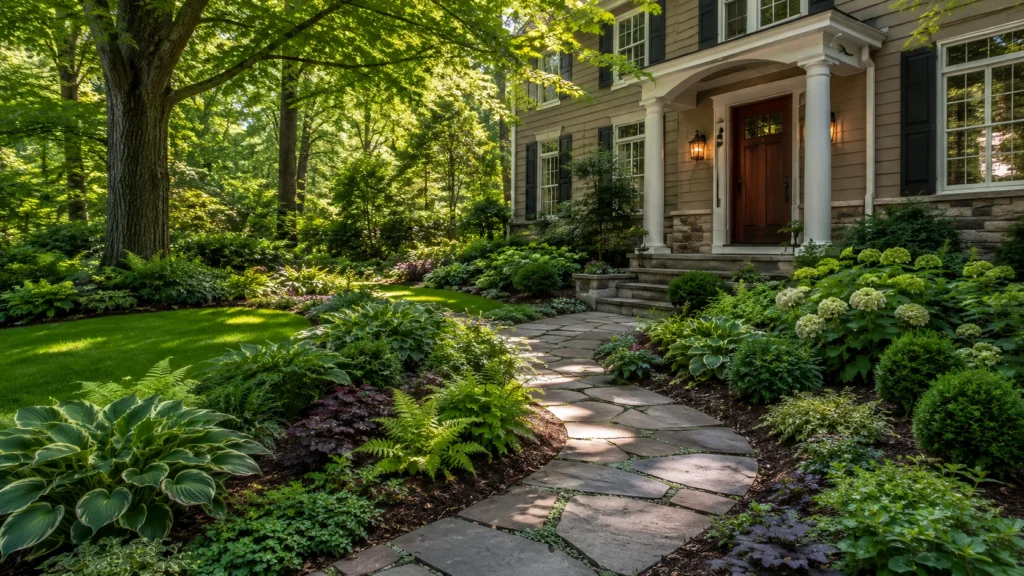
The conditions are.
Once you design for those conditions, shade can produce a surprisingly sophisticated landscape.
Shady gardens naturally lend themselves to layered foliage, woodland inspired planting, curved pathways, textured ground covers, delicate flowers, and peaceful seating areas. Colors often appear richer in softer light, while large leaves and different shades of green become more noticeable.
A good shade garden design relies less on nonstop flowers and more on contrast.
Think about glossy leaves beside feathery ferns. Deep green shrubs behind silver foliage. Broad hosta leaves beside fine textured sedges. White or pale flowers glowing underneath trees.
That contrast gives a shady landscape personality.
Start by Identifying the Type of Shade in Your Front Yard
Before choosing plants or drawing shade garden design plans, study the sunlight.
Not all shade is the same.
A plant that performs beautifully with four hours of gentle morning sun might struggle beside a porch that receives almost no direct light. Likewise, a plant suited to moist woodland conditions may fail underneath a large tree where the roots consume much of the available water.
Observe your front yard at several times during the day.
Full Shade
Full shade generally describes areas that receive very little direct sunlight during the growing season.
These areas may occur:
- Along the north side of a house.
- Beneath dense evergreen trees.
- Behind walls or tall structures.
- Under heavily shaded porches.
- Beneath dense tree canopies.
Full shade does not necessarily mean complete darkness. Many shade tolerant plants still need bright indirect light.
Partial Shade
Partial shade is one of the easiest conditions to landscape because many plants tolerate it.
A partial shade garden may receive several hours of direct sun followed by shade for the rest of the day.
Morning sun followed by afternoon shade is particularly useful for many woodland plants and shade tolerant flowering perennials.
When researching partial shade garden plans, pay attention to when the sunlight arrives, not only how many hours you receive.
Hot afternoon sun can be considerably more stressful than gentle morning light.
Dappled Shade
Dappled shade occurs when sunlight filters through the canopy of deciduous trees.
The light moves throughout the day, creating a shifting pattern of sun and shade.
This condition can support a wide range of woodland plants, native perennials, ferns, sedges, and spring flowering species.
It is also one of the most visually appealing settings for a naturalistic front yard shade garden.
Deep Shade
Deep shade is usually found beneath dense tree canopies, between closely spaced buildings, or in areas almost completely protected from direct sunlight.
Plant selection becomes more important here.
Instead of expecting abundant flowers, focus heavily on foliage, texture, form, evergreen structure, ground cover, and hardscape.
Dry Shade
Dry shade deserves its own category because it causes some of the biggest landscaping frustrations.
The soil may look protected from the sun but still remain surprisingly dry.
This commonly happens under established trees. Their roots compete with smaller plants for water and nutrients. Dense foliage can also intercept rainfall before much of it reaches the soil.
The result is shade without consistent moisture.
If this describes your property, your shade garden planning should prioritize plants capable of handling both lower light and periods of dry soil.
Check Soil, Drainage, and Tree Roots Before Planting
Good landscaping starts below ground.
Before buying a cart full of front yard landscaping plants for shade, examine the soil in several parts of the yard.
Look at three things in particular.
Soil Moisture
Check the soil a day or two after rainfall.
Does it remain soggy?
Does it drain quickly?
Is the soil underneath a tree already dry while other areas remain moist?
Moisture differences can exist within the same small front yard.
Matching plants to these smaller zones makes a shade garden much easier to maintain.
Drainage
Shade can slow evaporation, especially beside buildings and in low spots.
Poor drainage can cause roots to remain wet for too long, while steep areas may lose water quickly.
If water consistently pools after rain, solve the drainage issue before creating permanent planting beds.
Tree Root Competition
Mature trees provide valuable shade, but their roots can dominate the soil underneath them.
Avoid aggressively digging through large roots simply to install new plants. Damaging major roots can harm the tree.
Instead, look for natural spaces between roots and use smaller plants that require smaller planting holes.
A modest layer of organic mulch can help conserve moisture and visually connect the planting, but avoid piling mulch against tree trunks.
The goal is to work with the tree rather than build a garden at its expense.
Create a Shade Garden Layout Before You Buy Plants
The best shade garden layout is not necessarily complicated.
It simply gives each part of the landscape a job.
Before planting, stand at the street and look toward the house.
Then stand at the front door and look outward.
These two views reveal most of the design problems.
Ask yourself what should attract attention first.
The front door?
A beautiful ornamental tree?
A curved pathway?
A large architectural shrub?
Once you establish the main focal point, build the rest of the garden around it.
Use Layers to Make a Shady Front Yard Feel Full
One of the most effective shade garden landscaping techniques is layered planting.
A flat row of identical plants along the foundation can make a yard look rigid and unfinished. Layering plants at different heights creates depth.
A simple shade perennial garden layout can contain four levels.
Upper Layer
This is formed by existing canopy trees or small ornamental trees.
Depending on climate and growing conditions, possibilities may include dogwood, serviceberry, redbud in suitable light, or Japanese maple.
Structural Shrub Layer
Shrubs give the landscape weight and permanence.
Depending on your location and soil conditions, options may include:
- Oakleaf hydrangea.
- Smooth hydrangea.
- Inkberry holly.
- Rhododendron.
- Azalea.
- Summersweet.
- Selected viburnums.
Not every shrub is appropriate for every climate, so always match the plant to your USDA hardiness zone, soil, available moisture, and mature space.
Perennial Layer
This is where much of the personality appears.
Popular shade tolerant perennials include:
- Hostas.
- Ferns.
- Coral bells.
- Astilbe.
- Hellebores.
- Brunnera.
- Foamflower.
- Epimedium.
- Solomon’s seal.
- Woodland phlox in suitable regions.
- Japanese forest grass.
- Shade tolerant sedges.
Instead of planting one of everything, repeat selected plants throughout the bed.
Repetition makes the landscape feel deliberate.
Ground Layer
Low plants soften edges, cover exposed soil, and connect larger planting groups.
Consider shade tolerant sedges, foamflower, wild ginger where regionally appropriate, low growing ferns, or other noninvasive ground covers suited to your local climate.
Ground covers are especially valuable where traditional turfgrass struggles.
Choose the Best Shade Plants for Landscaping by Function
A common mistake is asking only, What grows in shade?
A better question is, What job does this plant need to perform?
Plants can provide structure, screening, seasonal flowers, ground coverage, texture, winter interest, or a focal point.
Selecting plants according to their function produces a stronger landscape.
Evergreen Plants for Year Round Structure
A front yard should still have shape when perennial flowers disappear for winter.
That is why evergreen structure matters.
Depending on region and light conditions, shade tolerant or part shade evergreen shrubs can create anchors near the foundation, entryway, or corners of the house.
Inkberry holly is one option in appropriate climates. Certain rhododendrons and other broadleaf evergreens can also provide year round interest.
Keep mature size in mind.
A small shrub at the garden center may eventually cover a window or crowd a walkway if planted too close to the house.
Ferns for Texture and Movement
Few plants communicate a woodland atmosphere as naturally as ferns.
Their finely divided foliage contrasts beautifully with the broad leaves of hostas, hydrangeas, and other shade plants.
Different fern species prefer different soil and moisture conditions, so choose varieties that match the site rather than assuming every fern prefers the same environment.
Native fern species are especially worth investigating for front yard native landscaping ideas.
Hostas for Bold Foliage
Hostas remain popular because their large leaves create instant visual weight.
Varieties range from deep green to blue green, chartreuse, cream, and variegated combinations.
They are particularly effective when repeated in groups rather than scattered individually.
However, hostas can attract slugs, snails, and deer in some areas, so local pest pressure should influence how heavily you depend on them.
Coral Bells for Foliage Color
Coral bells, commonly sold as Heuchera, can bring burgundy, lime, caramel, silver, purple, and green foliage into a shade garden.
That makes them useful where flowering color is limited.
They work particularly well near paths and at the front of planting beds where their foliage can be appreciated up close.
Astilbe for Soft Flowering Plumes
Astilbe brings upright flower plumes and finely textured foliage to shaded borders.
It generally performs better where the soil does not become excessively dry.
Pairing astilbe with hostas and ferns creates three distinct leaf and flower textures without making the bed feel chaotic.
Hellebores for Early Season Interest
Hellebores are valuable because they flower when much of the landscape is still waking up.
Their evergreen or semi evergreen foliage, depending on climate and variety, can also provide a substantial presence through several seasons.
They work well beneath deciduous trees where early season light reaches the ground before the canopy fully develops.
Hydrangeas for Larger Masses of Flowers
Certain hydrangeas can perform well in part shade and create the kind of generous flowering display homeowners often want near a front entrance.
The key word is certain.
Hydrangea species and cultivars differ in sunlight tolerance, mature size, flower behavior, and climate requirements.
Do not buy a hydrangea based on the word shade alone. Check the exact cultivar and growing requirements.
Native Plants for a More Resilient Shade Garden
Front yard native landscaping can be an excellent direction, particularly when you want the garden to support local insects, birds, and other wildlife.
There is no universal list of native shade plants because native status depends on location.
A plant native to Virginia may not be native to California.
Instead of searching only for native plants for shade gardens, narrow the search to your state, region, or ecological area.
Depending on where you live, possibilities may include native ferns, sedges, foamflower, wild ginger, woodland phlox, columbine, Solomon’s seal, serviceberry, dogwood, or regionally appropriate woodland shrubs.
A local native plant nursery, botanical garden, university extension service, or native plant society can help you identify plants genuinely suited to your area.
Design With Foliage Instead of Depending Only on Flowers
Sunny gardens can rely heavily on colorful blooms.
Shady gardens often look better when foliage leads the design.
Imagine a planting bed consisting only of medium green leaves.
Even if every plant is healthy, the garden can feel visually flat.
Now change the composition.
Place a broad blue green hosta beside a finely textured fern. Add dark burgundy coral bells near the front. Repeat a light green sedge along the path. Use a larger shrub behind them.
Suddenly, the garden has depth without needing dozens of flowers.
When creating your shade garden design, vary:
- Leaf size.
- Leaf shape.
- Plant height.
- Foliage color.
- Texture.
- Growth habit.
- Seasonal interest.
The result feels richer because the eye has something to discover at every level.
Repeat Plants Instead of Creating a Collection
It is easy to get excited at the nursery.
One hosta goes into the cart. Then one fern. One coral bell. One astilbe. One hellebore. One hydrangea. One unusual ground cover.
Soon the front yard resembles a plant collection rather than a designed landscape.
Repetition solves this.
Choose a smaller palette of reliable plants and repeat them in groups.
For example, a front yard shade garden might use repeated groups of ferns, coral bells, and sedges around a few larger shrubs.
The individual species become part of a visual rhythm.
This is one reason professionally designed landscapes often appear calmer than improvised gardens.
There may actually be fewer plant varieties.
They are simply used more intentionally.
Create a Strong Foundation Garden Plan
Landscaping ideas for a shaded front of house need to address the architecture as well as the garden.
Foundation beds should soften the transition between the home and landscape without hiding the house.
Start with the permanent features.
Locate windows, stairs, utility equipment, downspouts, walkways, porch columns, and the front door.
Then position plants around them.
Keep large shrubs away from windows they will eventually cover. Avoid placing thorny or sprawling plants where people regularly walk. Leave practical access to utility equipment.
A simple shaded foundation garden plan may include taller shrubs near blank sections of wall, medium perennials between the shrubs, and lower ground covers along the edge.
Near the front door, use plants with cleaner forms so the entrance remains obvious.
The front door should feel like the destination, not something visitors have to search for.
Use Paths to Give the Garden Structure
Plants are only part of landscaping.
Hardscape can be even more valuable in shade because it creates permanent structure where plants may grow slowly.
A defined path makes a front yard feel intentional immediately.
Materials may include:
- Natural stone.
- Brick.
- Pavers.
- Gravel.
- Stepping stones.
Choose a material that relates to the architecture of the house.
A traditional brick home may suit brick or natural stone. A contemporary home may look better with cleaner paver lines.
Make the primary route to the entrance obvious and comfortable.
Avoid forcing visitors through a narrow obstacle course of plants.
Add a Focal Point to Break Up Large Shady Areas
Large shaded front yards sometimes feel like an endless carpet of green.
A focal point gives the eye somewhere to stop.
This could be:
- A small ornamental tree.
- A large flowering shrub.
- A distinctive container near the entrance.
- A bench.
- A birdbath.
- A large natural stone.
- An architectural planter.
One strong focal point usually works better than several unrelated decorations competing for attention.
Let plants frame the feature instead of hiding it.
What to Do When Grass Will Not Grow in a Shady Front Yard
Thin grass beneath trees is one of the most common reasons homeowners start looking for shady front yard landscaping ideas.
The instinct is often to reseed.
Then reseed again.
And again.
But if the area receives inadequate light or has intense root competition, repeatedly replacing the lawn may never solve the underlying problem.
Consider reducing the amount of turf instead.
Expand planting beds beneath trees, add shade tolerant ground covers, create mulched areas, introduce a path, or use regionally appropriate sedges.
A smaller healthy lawn usually looks better than a larger lawn filled with bare patches.
You do not need to remove every blade of grass. Keep turf where the conditions support it and change the areas where it repeatedly fails.
How to Landscape Under a Large Shade Tree
Landscaping beneath a mature tree requires restraint.
The tree is already the most valuable plant in that part of the landscape.
Protect it.
Avoid severing major roots or burying the existing root system beneath a deep layer of new soil.
Work with available planting pockets where possible.
A practical under tree planting strategy is:
- Remove struggling weeds or turf carefully.
- Identify exposed and major roots.
- Place shade tolerant plants between roots.
- Use smaller nursery plants when necessary to reduce digging.
- Cover exposed soil with an appropriate layer of mulch.
- Water new plants consistently while they establish.
- Monitor moisture because tree roots can dry the soil quickly.
Use repeated drifts of woodland style plants rather than trying to fill every inch immediately.
Give the garden time.
A shade garden often becomes more attractive as plants mature, spread, and begin to knit together.
Plan a Dry Shade Garden Differently
A shady landscape is not automatically a moist landscape.
Under large trees, next to roof overhangs, and beside certain foundations, the soil can become extremely dry.
That changes plant selection.
For dry shade, prioritize plants known to tolerate lower moisture once established in your particular region.
Depending on local conditions, possibilities may include some epimediums, hellebores, hardy geraniums, selected sedges, certain ferns, and other woodland adapted plants.
Mulching can help reduce moisture loss.
New plants will still need regular watering while establishing roots, even when they are eventually considered drought tolerant.
This distinction matters when developing drought tolerant front yard ideas.
Drought tolerance does not mean a newly planted perennial can be ignored during its first hot summer.
Add Seasonal Color Without Overloading the Design
Shade does not mean giving up flowers.
It simply means using them more strategically.
Spring can bring hellebores, woodland bulbs, native spring ephemerals, and other early bloomers.
Later, depending on climate and conditions, astilbe, hydrangeas, woodland phlox, begonias, impatiens, and other shade tolerant flowering plants can continue the display.
Containers near the entrance are another easy way to introduce seasonal color.
Shade plants for a front porch may include coleus, begonias, ferns, impatiens, and other container plants suited to the amount of available light.
Containers are particularly useful because you can change them without redesigning the entire yard.
Use Light Colors to Brighten Deep Shade
Color behaves differently in a shaded landscape.
Deep purple or dark red flowers can disappear visually in low light.
White, cream, pale pink, light blue, chartreuse, and silver foliage often stand out more clearly.
Variegated foliage can also brighten dark corners.
Use these colors near the entrance, beside paths, and in deeper parts of the garden where you want to attract attention.
You do not need to make the entire garden pale.
A few bright accents against dark green foliage are usually enough.
Use Mulch as Part of the Design
Mulch is practical, but it also affects appearance.
A clean, consistent mulch layer visually connects groups of plants and helps planting beds look finished before perennials have reached mature size.
Organic mulch can also help conserve soil moisture and suppress many weeds.
Avoid creating thick piles around tree trunks or plant crowns.
Mulch should support the landscape, not bury it.
Clean bed edges make just as much difference.
A crisp edge between lawn, planting beds, and pathways can make a relatively simple shade garden look much more intentional.
Small Shady Front Yard Landscaping Ideas
A small shaded front yard needs editing more than it needs additional plants.
Trying to squeeze every favorite plant into a tight space creates clutter.
Choose fewer elements and make them count.
For a small yard, consider:
- One compact ornamental tree or existing focal point.
- Two or three structural shrubs.
- Repeated groups of three or four perennial varieties.
- One consistent ground cover.
- A clear path to the front door.
- A pair of coordinated containers near the entrance.
Keep the plant palette connected to the scale of the house.
If the house and yard are small, enormous shrubs can quickly overwhelm both.
Vertical elements can help where ground space is limited. Depending on available light, walls, porch columns, and trellises may support shade tolerant or part shade climbing plants suited to the local climate.
A Simple Front Yard Shade Garden Layout
If you are unsure where to begin, use this basic shade garden plan as a framework rather than a rigid blueprint.
Back Layer Near the House
Use a small number of shade tolerant shrubs to establish structure.
Place them far enough from the foundation and windows to accommodate their mature size.
Middle Layer
Create repeating groups of perennials such as ferns, hostas, hellebores, astilbe, or locally suitable native plants.
Allow enough room for mature width.
Front Layer
Use low growing sedges, coral bells, foamflower, or other compact plants along the edge.
Keep plants low near walkways so they do not spill into the path.
Accent Areas
Introduce one or two foliage colors that contrast with the dominant green.
Repeat the same accent elsewhere so it feels intentional.
Entry Area
Use symmetrical or balanced containers, depending on the architecture, to make the front door visually obvious.
This simple framework can be adjusted for formal shade garden design plans, cottage gardens, woodland landscapes, native plant gardens, or modern front yards.
How to Make a Shade Garden Look Modern
Shade gardens are often associated with informal woodland planting, but they can also look clean and contemporary.
For a modern style:
- Simplify the plant palette.
- Plant in larger masses.
- Repeat foliage shapes.
- Use crisp bed lines.
- Limit hardscape materials.
- Choose one or two strong focal plants.
- Leave intentional open space.
For example, a restrained combination of evergreen shrubs, ornamental sedges, ferns, and one contrasting foliage plant can look highly contemporary.
The difference is less about which plants you choose and more about how they are arranged.
How to Make a Shady Front Yard Look More Natural
For a woodland inspired design, loosen the structure.
Use curved bed edges and irregular planting groups.
Repeat native woodland plants but vary group sizes.
Let ground covers weave gently between larger perennials.
Use natural stone and mulch rather than highly formal edging.
The garden should still be planned, but the planning should be less visible.
A convincing naturalistic garden does not look accidental. It looks as though the plants belong there.
Low Maintenance Shady Front Yard Landscaping Ideas
Low maintenance does not mean zero maintenance.
It means designing the garden so routine care remains manageable.
Start by choosing plants suited to the existing conditions.
A plant constantly fighting unsuitable light, soil, or moisture will demand more care than one growing where it naturally performs well.
For easier maintenance:
- Reduce struggling turf areas.
- Use perennial plants instead of relying entirely on annuals.
- Repeat proven plants.
- Space plants according to mature size.
- Cover open soil with mulch or appropriate ground covers.
- Choose shrubs that do not require constant pruning.
- Group plants with similar moisture needs.
- Use native plants where they fit the site and design.
- Install a practical watering system if regular irrigation is necessary.
- Keep the overall plant palette manageable.
The easiest garden to maintain is usually the one designed around the property rather than against it.
Common Shady Front Yard Landscaping Mistakes
A few mistakes can turn a promising shade garden into an expensive cycle of replacing plants.
Treating All Shade as Identical
Deep shade, partial shade, dappled shade, and dry shade are different growing conditions.
Identify yours before buying plants.
Choosing Plants Only for Their Flowers
Flowers last for a limited period.
Foliage may remain visible for months.
Build the design around leaves, form, and texture first, then add flowering plants.
Planting Too Close Together
New plants can look small, which tempts homeowners to crowd them.
Check mature width.
A well designed planting bed should have room to grow.
Planting Shrubs Too Close to the House
That compact shrub may eventually become considerably larger.
Plan for mature size rather than nursery size.
Ignoring Tree Roots
Aggressive digging can damage mature trees.
Adapt the planting plan to the root system whenever possible.
Assuming Shade Means Wet Soil
Many shaded areas are dry.
Test the soil instead of guessing.
Trying to Save Grass That Will Never Thrive
Sometimes the best lawn solution is less lawn.
Convert persistently bare areas into planting beds, ground cover, pathways, or mulched zones.
Using Too Many Different Plants
Variety is useful. Randomness is not.
Repeat successful plants to create unity.
Forgetting Winter
A landscape that looks wonderful in June can feel empty in January.
Include evergreen shrubs, attractive bark, ornamental stems, persistent foliage, or strong hardscape to provide winter structure.
How to Maintain a Shady Front Yard Through the Seasons
A good shade garden changes rather than remaining static.
Spring
Remove damaged foliage and refresh bed edges.
Watch for early flowering perennials and inspect areas where winter water may have collected.
Spring is also a useful time to identify empty spaces before the tree canopy fills out.
Summer
Monitor soil moisture carefully, especially beneath mature trees.
New plants may need supplemental water even when surrounding established plants look healthy.
Remove weeds before they spread and trim plants only where necessary to keep pathways accessible.
Fall
Allow healthy foliage to remain where it contributes to habitat and does not create disease problems.
Fall can also be a useful planting season in many climates because cooler temperatures reduce stress while roots establish.
Winter
Study the structure of the garden.
Without summer foliage, it becomes easier to see where the landscape lacks evergreen form, attractive branches, focal points, or hardscape.
Winter often reveals design problems that are hidden during the growing season.
How to Create Better Curb Appeal in a Shady Front Yard
Curb appeal does not require a front yard packed with flowers.
It requires clarity.
The entrance should be easy to identify.
The walkway should feel inviting.
Plants should relate to the proportions of the house.
Beds should have intentional shapes.
Overgrown shrubs should not cover windows or architectural features.
A limited number of repeated plants can often improve curb appeal more than dozens of unrelated varieties.
Think of your front yard as the frame around the house.
The landscape should make the architecture look better, not compete with it.
At Front Yard Landscaping Ideas, we believe this is especially important in shaded spaces. When sunlight is limited, thoughtful structure, foliage contrast, and proportion become the elements that carry the design.
A Step by Step Plan for Landscaping a Shady Front Yard
If you want to turn everything in this guide into a practical project, follow this order.
Step 1. Observe the Light
Track sun and shade through the day.
Identify full shade, partial shade, dappled shade, and areas receiving stronger direct sun.
Step 2. Evaluate the Soil
Check moisture, drainage, soil texture, and major root competition.
Step 3. Identify Existing Features
Mark trees, walkways, windows, downspouts, porches, utilities, slopes, and the front entrance.
Step 4. Decide What Stays
Keep healthy trees and shrubs that already contribute to the landscape.
Remove or replace plants that are failing, dangerously overgrown, or inappropriate for the location.
Step 5. Draw a Basic Layout
Mark the main planting beds, pathways, focal points, lawn areas, and ground cover zones.
Step 6. Choose Structural Plants
Select the shrubs and small trees first.
These form the skeleton of the garden.
Step 7. Add Perennial Layers
Choose plants for foliage, texture, seasonal flowers, and repeated visual patterns.
Step 8. Fill the Ground Layer
Use low growing shade plants, sedges, ground covers, or mulch to reduce bare soil.
Step 9. Add Entrance Details
Use containers, lighting, a clean walkway, and carefully placed accents to make the entry welcoming.
Step 10. Give the Landscape Time
Do not judge a new shade garden in its first few weeks.
Plants need time to establish, spread, and settle into the design.
A landscape often looks better in its second and third growing seasons than it does immediately after installation.
Conclusion
Learning how to landscape a shady front yard is less about overcoming shade and more about understanding it.
Start with the light.
Then look at moisture, drainage, soil, tree roots, architecture, and the way people move through the space. Once you know what the yard naturally wants to support, designing it becomes much easier.
Build the landscape in layers. Give shrubs enough room to mature. Repeat a limited number of shade tolerant perennials. Use ferns, hostas, coral bells, sedges, hellebores, astilbe, hydrangeas, native woodland plants, and other suitable species according to your climate and site conditions. Replace failing turf where necessary rather than continually forcing grass into unsuitable locations.
Most importantly, allow foliage to do some of the work that flowers perform in sunnier gardens.
A beautifully landscaped shady front yard does not need to be bright and colorful everywhere. It can be quiet, textured, green, layered, and deeply welcoming.
When the plants, paths, soil, and architecture begin working together, the shade stops looking like a limitation.
It becomes the character of the garden.
Frequently Asked Questions
How do you landscape a front yard with lots of shade?
Start by determining whether the yard has full shade, partial shade, dappled shade, or dry shade. Check soil moisture, drainage, and tree roots before selecting plants. Build a layered design using shade tolerant shrubs, perennials, ground covers, mulch, paths, and one or two focal points. Choose plants according to both the amount of light and the soil conditions.
What are the best plants for a shady front yard?
Good options can include ferns, hostas, coral bells, hellebores, astilbe, foamflower, sedges, hydrangeas, rhododendrons, and selected shade tolerant native plants. The best choices depend on your USDA hardiness zone, soil, moisture, deer pressure, mature space, and specific type of shade.
What can I put in a shady front yard instead of grass?
Consider expanding planting beds, using shade tolerant ground covers or sedges, adding mulch, installing stepping stone or gravel paths, or combining planted areas with small hardscape features. If some areas receive enough light for healthy turf, you can keep lawn there and replace only the sections that consistently struggle.
How can I make a shady front yard look brighter?
Use plants with light green, chartreuse, silver, cream, or variegated foliage. White and pale colored flowers are also easier to see in low light. Light colored containers, carefully positioned paths, and a clean front entrance can further brighten the space.
How do I design a shade garden under a tree?
Protect the existing tree first. Avoid cutting major roots or adding deep layers of soil over the root zone. Plant smaller shade tolerant plants in spaces between roots and use mulch to cover remaining bare soil. Select plants that can handle both shade and root competition, especially if the area becomes dry during summer.
What grows in dry shade in a front yard?
Dry shade can support plants such as selected sedges, epimedium, hellebores, certain hardy geraniums, and some woodland perennials, depending on your region. Plant selection should always reflect local climate and soil conditions. Even drought tolerant plants require regular water while their root systems establish.
How do you make a shade garden look attractive without many flowers?
Focus on foliage. Combine broad, fine, glossy, matte, upright, arching, light, and dark leaves. Repeat plants in groups and create layers of different heights. Add evergreen shrubs, pathways, stones, containers, or another focal point for additional structure.
Can hydrangeas grow in a shady front yard?
Some hydrangeas perform well in partial shade, particularly where they receive morning light and protection from intense afternoon sun. Requirements vary considerably among species and cultivars, so check the specific plant before adding it to your landscape.
What is a good shade garden layout for the front of a house?
Place appropriately sized shrubs toward the back of the foundation bed, medium height perennials through the middle, and compact perennials or ground covers near the front. Repeat plant groups rather than using a different species in every position. Keep windows, utilities, pathways, and the front entrance clear.
How can I make shady front yard landscaping low maintenance?
Use plants already suited to your shade, soil, and moisture conditions. Reduce turf where grass struggles, choose appropriately sized shrubs, repeat reliable perennials, group plants with similar watering needs, mulch open soil, and avoid overcrowding. Using regionally appropriate native plants can also reduce unnecessary maintenance when they match the conditions of the site.
Can a shady front yard still have good curb appeal?
Yes. Strong curb appeal depends more on structure and proportion than constant sunlight. A clear path, visible entrance, healthy shrubs, repeated plant groups, contrasting foliage, tidy bed edges, and one attractive focal point can create an impressive front landscape even with very little direct sun.
Should I use native plants in a shaded front yard?
Native plants are worth considering because many woodland species are naturally adapted to shade. They can also provide habitat and food for local wildlife. Choose plants native to your specific region rather than relying on a generic national list, and make sure their moisture and soil requirements match your front yard.

Sara Bendrick believes your yard should be a place you actually look forward to coming home to. A licensed and bonded design-build contractor (C-27 #1006161), she founded Sarita Landscape Designs and has spent over twelve years designing residential outdoor spaces across Southern California with a real soft spot for curb appeal and low-water, no-lawn designs.
When she’s not on a job site, Sara’s on camera or on stage. She’s hosted yard-renovation shows including I Hate My Yard, Build It Like Bendrick, and Lawn & Order, written Big Impact Landscapes, given two TEDx talks, and serves as a spokesperson for Stihl. Her mission is simple, help people see the potential in the yard they already have.