
Start by working with the slope instead of trying to force the entire yard flat. First, study where rainwater travels, where soil is washing away, how steep the grade feels underfoot, and which parts receive sun or shade. Then build the landscape around three priorities: controlling runoff, stabilizing the soil, and creating safe, attractive access.
On a mild slope, curved planting beds, ground covers, shrubs, ornamental grasses, strategically placed rocks, and a stepped walkway may be all you need. A moderate hill can benefit from terraced garden beds, low retaining walls, or boulders that visually break the incline into smaller sections. For a very steep front yard, structural retaining walls, properly designed drainage, stairs, and professionally planned grading may be necessary.
Planting also matters. A mixture of ground covers, grasses, shrubs, and small trees creates more useful root coverage than leaving large areas of exposed soil. Slopes are particularly vulnerable to erosion when soil remains bare.
The goal is not simply to hide a hill. It is to turn the slope into an intentional part of your home’s curb appeal.
That is where good slope landscaping begins.
Table of Contents
Why a Sloped Front Yard Needs a Different Landscaping Approach
A flat front lawn is relatively predictable. A hilly front yard is not.
Water moves downhill. Mulch can migrate. Soil can erode. Mowing becomes awkward as the grade increases, and poorly placed paths can become difficult to walk after rain.
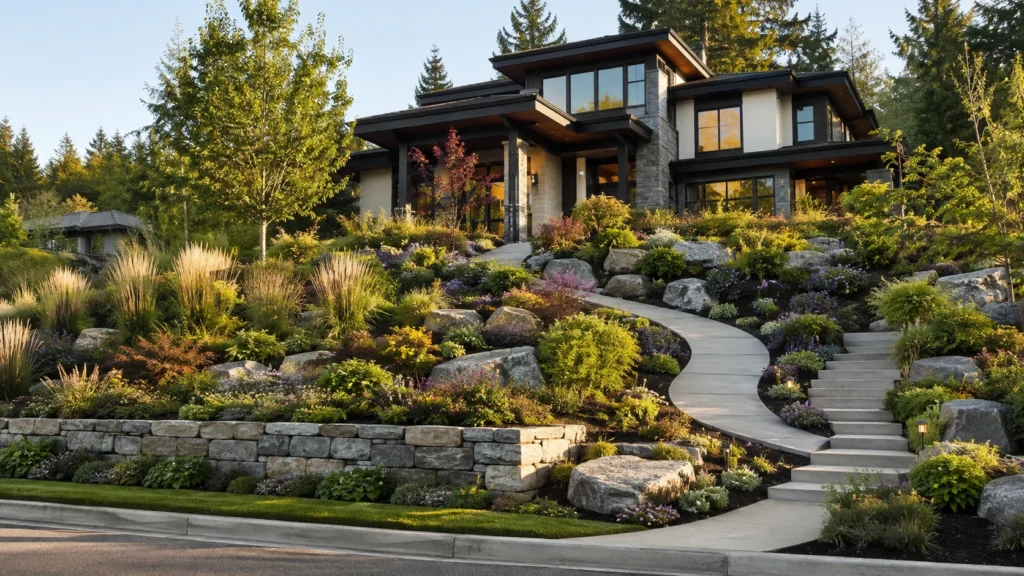
At the same time, a slope gives you something flat yards often struggle to create naturally: depth.
Plants can be arranged in layers. Stone can rise through the landscape. A staircase can become a focal point rather than merely a route to the front door. Terraces can make a small property feel larger because the eye experiences several distinct levels instead of one open plane.
The best sloped front yard landscaping plans therefore combine function with appearance.
Before thinking about flowers or decorative rock, think about:
- Drainage and stormwater runoff
- Soil erosion
- Slope stability
- Safe access to the house
- Existing grading
- Sun and shade
- Soil conditions
- Irrigation
- Maintenance
- Views from the street and inside the home
- Retaining walls or terracing
- Local building requirements
Once these fundamentals are understood, the decorative decisions become much easier.
Assess the Slope Before You Start Landscaping
A common landscaping mistake is buying plants first and studying the site later.
Reverse that process.
Walk your front yard during dry weather, and then look at it again during or shortly after rainfall. Water often reveals problems that are invisible on a sunny afternoon.
Look for Signs of Erosion
Check for:
- Exposed roots
- Small channels in the soil
- Washed-out mulch
- Bare patches
- Soil collecting at the bottom of the hill
- Water flowing rapidly toward a sidewalk or driveway
- Mud appearing after storms
- Areas where plants repeatedly fail
The steeper and barer a slope becomes, the more vulnerable it generally is to erosion. Vegetation can help because roots stabilize soil while foliage reduces the direct impact of rain on exposed ground.
Watch Where the Water Goes
Do not think about the hill in isolation.
Look at gutters, downspouts, driveway runoff, neighboring elevations, and the grade around your foundation.
A beautiful planting plan will not compensate for a major drainage problem.
If large amounts of water are being concentrated onto one area of the slope, the first job may be redirecting or slowing that water rather than adding more plants.
The idea is simple: slow water down, spread it where appropriate, and manage it without creating a new drainage problem somewhere else.
Check the Soil
Sloped properties can have surprisingly inconsistent soil.
The upper section may be dry and thin, while the bottom stays moist. Construction debris or compacted subsoil can also affect newer properties.
Before investing heavily in plants, understand:
- Soil texture
- Drainage
- Organic matter
- Moisture patterns
- Soil depth
- Soil pH when relevant to your planting choices
The plant that thrives at the bottom of your hill may struggle near the top.
Study Sun Exposure
Spend a day noticing which areas receive morning sun, intense afternoon sun, partial shade, or deep shade.
Do not choose a plant simply because it is recommended for hillside landscaping.
Choose it because it is suitable for your hillside.
Control Drainage and Erosion Before Decorating the Yard
This is the unglamorous part of slope landscaping, but it is also the part that protects everything else.
Water gains opportunities to move soil as it travels over exposed sloping ground. Vegetation, terraces, strategically placed barriers, mulch, and other erosion-control techniques can help slow runoff and protect the soil surface.
Depending on the property, drainage solutions may include:
- Broad planted areas
- Vegetated swales
- Dry creek beds
- Terraces
- Catch basins
- Properly designed drain systems
- Downspout extensions
- Stone-lined channels
- Erosion-control fabric during plant establishment
The correct option depends on where the water originates and where it can safely go.
Avoid casually redirecting runoff toward your house, a neighboring property, the public sidewalk, or another vulnerable location.
When the drainage problem involves significant grading, persistent foundation moisture, failing retaining walls, or heavy runoff from surrounding properties, consulting a qualified landscape professional or drainage specialist is usually more sensible than experimenting with a series of small fixes. Illinois Extension likewise recommends professional input for complicated drainage and grading situations.
Use Terracing to Turn One Big Slope Into Smaller Spaces
Terracing is one of the most effective landscape design ideas for a hilly front yard because it changes how the slope looks and functions.
Instead of one uninterrupted incline, you create a sequence of shorter levels.
Those levels might contain:
- Ground covers
- Flowering perennials
- Shrubs
- Ornamental grasses
- Small specimen trees
- Decorative gravel
- Boulders
- Seating
- Pathways
Terraces can also slow water movement by shortening a long slope and creating more level planting areas.
Visually, this makes a steep property feel more organized.
Rather than seeing a wall of grass rising toward the house, the eye sees layers.
For a formal home, terraces can be symmetrical and structured.
For a cottage or naturalistic landscape, they can curve gently across the hillside with irregular stone, flowering plants, and grasses spilling over the edges.
Consider Retaining Walls Where the Grade Needs Structure
A retaining wall is not mandatory for every sloped front yard.
In fact, many mild slopes can be landscaped beautifully without one.
But retaining walls become useful when you need to hold soil at different elevations or create more usable planting areas.
Common retaining wall materials include:
- Natural stone
- Concrete block
- Poured concrete
- Brick
- Timber
- Large landscape boulders
The material should complement the architecture of the house.
A rustic stone wall can look natural beside a cottage or woodland-style home. Clean concrete or large-format block may suit contemporary architecture better.
For visual balance, multiple lower terraces can sometimes feel more integrated with a front landscape than one visually dominant wall.
Drainage behind retaining structures is important because these walls interact with both soil and water. Larger or structurally significant retaining walls may also be subject to engineering, setback, and permit requirements depending on local rules.
This is one area where a professional should be involved when the wall is tall, load-bearing, close to a foundation, or holding back a substantial grade.
How to Landscape a Front Yard Hill
Knowing how to landscape a front yard hill starts with seeing the hill as a series of visual layers rather than one difficult surface.
The street usually provides the primary view, so design from the bottom upward.
Create a Strong Lower Edge
The base of the hill is the visual foreground.
Use it to establish a clean transition between the lawn, sidewalk, driveway, and planted slope.
You might use:
- A curved garden bed
- Low ground covers
- Natural stone edging
- Low shrubs
- Decorative grasses
- A short retaining wall
- A dry creek feature where drainage conditions make it appropriate
Keep plants near intersections and driveways low enough to preserve visibility.
Add Mid-Slope Structure
The center of the hill needs enough visual weight to keep the planting from appearing scattered.
Instead of placing individual plants randomly, create repeated groups.
For example, use several masses of the same ornamental grass, repeat one flowering shrub in three locations, or let a ground cover flow between larger structural plants.
Repeating plants creates rhythm.
It also makes a complicated hillside look intentional.
Use the Upper Slope to Frame the House
Plants near the top should connect the landscape to the architecture.
Shrubs can soften the foundation. A small ornamental tree can frame a blank wall. Taller grasses or flowering shrubs can create depth without completely hiding the house.
Avoid filling every available inch.
A successful front yard hill should lead the eye toward the house rather than compete with it.
Let the Hill Create Depth
One advantage of landscaping on a hill is natural elevation.
Place smaller plants toward visible edges and taller plants farther back where appropriate. Allow textures to overlap.
A flat garden often has to manufacture depth.
A hillside gives it to you for free.
How to Landscape a Steep Front Yard
Learning how to landscape a steep front yard requires a slightly different mindset because maintenance and accessibility become more important.
If walking or mowing the slope already feels uncomfortable, recreating a conventional lawn may not be the best goal.
Government and Extension guidance commonly recommends considering low-maintenance vegetation instead of turf on very steep slopes because mowing can become difficult and the soil needs dependable cover.
Replace Difficult Lawn Areas
You do not necessarily need to remove every patch of grass.
Keep lawn where it is easy to reach and maintain.
Then convert the most difficult parts of the hill into:
- Ground-cover beds
- Native plantings
- Shrub masses
- Meadow-style planting
- Rock gardens
- Terraced beds
- Mulched planting areas
The result often looks more designed while requiring less repeated mowing on awkward terrain.
Break Up the Long Incline
A steep slope appears even steeper when nothing interrupts it.
Terraces, retaining walls, planting bands, boulders, and stairs create horizontal lines that visually reduce the height of the hill.
These elements can also help interrupt concentrated surface flow when appropriately designed.
Create a Safe Route Through the Yard
If the front door sits significantly above street level, access deserves as much attention as planting.
Instead of forcing one straight staircase directly up the hill, consider whether a gently turning path or switchback layout suits the site better.
A route that follows the landscape can feel more welcoming and less severe.
Depending on the height and design, the project may involve:
- Landscape steps
- Landings
- Handrails
- Path lighting
- Retaining edges
- Non-slip paving
- Drainage beside the walkway
Local codes can apply to stairs, railings, walls, and changes in grade, so structural access work should be planned accordingly.
Use Plants With More Than One Job
On a steep front yard, plants should not be chosen only for flowers.
Look for species that provide combinations of:
- Dense foliage
- Spreading growth
- Fibrous or extensive root systems
- Seasonal color
- Pollinator value
- Drought tolerance where appropriate
- Low maintenance
- Adaptability to the site’s soil and sunlight
A layered mixture of grasses, herbaceous plants, woody ground covers, shrubs, and trees can provide stronger landscape structure than relying on a single type of plant.
Choose the Right Plants for a Sloped Front Yard
There is no universal list of best plants for every slope.
A sunny hill in Arizona should not be planted like a shaded slope in Pennsylvania.
Climate, rainfall, soil, USDA hardiness zone, exposure, deer pressure, irrigation, and maintenance all affect plant selection.
Still, several plant categories are especially useful.
Ground Covers
Ground covers help fill the spaces between larger plants and reduce the amount of exposed soil.
Depending on your region, options may include plants such as:
- Creeping phlox
- Creeping juniper
- Bearberry
- Native sedges
- Low-growing native perennials
- Regionally appropriate spreading ground covers
Choose carefully because some aggressive ground-cover plants are invasive in certain regions.
Your local Cooperative Extension office or native plant society can help identify appropriate alternatives.
Ornamental and Native Grasses
Grasses bring movement to a hillside.
Their fine foliage contrasts well with shrubs, stone, and broad-leaved plants.
Depending on location, native grasses such as little bluestem or switchgrass may work in sunny landscapes, while sedges can be useful in other conditions.
The right species depends heavily on moisture and climate.
Shrubs
Shrubs provide the middle layer between ground covers and trees.
Useful landscape characteristics include:
- Dense branching
- Seasonal flowers
- Berries
- Fall color
- Evergreen foliage
- Interesting bark
- Drought tolerance
Instead of planting ten unrelated shrubs, repeat several compatible varieties.
Mass planting usually looks calmer and more deliberate from the street.
Small Trees
A carefully placed small tree can become the anchor of the entire landscape.
Possible roles include:
- Framing the entrance
- Creating shade
- Screening an undesirable view
- Providing seasonal flowers
- Adding fall color
- Connecting the height of the house to lower planting beds
Avoid planting large trees where mature roots, trunks, or canopies could conflict with retaining structures, utilities, foundations, overhead lines, or sight lines.
Use Boulders and Stone to Make the Slope Feel Intentional
Few things look more natural on a hillside than stone used well.
Few things look more artificial than stone used randomly.
Large boulders should appear connected to the landscape rather than sitting on top of it like decorations placed after the fact.
Use them to:
- Anchor planting groups
- Create visual breaks
- Edge informal terraces
- Frame steps
- Add texture
- Support a rock garden
- Reinforce a naturalistic design style
Partially integrating large rocks into planting beds usually produces a more established appearance than scattering small stones evenly across the hill.
Plant around them with ground covers, grasses, or low shrubs to soften the transition.
Build Steps and Paths Into the Landscape
Landscape steps on a slope are both practical and decorative.
A pathway can become the organizing line around which the rest of the front yard is designed.
For a formal property, a direct staircase aligned with the entrance may make sense.
For a natural or cottage-style property, a gently curving route can soften the hill.
Materials might include:
- Natural stone
- Concrete
- Brick
- Pavers
- Gravel on appropriately designed paths
Whatever style you choose, prioritize stable footing and drainage.
Planting alongside steps can make hardscape feel integrated rather than imposed.
Low grasses, flowering perennials, compact shrubs, and ground covers work especially well because they soften the edges without overwhelming the walkway.
Try a Dry Creek Bed Where Runoff Naturally Travels
A dry creek bed can turn a drainage route into a landscape feature when the site is suitable.
Instead of pretending water never crosses the yard, the design acknowledges its natural path.
Stone of varying sizes can create the appearance of a seasonal stream, while grasses, sedges, shrubs, and moisture-tolerant plants can soften the edges.
A dry creek bed should still be designed around actual drainage conditions.
It is not simply a trench filled with decorative stone.
Its starting point, outlet, depth, slope, and relationship to nearby structures all matter.
Never create a drainage feature that sends concentrated water toward a foundation or another property.
Consider a Rain Garden at the Bottom of the Slope, Not on a Very Steep Face
A rain garden may be useful where runoff can collect in an appropriate lower area of the landscape.
It is generally a poor idea to simply excavate a depression into the face of a steep hill.
Rain gardens require suitable soil, infiltration, location, and grading. Guidance from municipalities and Extension programs also cautions that steeper sites can require technical assessment because poorly placed rain gardens may create erosion or instability rather than solve it.
If you want to incorporate one, treat it as part of the drainage plan, not merely as a decorative planting bed.
Low Maintenance Steep Slope Landscaping Ideas
A steep yard becomes frustrating when every maintenance task requires climbing the hill.
Design so that routine care becomes easier over time.
Good low maintenance hillside landscaping strategies include:
- Reducing difficult-to-mow turf
- Planting ground covers
- Using larger planting masses
- Selecting plants suited to existing moisture and light
- Choosing native or regionally adapted plants
- Installing permanent steps or access paths
- Using mulch appropriately
- Grouping plants with similar water requirements
- Avoiding plants that require frequent shearing
- Installing irrigation that does not create excessive runoff
The important word is appropriate.
A plant is not low maintenance if it constantly struggles with the site.
Sloped Front Yard Ideas on a Budget
A hillside does not automatically require a major retaining-wall project.
If the slope is stable and the drainage is manageable, you can often improve it gradually.
Start With the Biggest Problem
Do not spread your budget equally across the entire yard.
If erosion is the main issue, stabilize that first.
If access is poor, build the path first.
If the slope is stable but ugly, focus on planting.
Keep Existing Healthy Plants
Mature shrubs and trees are expensive to replace.
If existing plants are healthy, correctly positioned, and compatible with your design, work around them.
Plant in Repeated Groups
Buying fewer plant varieties in larger quantities can create a stronger design than purchasing one of everything.
Three groups of the same flowering perennial often look more polished than twelve unrelated plants.
Use Ground Covers to Replace Lawn Gradually
You do not have to renovate the whole hill in one weekend.
Convert one section at a time.
This approach spreads out costs and lets you learn which plants perform best before expanding them.
Reuse Stone When Appropriate
Existing landscape stone may be reusable for bed edges, informal accents, or drainage features.
However, do not repurpose random materials into structural retaining walls unless they are appropriate for that use.
Let Plants Mature
A new slope can look sparse during the first season.
That does not mean every empty space needs another shrub.
Allow room for mature plant size.
Overplanting creates a different maintenance problem later.
Landscape Ideas for a Small Sloped Front Yard
A small sloped front yard needs restraint more than variety.
Too many materials, colors, walls, and plant species can make a compact space feel restless.
Choose a simple palette.
For example:
- One material for steps
- One primary stone
- Two or three shrub varieties
- One ornamental grass
- Two flowering perennials
- One ground cover
- One small focal tree if space allows
Repeat those elements throughout the slope.
In a small yard, repetition creates visual calm.
You can also make the slope feel wider by using planting bands that move horizontally across the property rather than emphasizing only vertical lines from the street to the house.
How to Make a Hilly Front Yard Look More Expensive
Expensive-looking landscaping is usually more about editing than adding.
You do not need twenty plant varieties.
You need structure.
Focus on:
Repetition
Repeat key plants across the hillside.
Defined Edges
Clean bed lines immediately make a landscape feel more intentional.
Layering
Combine low ground covers, medium-height perennials and grasses, shrubs, and a few taller focal elements.
Consistent Materials
If the house already uses brick or stone, echo that material or a complementary tone in the landscape.
A Clear Entrance
The front door should remain visually important.
Use pathways, planting, and lighting to guide attention toward it.
Fewer, Larger Features
One substantial boulder or specimen shrub often creates more impact than several tiny decorative objects.
The slope itself already provides drama.
You do not need to decorate every inch of it.
Common Sloped Front Yard Landscaping Mistakes
Leaving Bare Soil
Bare soil on a hill is vulnerable to erosion.
Keep disturbed areas protected and establish vegetation as soon as practical.
Relying Only on Mulch
Mulch is useful, but a steep bare hillside covered only with loose mulch can be difficult to maintain.
Plants provide living coverage and root structure that mulch cannot replace.
Planting Before Fixing Drainage
If runoff is cutting channels through the soil, plants alone may not solve the underlying water problem.
Installing a Tall Retaining Wall Without Professional Input
Large retaining structures deal with soil loads, drainage, and sometimes nearby structures.
Do not treat a significant retaining wall like a simple garden border.
Using Too Many Plant Varieties
A slope already creates visual movement.
Too many unrelated plants can make it chaotic.
Choosing Plants Only for Flowers
Flowers may last several weeks.
Foliage, form, bark, texture, and evergreen structure affect the yard much longer.
Forgetting Access
Ask yourself how you will prune, weed, water, and maintain every part of the slope.
If you cannot comfortably reach a planting bed, maintenance will eventually become a problem.
Fighting the Natural Grade Everywhere
Sometimes homeowners assume the best landscape design is the one that makes a hill disappear.
It is not.
Selective grading and terracing can be useful, but completely flattening a property can become expensive and create additional drainage and structural considerations.
A better design often celebrates the elevation.
A Simple Step by Step Plan for Landscaping a Sloped Front Yard
If the project still feels overwhelming, approach it in this order.
Step 1: Observe the Property
Study the slope, water movement, soil, sunlight, existing plants, utilities, and access.
Step 2: Identify the Main Problem
Decide whether your priority is erosion control, drainage, maintenance, accessibility, privacy, curb appeal, or a combination.
Step 3: Decide What Should Stay
Mark healthy trees, shrubs, walls, walkways, and lawn areas worth keeping.
Step 4: Plan Water Management
Address gutters, downspouts, runoff, erosion, and drainage before adding expensive plants or hardscape.
Step 5: Establish the Main Structure
Plan terraces, retaining walls, stairs, pathways, boulders, and major trees.
Step 6: Add Shrubs and Grasses
These create the landscape’s middle layer.
Step 7: Fill With Ground Covers and Perennials
Use these plants to connect larger elements and cover exposed soil.
Step 8: Mulch and Protect New Plantings
Newly disturbed hillside soil may require temporary erosion-control measures while vegetation becomes established. Natural fiber erosion materials and similar temporary approaches are sometimes used for this purpose.
Step 9: Watch the Yard During Rain
A landscape plan is not finished the moment the last plant goes into the ground.
Observe how water behaves after installation and correct developing problems early.
Step 10: Let the Landscape Mature
Give plants time to spread, soften walls, cover soil, and connect visually.
A good hillside garden usually gets better as it settles into the site.
Designing a Sloped Front Yard for Year Round Curb Appeal
Think beyond spring flowers.
A front yard is visible twelve months a year.
Use a combination of:
- Evergreen structure
- Deciduous shrubs
- Flowering perennials
- Ornamental grasses
- Plants with fall color
- Interesting bark
- Seed heads
- Stone
- Architectural hardscape
Winter is where good landscape structure reveals itself.
If the yard still looks intentional after the flowers disappear, the design is working.
This is an important principle behind the landscape ideas we explore at Front Yard Landscaping Ideas: curb appeal should come from the overall composition of the yard, not from one short season of color.
When Should You Hire a Professional?
Some sloped front yard landscaping projects are realistic DIY projects.
Others are not.
Consider professional help if:
- A retaining wall is structurally significant
- The slope shows signs of instability
- Soil is moving after storms
- Runoff threatens the foundation
- Water is entering the house
- Major regrading is required
- Large trees may be affected
- Underground drainage must be redesigned
- Heavy excavation is necessary
- The project affects neighboring drainage
- Stairs, railings, or elevated structures require code compliance
Landscape designers can help with aesthetics and planting.
Landscape architects can handle more complex site planning.
Civil or geotechnical engineering expertise may be appropriate when slope stability, major structural walls, or significant grading is involved.
The right professional depends on the actual problem.
Conclusion
A sloped, steep, or hilly front yard is not a landscaping flaw. It is a site condition that needs a different design strategy.
Start with water, erosion, soil, and safe access. Then decide whether the slope needs planting alone or a combination of terracing, retaining walls, landscape steps, boulders, drainage features, and layered vegetation.
For a gentle hill, curved garden beds and repeated plant groups may transform the entire property. For a moderate slope, terraces can introduce structure and make the landscape easier to understand visually. For a truly steep front yard, reducing difficult lawn areas and investing in safe access, drainage, and professionally designed structural elements can produce a much more practical long-term result.
Most importantly, do not fight every inch of elevation.
Use it.
A hill creates natural layers, changing views, depth, and opportunities for dramatic planting that a flat front yard simply does not have.
With thoughtful planning, even a difficult slope can become the feature that gives your home its strongest curb appeal.
At Front Yard Landscaping Ideas, that is the way we like to think about challenging landscapes: not as problems to cover up, but as opportunities to design something distinctive.
Frequently Asked Questions
How do you landscape a sloped front yard?
Begin by evaluating drainage, erosion, soil, sunlight, and the steepness of the grade. Address major water problems first. Then use a combination of ground covers, shrubs, ornamental grasses, terraces, retaining walls, boulders, and steps depending on how steep the property is. Try to work with the existing grade instead of flattening the entire yard.
What is the easiest way to landscape a hill?
For a stable hill with no serious drainage problems, one of the simplest approaches is to replace difficult lawn areas with low-maintenance planting. Use repeating groups of ground covers, shrubs, grasses, and perennials suited to the site’s sunlight, soil, and climate. Vegetation is widely recommended as part of erosion management on slopes because established roots help stabilize soil.
How do you landscape a very steep front yard?
A very steep front yard may require more than planting. Consider terraces, properly engineered retaining walls, stairs, permanent access paths, erosion-control planting, and an overall drainage strategy. Avoid creating a design that requires regular mowing on a slope that is uncomfortable or unsafe to maintain.
What can I plant on a steep slope instead of grass?
Depending on your region, alternatives can include native ground covers, sedges, ornamental grasses, low shrubs, flowering perennials, spreading woody plants, and small trees. Mixed vegetation with different root and canopy structures can be useful for slope stabilization.
What is the cheapest way to landscape a sloped front yard?
Keep healthy existing plants, reduce lawn gradually, plant repeated groups of affordable ground covers and perennials, reuse suitable stone already on the property, and renovate one section at a time. If the slope is stable, planting may be considerably simpler than immediately constructing extensive hardscape. Do not cut costs on structural walls or serious drainage problems.
Do I need a retaining wall for a sloped yard?
Not necessarily. Gentle and some moderate slopes can often be landscaped with vegetation, stone, erosion-control methods, and careful grading. Retaining walls become more useful when soil must be held at different elevations, the hill needs terraces, or usable level areas are being created.
How can I prevent erosion on a sloped front yard?
Keep soil covered, establish appropriate vegetation, manage concentrated runoff, maintain mulch where suitable, and consider terraces or other measures that slow water movement. Plant roots and foliage both contribute to protecting sloped soil.
Are rocks good for landscaping a slope?
Yes, when they are used as part of a complete design. Boulders and stone can provide visual structure, help define terraces, edge paths, and support naturalistic planting. They should not be treated as a substitute for solving serious drainage or slope-stability problems.
Should I put mulch on a steep slope?
Mulch can help protect exposed soil, but it should not be the only strategy on a steep hill. Loose mulch can migrate downhill, particularly where runoff is concentrated. Combining suitable mulch with established plants and proper water management usually creates a more durable landscape.
How do you make a sloped front yard low maintenance?
Reduce hard-to-mow turf, choose plants adapted to existing conditions, use ground covers to fill open soil, plant in larger repeated masses, install reliable access routes, and avoid shrubs that require constant shaping. The less your design asks you to repeatedly climb the hill, the easier it will be to maintain.
How do you make a sloped front yard look good from the street?
Design in layers. Create a clean foreground near the sidewalk or driveway, use larger plant masses through the middle of the slope, and frame the house with shrubs or small trees near the top. Repeat plants and materials so the slope reads as one composition rather than a collection of unrelated garden beds.
Can I landscape a small sloped front yard?
Yes. Small slopes often benefit from a restrained design. Use fewer plant varieties, repeat them throughout the yard, maintain clear edges, and choose one primary hardscape material. A simple layered planting can make a compact sloped yard look larger and more polished.
Is terracing good for a steep hill?
Terracing can be very useful because it divides one long incline into a series of shorter levels, creating planting areas and helping slow runoff. Structural terraces and retaining systems should be designed appropriately for the amount of soil being retained.
What are the best landscaping ideas for a downward sloping front yard?
Focus on controlling the view and water movement toward the lower part of the property. Use layered planting, low terraces, boulders, a defined walkway, ground covers, and strategically placed shrubs. Pay particular attention to where runoff collects at the bottom of the slope.
Can a sloped front yard increase curb appeal?
Absolutely. Elevation can create depth, stronger plant layering, dramatic stairs, terraced beds, rock gardens, and more interesting views of the house. The most successful designs make the grade appear intentional rather than trying to conceal it completely.

Sara Bendrick believes your yard should be a place you actually look forward to coming home to. A licensed and bonded design-build contractor (C-27 #1006161), she founded Sarita Landscape Designs and has spent over twelve years designing residential outdoor spaces across Southern California with a real soft spot for curb appeal and low-water, no-lawn designs.
When she’s not on a job site, Sara’s on camera or on stage. She’s hosted yard-renovation shows including I Hate My Yard, Build It Like Bendrick, and Lawn & Order, written Big Impact Landscapes, given two TEDx talks, and serves as a spokesperson for Stihl. Her mission is simple, help people see the potential in the yard they already have.