
To landscape a front yard with rocks, start by deciding what job the rocks need to do. They can replace high-maintenance lawn, define flower beds, create a walkway, improve drainage, cover bare soil, or simply add texture around plants. Once you know the purpose, choose a rock size and color that complement your house and existing landscape. Pea gravel and crushed stone work well for paths and open areas, river rock suits drainage channels and decorative beds, while large rocks and boulders create strong focal points.
Before spreading any stone, remove weeds, shape the planting areas, improve drainage where necessary, and install appropriate edging so the rock stays where it belongs. Then combine the hard surface of the stone with plants such as ornamental grasses, compact shrubs, flowering perennials, succulents, or drought-tolerant species suited to your climate.
The best front yard landscaping with rocks does not look like a yard that has simply been covered in stone. It looks intentional. Rocks should guide the eye, frame plants, connect different areas, and make the front of the house feel finished.
That balance is what we will explore throughout this guide from Front Yard Landscaping Ideas.
Table of Contents
Why Front Yard Landscaping with Rocks Works So Well
Rock landscaping has become popular for a simple reason. It can solve practical landscape problems while also making a front yard more visually interesting.
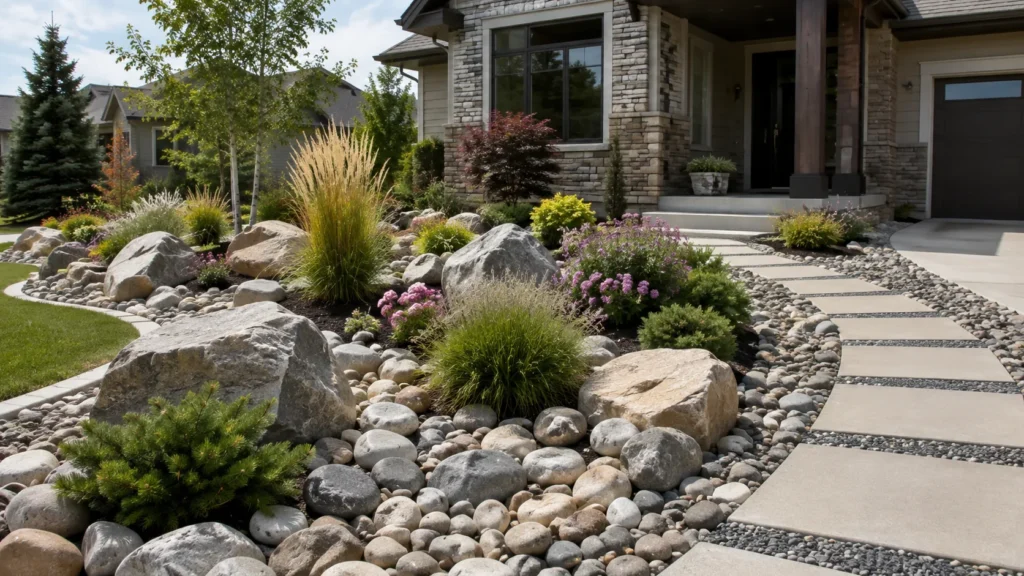
Traditional lawns demand mowing, watering, fertilizing, edging, and ongoing care. Organic mulch is useful but eventually breaks down and needs replenishing. Landscape rock behaves differently. Once a properly prepared rock area is installed, it can remain attractive for years with relatively modest maintenance.
That does not mean a rock front yard should become a lifeless field of gravel.
The most successful designs combine stone with living plants, pathways, defined borders, and open space. The contrast between hard rock and soft foliage creates much of the appeal.
Front yard landscaping ideas with rocks can be especially effective when you want to create a yard that feels cleaner, more structured, or easier to maintain.
Rocks can also help visually connect a house to the surrounding landscape. Warm stone can soften a modern exterior. Dark decorative rock can create contrast against pale siding. Rounded river stones can make a garden feel relaxed and natural, while angular crushed stone can give the same space a sharper, more contemporary character.
Choose the Right Landscaping Rocks for Your Front Yard
One of the biggest mistakes in rock landscaping is choosing stone based only on color.
Color matters, but size, shape, texture, drainage, foot traffic, and maintenance matter just as much.
A beautiful rock at the garden center may be completely wrong for a walkway. A stone that works perfectly beside a downspout may look awkward across a large planting bed.
Think about function first and appearance second.
River Rock
River rock is one of the most versatile materials for front yard landscaping.
Its smooth, rounded appearance makes it particularly attractive around foundations, shrubs, trees, dry creek beds, and drainage areas. River rock landscaping also works well when you want a softer, more natural look than crushed stone provides.
Small river rocks can cover flower beds, while large river rocks can create visual weight near larger plants or architectural features.
Front house river rock landscaping is especially effective when the colors in the stone echo colors already found in the brick, siding, roof, or walkway.
River rock can also be used to create:
- Rock flower beds around shrubs and perennials
- Dry creek beds that direct rainwater
- Decorative strips beside driveways and walkways
- River rock edging around garden beds
- Low maintenance planting areas
- Borders around porches and foundations
- Transitional areas between lawn and planted beds
- Decorative drainage channels beneath downspouts
The goal is to give the material a reason to be there.
Pea Gravel
Pea gravel consists of small, rounded stones that create a softer appearance than many types of crushed rock.
It works particularly well in informal pathways, seating areas, small courtyards, and sections between stepping stones.
Because the individual pieces are small, pea gravel can move underfoot. Good edging is important if you do not want stones escaping into nearby lawn or planting beds.
Pea gravel is usually better for areas where you want a relaxed, walkable surface than for steep slopes where loose material can migrate downhill.
Crushed Stone
Crushed stone has sharper, more angular edges than pea gravel or river rock.
Those angular pieces tend to lock together more effectively, which can make crushed stone useful for paths, side-yard access, and contemporary landscape designs.
Crushed stone landscaping often has a cleaner, more architectural appearance.
It can pair especially well with:
- Concrete
- Modern pavers
- Straight garden borders
- Geometric planting beds
- Ornamental grasses
- Minimalist architecture
The combination creates structure without requiring every part of the yard to be paved.
Large Landscape Rocks and Boulders
Large rocks do something small gravel cannot. They create scale.
A carefully positioned boulder can anchor an entire garden bed. Several large rocks placed at different depths can make a new planting area look more established.
Boulder landscaping ideas work best when the stones appear connected to the ground rather than placed on top of it.
When possible, partially bury large stones so they look naturally settled into the landscape.
Avoid placing identical boulders in a perfectly straight row unless the design intentionally calls for a formal structure.
Nature tends to be irregular. A little asymmetry usually makes landscaping with large rocks look more believable.
Decorative Landscape Rock
Decorative rock comes in many colors, including gray, tan, cream, brown, red, white, and black.
The right color depends heavily on the house.
A stone that looks striking in a sample bag can become visually overwhelming when spread across several hundred square feet.
Before purchasing a large quantity, view a larger sample outdoors in both direct sunlight and shade.
This simple step can prevent an expensive mistake.
How to Plan a Front Yard Rock Landscape
Good landscape design begins before the first bag of stone is opened.
Start by standing across the street and looking at the entire property.
Where does your eye go first?
Ideally, the landscape should lead attention toward the house, entryway, or another attractive architectural feature. If every corner is filled with a different rock, plant, border, and decoration, the yard can quickly feel chaotic.
Instead, identify a few major areas.
You might have a foundation bed, a walkway, a tree bed, and one larger planting area near the driveway.
Using similar materials throughout those areas creates continuity.
Start With the Architecture of the House
Your house should influence the landscape design.
A modern home may suit straight lines, large rectangular pavers, ornamental grasses, and dark crushed rock.
A cottage-style home often feels more natural with curved beds, flowering plants, river stone, and irregular stepping stones.
A Southwestern landscape may combine gravel, large boulders, agave, yucca, and other drought-tolerant plants.
Rock landscape ideas become more convincing when the garden and the building feel like parts of the same design.
Decide Where Rock Is Actually Needed
More rock is not always better.
Some of the best landscaping ideas with rocks use stone in carefully selected locations rather than across the entire property.
Rock can be used around the foundation, between planting groups, along a pathway, beside a driveway, or in a drainage channel while other sections remain lawn or traditional garden beds.
This creates visual contrast.
It also prevents the yard from feeling excessively hard or barren.
Low Maintenance Front Yard Landscaping with Rocks
Low maintenance front yard landscaping is one of the biggest reasons homeowners consider rock.
But low maintenance does not mean no maintenance.
Leaves still fall on gravel. Weeds can eventually appear. Soil can collect between stones. Edging occasionally needs correction.
The advantage is that well-designed stone beds do not need to be replaced every season, and they can reduce the amount of lawn or organic mulch that needs regular attention.
Use Plants in Groups
Instead of scattering individual plants randomly through a large rock bed, create small plant communities.
For example, three ornamental grasses placed together have far more visual impact than three grasses spread across the entire yard.
The same principle works with flowering perennials, evergreen shrubs, or succulents.
Repeating those plant groups elsewhere in the landscape creates rhythm.
The result feels designed rather than accidental.
Select Plants That Match Your Climate
Rock can absorb and radiate heat, especially when exposed to strong afternoon sun.
That makes plant selection important.
Choose species suited to the light, soil, rainfall, and temperatures of your region.
In dry climates, rock gardens often pair naturally with drought-tolerant plants.
In wetter climates, plants may need more separation from large rock-covered areas so the soil does not remain excessively wet beneath poorly drained sections.
Local conditions should always guide plant selection.
Front Yard Landscaping Ideas with Rocks and Mulch
Landscaping with rocks and mulch allows you to use each material where it performs best.
Rock can define pathways, drainage zones, borders, or architectural areas, while organic mulch can remain around plants that benefit from gradually decomposing material.
The contrast can also make the landscape more interesting.
For example, a curved planting bed may contain dark mulch around shrubs while a pale river rock strip follows the edge of the walkway.
Another option is to use rock around a dry creek or drainage area while neighboring flower beds contain mulch.
The important thing is to create clear boundaries.
When mulch constantly spills into gravel, both materials begin to look messy.
Edging helps maintain separation.
Rock Flower Beds for the Front of the House
Rock flower beds can look polished and structured, particularly around the front foundation.
However, successful flower bed ideas with rocks still need plants.
The rock should support the planting design, not replace it completely.
Start with taller shrubs or structural plants near the back of the bed, provided they will not eventually block windows or crowd the siding.
Add medium-height flowering plants in front of them.
Finish with low-growing plants near the border.
Then use decorative stone to cover open areas of soil.
This layered arrangement creates depth.
A river stone flower bed can work particularly well around homes with natural wood, brick, stone veneer, or neutral siding because the rounded stones soften the transition between the building and garden.
Does pea gravel look good in front yard landscaping?
Yes, pea gravel can look very good in front yard landscaping when it is used deliberately.
Its small, rounded stones create a casual and welcoming texture that works particularly well in cottage gardens, Mediterranean-inspired landscapes, informal walkways, seating areas, and spaces between stepping stones.
The key is containment.
Because pea gravel is loose, it needs a defined edge. Steel edging, paver borders, stone borders, or another solid landscape edge can prevent the gravel from spreading into grass and nearby planting beds.
Color also matters.
Choose pea gravel that works with your house rather than simply choosing the brightest or most dramatic option available. Warm tan gravel can complement brick and warm-toned siding, while cooler gray material may work better with modern concrete, gray siding, or charcoal accents.
Pea gravel is particularly attractive when softened with plants.
Allow ornamental grasses, creeping plants, flowering perennials, or compact shrubs to interrupt broad areas of gravel. That mixture prevents the landscape from looking flat.
For walkways, consider adding stepping stones through the pea gravel. The combination gives visitors a clear route to follow while keeping the softer texture of loose stone around the pavers.
Create a River Rock Garden
A river rock garden can become one of the most attractive features in a front yard.
Rather than covering a random patch of ground with identical stones, build the design in layers.
Start with several larger stones or boulders. Add medium-size rocks around them, then transition into smaller river rock.
Plants can emerge from pockets between these different stone sizes.
This variation mimics the way rocks often appear in natural landscapes.
A river rock garden also works beautifully around ornamental grasses, dwarf evergreens, flowering shrubs, and plants with strong foliage.
Use restraint with plant varieties. Repeating a smaller number of species usually creates a more cohesive design than planting one of everything.
Build a Dry Creek Bed with River Rocks
A dry creek bed is both a decorative landscape feature and, when correctly planned, a potential way to move surface water through part of the yard.
The shape matters enormously.
Perfectly straight channels tend to look artificial unless the surrounding architecture is very modern.
A gently curved channel often creates a more natural appearance.
Use larger stones near the edges and smaller river stones through the center. Adding occasional boulders can make the feature feel established.
If the dry creek is intended to manage actual runoff, appearance should come after drainage performance.
Water must have a safe place to go.
Do not redirect runoff toward a neighboring property, foundation, sidewalk, or another area where water could create problems. Local grading and drainage requirements should guide any functional drainage project.
Landscaping with Rocks Around Trees
Rocks around trees can create a tidy border, but this is one area where restraint is particularly important.
Do not pile rocks directly against the trunk.
The root flare, where the trunk naturally widens into the roots, should remain visible rather than being buried beneath soil, mulch, or deep layers of stone.
A broader planting area around the tree can look much more natural than a tiny ring.
You can combine appropriately placed rock edging with groundcover plants or other landscaping while leaving breathing room around the trunk.
Landscaping ideas around trees should support the health of the tree first and visual appearance second.
Use River Rock Edging to Define Garden Beds
River rock edging can soften the boundary between a lawn, pathway, driveway, and garden bed.
Unlike rigid plastic or metal edging, visible rock edging becomes part of the design.
Larger river stones are usually easier to keep in place than very small stones when they are being used as an exposed border.
For a natural appearance, vary the size slightly while keeping the general color palette consistent.
Rock edging ideas can work around:
- Foundation beds
- Flower gardens
- Walkways
- Trees
- Mailbox gardens
- Driveway planting beds
- Dry creek beds
- Small rock gardens
Avoid creating a different edging material around every feature. Repeating the same stone in several locations helps connect the landscape visually.
Create a Front Yard Rock Garden
Rock garden ideas range from highly naturalistic alpine-style gardens to simple modern beds containing gravel, grasses, and a handful of larger stones.
For most front yards, simplicity wins.
Choose one main stone type and use larger accent stones for variation.
Then select plants with contrasting shapes.
A broad-leaved shrub looks more interesting beside a fine-textured ornamental grass. A rounded evergreen can contrast with upright flowering plants. Low groundcovers can soften the base of large rocks.
Modern rock garden ideas often rely on fewer plant varieties and more visible negative space.
Traditional rock garden landscaping may be denser and more organic.
Both can work. What matters is matching the style to the house.
Small Front Yard Landscaping Ideas with Rocks
A small yard does not need dozens of features.
In fact, too many materials can make a compact front yard feel even smaller.
Limit the palette.
One type of gravel, one accent rock, a small group of plants, and a simple walkway may be enough.
Small front yard rock garden ideas work particularly well beside an entrance, porch, driveway, or mailbox.
Create one strong focal point rather than several competing ones.
A single boulder surrounded by three ornamental grasses and a low flowering groundcover can make a stronger statement than ten different decorations.
Small front yard landscaping ideas that are low maintenance usually depend on disciplined editing.
Every material should earn its place.
Front Yard Landscaping with Rocks and No Grass
Front yard landscaping ideas with rocks and no grass can be practical in locations where traditional turf struggles or requires excessive irrigation.
However, removing grass does not mean replacing every square foot with gravel.
A successful no-grass front yard can still include:
Planting beds, shrubs, groundcovers, trees, stepping stones, gravel paths, boulders, flowering perennials, ornamental grasses, and small seating areas.
The strongest designs create different layers instead of one uninterrupted rock surface.
Think of rock as the background material.
Plants and architectural features provide the foreground.
This approach creates a front yard that feels landscaped rather than merely covered.
Combine Large Rocks with Smaller Stone
One of the easiest ways to make rock landscaping feel more natural is to vary scale.
If every stone is the same size, the surface can become visually monotonous.
A few larger rocks create focal points.
Medium stones provide transition.
Smaller gravel or river rock fills the remaining space.
Landscape design with rocks often works best when these different sizes look related.
For example, large gray boulders paired with smaller gray gravel feel connected even though their texture differs.
You can also use contrasting materials intentionally, but the design should still have a clear visual relationship.
Use Rocks to Highlight the Front Walkway
The path to the front door is one of the most important elements in a front yard.
Landscape features should help visitors understand where to go.
Rock can emphasize that route.
You might install decorative gravel beside a concrete walkway, use river stones between stepping stones, or create planting beds that frame both sides of the path.
Avoid placing large rocks where they visually or physically crowd the walkway.
The entrance should feel open and inviting.
Lighting can further reinforce the path at night, especially when fixtures are integrated discreetly among plantings and stone.
How to Keep Landscaping Rocks in Place
A beautiful rock bed can quickly lose its shape if stone constantly spreads into the lawn or driveway.
Good edging is the first defense.
The appropriate edging depends on the design and stone size. Metal edging creates a clean, almost invisible line. Pavers make the border more visible. Larger natural stones can create a softer edge.
Depth also matters.
A very thin scattering of rock often looks unfinished and exposes the surface underneath.
Too much loose material, on the other hand, can make walking difficult and increase movement.
Prepare the base carefully and install enough material for consistent coverage without creating unnecessarily deep piles.
On slopes, avoid relying on small loose gravel where gravity and stormwater can constantly move it downhill.
Larger stone, terracing, planting, or another stabilization strategy may work better.
Should You Put Landscape Fabric Under Rocks?
Landscape fabric is commonly installed beneath decorative rock, but the answer depends on the location and purpose.
It can help separate stone from the soil underneath and may suppress some weed growth initially.
However, landscape fabric does not make a rock bed permanently weed free.
Over time, windblown dust, leaves, and organic debris can collect between the rocks. Weed seeds can then germinate in that material above the fabric.
For areas containing permanent shrubs and other established plants, consider how the fabric will affect future planting, maintenance, and soil access.
For pathways and certain non-planted decorative zones, separation fabric may be more useful.
The important point is to treat fabric as one part of site preparation, not as a permanent guarantee against weeds.
How to Prevent Weeds in Rock Landscaping
Weed prevention begins before the rock arrives.
Remove existing weeds and their roots as thoroughly as practical.
Do not simply bury an active weed problem beneath decorative stone.
Once the bed is installed, remove new weeds while they are small.
A leaf blower used carefully can also help remove leaves and organic debris before that material decomposes between rocks.
That matters because accumulated debris eventually creates a thin layer where weeds can establish.
Regular light maintenance is much easier than allowing the area to become overgrown and attempting a major cleanup several years later.
Rock Versus Mulch in a Front Yard
Neither rock nor mulch is automatically better.
They simply behave differently.
Rock lasts longer and provides a permanent visual texture. It works especially well in pathways, drainage features, architectural beds, and dry landscape designs.
Organic mulch changes over time and typically requires replenishment, but it can contribute organic matter as it decomposes and often creates a softer planting environment.
Many front yards benefit from both.
Use rock where permanence, drainage, or hardscape character matters. Use mulch where the planting design and soil management make organic material more appropriate.
Landscaping with rocks and mulch can give you the visual strength of stone without making the entire garden feel hard.
Common Mistakes to Avoid with Front Yard Rock Landscaping
Covering the entire yard with one stone is one of the most common mistakes.
It may reduce mowing, but it can also remove depth, shade, movement, and seasonal interest.
Another mistake is using too many different rocks.
White gravel around one bed, red rock around another, river stone beside the driveway, and black stone near the porch can make the property look fragmented.
Choose a restrained material palette.
Also avoid choosing rock that fights with the architecture.
Bright white stone, for example, can create intense contrast and glare in full sun. Black rock may absorb considerable heat. Large rounded stones can be uncomfortable for walking. Tiny gravel can escape poorly designed borders.
Think beyond the photograph taken on installation day.
Consider how the landscape will function several years from now.
How to Make Rock Landscaping Look Natural
Natural-looking rock landscaping depends on irregularity, repetition, and connection.
Instead of dropping isolated boulders into the center of flat gravel, nest them beside plants and partially settle them into the ground.
Group plants around certain rocks while leaving other sections open.
Repeat the same rock type in more than one part of the front yard.
Allow plants to soften selected edges instead of maintaining a hard border around every stone.
Most importantly, give the rock a relationship to the larger landscape.
A dry creek should appear to follow the land.
A boulder should seem anchored.
A gravel path should lead somewhere.
A rock flower bed should frame plants or architecture.
When every element has a purpose, the landscape feels convincing.
How Much Landscaping Rock Do You Need?
The amount of rock required depends on the square footage of the area and the planned installation depth.
Measure the length and width of straightforward rectangular areas first.
For curved beds, divide the area into smaller approximate shapes and calculate them separately.
Rock suppliers often sell bulk material by weight or volume, while smaller projects may use bagged rock.
Because stone density and recommended depth vary by product, calculate your project using the coverage information provided for the specific material you plan to purchase.
It is usually wise to allow a modest margin for irregular edges, settlement, and small measurement errors rather than ordering an amount based on a perfect theoretical calculation.
Is Rock Landscaping Really Low Maintenance?
Rock landscaping can be low maintenance, but it is not maintenance free.
A realistic maintenance routine may involve occasionally removing leaves, pulling isolated weeds, correcting displaced stone, trimming surrounding plants, and refreshing areas where the rock has shifted.
Compared with frequently mowing a lawn or repeatedly replacing organic groundcover material, this can still represent a major reduction in routine work.
The design itself determines much of the future maintenance.
Well-defined borders, suitable plant spacing, thoughtful drainage, and the right stone for the location all make the landscape easier to manage.
Poor planning creates the opposite result.
How to Make Front Yard Landscaping with Rocks Look Expensive
An expensive-looking landscape does not necessarily require expensive materials.
It requires restraint.
Use fewer materials, but repeat them consistently.
Create generous planting groups instead of tiny isolated plants.
Choose one or two strong focal points.
Keep the walkway and entrance visually clear.
Match the stone to the house.
Use larger rocks strategically instead of scattering small decorative stones everywhere.
Most importantly, pay attention to edges.
Clean transitions between lawn, rock, plants, paving, and driveway surfaces make even an affordable landscape look finished.
At Front Yard Landscaping Ideas, we believe this is one of the most useful principles in outdoor design: simple materials arranged thoughtfully usually outperform expensive materials arranged without a plan.
Conclusion
Front yard landscaping with rocks works best when stone is treated as part of the landscape rather than the entire landscape.
River rock can soften foundation beds and create beautiful drainage features. Pea gravel can bring texture to walkways and small gathering spaces. Crushed stone can add a clean contemporary edge. Large rocks and boulders can anchor planting areas and give a young landscape a sense of permanence.
But the real transformation comes from combining those materials thoughtfully.
Use plants to soften stone. Repeat materials so different areas feel connected. Protect trees and drainage patterns. Choose rock that matches both the architecture and the practical demands of the site.
Whether you are exploring low maintenance front yard landscaping, rock flower beds, river rock landscaping ideas, or a complete front yard with rocks and no grass, begin with a simple question.
What does this area need to do?
Once every rock, plant, path, and border has a purpose, the front yard begins to feel less like a collection of landscaping materials and more like a complete outdoor design.
Frequently Asked Questions About Front Yard Landscaping with Rocks
What kind of rock is best for front yard landscaping?
The best rock depends on how the area will be used. River rock is attractive for decorative beds and drainage features. Pea gravel works well in informal paths and seating areas when properly contained. Crushed stone is useful for structured paths and modern designs. Large boulders are better for focal points and creating visual scale.
What is the best rock for low maintenance landscaping?
River rock and decorative landscape stone are popular for low maintenance areas because they do not decompose like organic mulch. The best choice still depends on drainage, slope, surrounding plants, and the appearance you want.
Is river rock good for front yard landscaping?
Yes. River rock landscaping can work especially well around foundations, in flower beds, along walkways, around drainage features, and in dry creek beds. Its rounded surface creates a softer and more natural appearance than angular crushed stone.
Can I use rocks instead of mulch in flower beds?
Rocks can be used instead of mulch in some flower beds, particularly around established shrubs and plants suited to the conditions. However, rock and organic mulch behave differently, so the best choice depends on your plants, soil, climate, and maintenance goals.
How can I landscape my front yard with rocks on a budget?
Start with a smaller area rather than replacing the entire yard. Use rock where it creates the most visual impact, such as beside the walkway, around a foundation bed, or in a small rock garden. Limit the number of stone types and use plants to fill space as they mature.
How do I make a rock front yard look less bare?
Add layers of plants with different heights and textures. Combine structural shrubs, ornamental grasses, flowering perennials, and groundcovers. Large rocks or boulders can also break up broad gravel areas and create stronger focal points.
Can you put river rock around the front of a house?
Yes, provided the area has suitable grading and drainage. River rock is often used around foundations because it creates a clean transition between the house and planting beds. Do not allow landscaping changes to direct water toward the foundation.
What looks good with river rocks?
River rocks pair well with ornamental grasses, evergreen shrubs, flowering perennials, succulents in suitable climates, larger boulders, stepping stones, wood accents, and natural stone paving. Plants with strong foliage provide an especially attractive contrast against smooth stone.
Are rocks better than grass for a front yard?
Rocks may be a better option where reducing lawn maintenance or water demand is a priority, but they are not automatically better for every property. Trees, plants, groundcovers, and other living elements still provide benefits that a completely rock-covered yard cannot replace. A mixed landscape often creates the best balance.
How do I stop landscape rocks from spreading?
Install a durable edge between the rock and surrounding lawn, mulch, pavement, or planting areas. Choose an edging height appropriate for the size of stone being used and avoid putting loose gravel on steep slopes where it can easily migrate.
Can I mix different kinds of rocks in landscaping?
Yes, but limit the palette. Combining one primary stone with a larger accent rock usually looks more cohesive than using several unrelated colors and textures. Repeating the same materials throughout the front yard helps create a unified design.
Does rock landscaping increase curb appeal?
Well-designed rock landscaping can improve curb appeal by creating cleaner borders, stronger pathways, defined planting beds, and year-round texture. The strongest results come from choosing stone that complements the house and combining it with healthy, appropriately scaled plants.
What plants work well in front yard rock landscaping?
The best plants depend on your climate and exposure. Ornamental grasses, compact shrubs, flowering perennials, groundcovers, succulents, and drought-tolerant plants are commonly paired with rock. Choose plants based on local growing conditions rather than appearance alone.
How deep should landscaping rocks be?
The appropriate depth varies according to the rock size, product, base conditions, and intended use. Follow the coverage and installation recommendations for the specific stone you purchase. The goal is enough material to create consistent coverage without creating unnecessarily deep loose layers.
How do you modernize a front yard with rocks?
Use a limited material palette, clean lines, restrained planting groups, simple edging, and rocks that complement the architecture. Gray gravel, large pavers, sculptural plants, ornamental grasses, and carefully positioned boulders can create a particularly modern look.

Sara Bendrick believes your yard should be a place you actually look forward to coming home to. A licensed and bonded design-build contractor (C-27 #1006161), she founded Sarita Landscape Designs and has spent over twelve years designing residential outdoor spaces across Southern California with a real soft spot for curb appeal and low-water, no-lawn designs.
When she’s not on a job site, Sara’s on camera or on stage. She’s hosted yard-renovation shows including I Hate My Yard, Build It Like Bendrick, and Lawn & Order, written Big Impact Landscapes, given two TEDx talks, and serves as a spokesperson for Stihl. Her mission is simple, help people see the potential in the yard they already have.