To landscape a front yard on a busy street, create several layers between the road and your home instead of relying on one tall hedge or fence. Start with a defined roadside boundary, then combine evergreen trees, dense shrubs, ornamental plants, groundcovers, and, where space allows, a berm or solid fence. Keep driveway sightlines clear, protect the front entrance from headlights and passing pedestrians, and choose tough plants that can handle roadside heat, wind, compacted soil, dust, and road salt where that is an issue. For traffic noise, dense planting helps soften the environment, but a solid wall, fence, or planted berm generally provides a stronger physical barrier than plants alone.
At the same time, avoid turning the front yard into a fortress. The house should still feel welcoming from the street. Preserve views of the front door, use attractive planting around your privacy features, and give walkways, lighting, drainage, and driveway access as much attention as the screening itself.
That balance between privacy and curb appeal is what makes landscaping a front yard on a busy street different from designing an ordinary suburban lawn.
Table of Contents
Why Landscaping a Front Yard on a Busy Street Requires a Different Approach
A quiet residential street gives you freedom to landscape almost entirely for appearance. A busy road changes the brief.
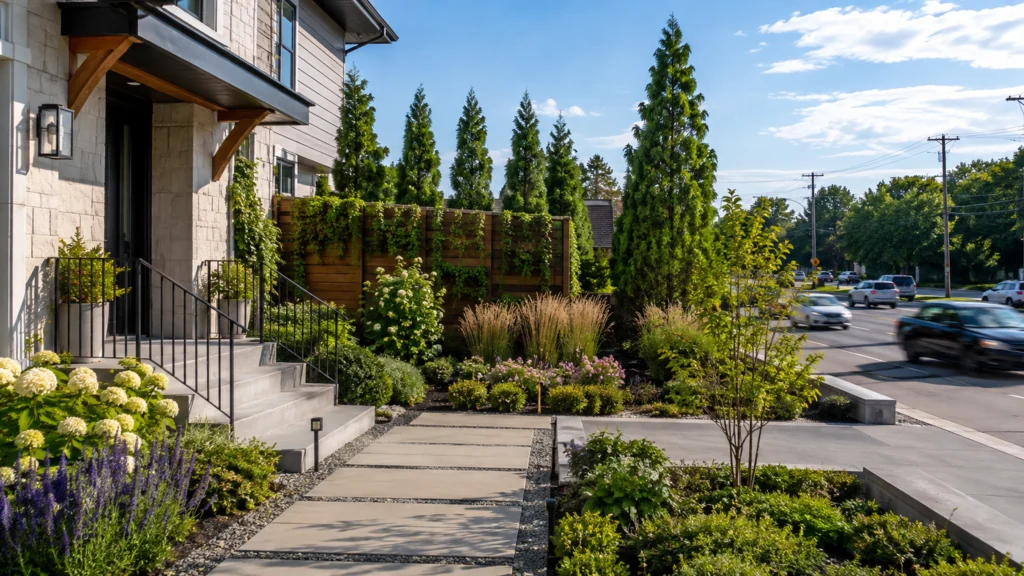
Now your front yard has several jobs.
It needs to create privacy from passing cars and pedestrians. It may need to soften traffic noise, reduce the glare of headlights, discourage people from cutting across the lawn, make the front door feel less exposed, and still look attractive from the street.
There are practical issues too. Plants near the roadway may experience wind, reflected heat, compacted soil, exhaust, snow piles, salt spray, and less-than-perfect drainage. A driveway entering a busy road also makes visibility especially important. Current landscape design guidance for busy-road properties similarly emphasizes treating privacy, circulation, driveway visibility, lighting, drainage, planting, architecture, and maintenance as one connected design problem.
The best front yard landscaping therefore does not simply hide the road.
It changes how the road feels from inside your property.
That is an important distinction.
Start by Identifying What You Actually Want to Block
Before buying trees or digging a planting bed, stand in several places around your property and look toward the road.
Then reverse the exercise.
Stand near the sidewalk or property line and look toward the house.
You may discover that the problem is not the entire street. It could be one specific view.
Perhaps cars can see directly into your living room. Maybe headlights sweep across a bedroom window at night. Perhaps people waiting at a bus stop overlook your porch. On a corner lot, you may have exposure from two directions.
Screening everything equally can waste space and money.
Instead, concentrate your strongest landscaping where the exposure is greatest.
A dense evergreen screen outside a living room window may matter more than a hedge running across the entire front boundary. An ornamental tree positioned between an upstairs window and the road may solve a problem that a six-foot hedge cannot.
Think of privacy landscaping as view management rather than simply plant coverage.
Create Layers of Privacy Instead of One Flat Hedge
One of the most effective front yard privacy ideas for a busy street is layered planting.
Imagine looking from the street toward the house.
Near the roadside boundary, you might have a low fence or sturdy shrubs. Behind them are taller evergreen shrubs. Farther inward, a small ornamental tree or larger evergreen provides height. Perennials, grasses, and groundcovers soften the lower portions of the planting.
Now the landscape has depth.
This approach usually feels much more natural than planting one identical row of trees from one side of the property to the other.
Layered planting also gives you flexibility throughout the year. Evergreen trees and shrubs maintain structure during winter, while deciduous shrubs, ornamental trees, flowering perennials, and grasses can bring seasonal color, texture, movement, and pollinator value.
Landscape professionals working with busy-road properties increasingly recommend this type of layered approach because it can provide screening without completely disconnecting the home from its surroundings.
At Front Yard Landscaping Ideas, this is one of the most useful principles to keep in mind. Privacy should feel like part of the garden, not something added afterward to hide a problem.
Use Evergreen Trees and Shrubs for Year Round Screening
Evergreens are particularly valuable along busy streets because they retain foliage through seasons when deciduous trees become bare.
Depending on your climate and growing conditions, potential screening plants may include arborvitae, juniper, holly, yew, wax myrtle, inkberry, selected viburnums, and other dense evergreen shrubs and small trees.
Do not select a plant just because someone calls it the best privacy tree.
There is no universally perfect privacy hedge.
The right plant depends on your USDA hardiness zone, available sunlight, mature plant width, drainage, soil conditions, exposure, maintenance expectations, local pests, and the amount of room between your house and the street.
Iowa State University Extension specifically notes that effective landscape noise buffers depend more on the height, width, density, and overall design of the planting than on any particular tree or shrub species.
Mature size matters especially in a small front yard.
A shrub that looks perfectly proportioned in a nursery container could eventually become ten or fifteen feet wide. If your planting bed only has four feet of usable depth, that creates years of pruning and an eventual struggle between the plant, sidewalk, driveway, and house.
Choose plants for the space they will occupy when mature, not the empty space you see today.
Mix Evergreen and Deciduous Plants
An all-evergreen screen gives dependable privacy, but it can sometimes feel heavy.
Mixing evergreen and deciduous plants tends to produce a softer landscape.
For example, evergreen shrubs can form the structural backbone of a privacy border. Small flowering trees or multi-stem ornamental trees can provide height and seasonal interest. Flowering shrubs add another layer, followed by perennials and low groundcovers at the front.
Repetition keeps this mixture from becoming chaotic.
Use several groups of the same shrub rather than buying one of everything that catches your eye at the garden center.
The result feels intentional while still being more interesting than a single-species hedge.
Mixed planting can also prevent the dramatic visual gap that occurs when one plant dies in a perfectly uniform row.
Consider a Front Yard Fence for Immediate Privacy
Plants take time to grow.
A fence works immediately.
For a home directly beside a busy street, combining a fence with landscaping can be one of the strongest solutions because the fence establishes a physical boundary while plants soften its appearance.
A solid wood fence, masonry wall, brick wall, stone wall, or other dense barrier may also help with road noise more effectively than a decorative open fence because sound can pass through large gaps.
If full privacy is not necessary, a lower picket, metal, or estate-style fence can still define the property, discourage foot traffic, and make the yard feel more protected.
Avoid placing an imposing fence directly against the sidewalk if you have room to do something better.
A narrow planting bed between the sidewalk and fence can soften the boundary considerably. Houzz recommends leaving planting room in front of a roadside fence where conditions and local rules allow, using shrubs, perennials, vines, or other planting to keep the street-facing side attractive.
Before building anything, check local zoning ordinances, fence height restrictions, corner-lot visibility requirements, property boundaries, easements, homeowners association rules, and required street setbacks.
Front yard fencing rules can vary considerably by municipality.
Use a Berm When You Have Enough Space
An earth berm is essentially a raised mound of soil incorporated into the landscape.
It can be extremely useful when landscaping along a busy road because increasing the elevation of your planting immediately gives shrubs and trees more screening height.
A four-foot shrub planted on elevated ground screens differently from the same shrub planted at the existing lawn level.
Berms are particularly useful when combined with trees and shrubs. Iowa State University Extension notes that earth berms planted with vegetation can be considerably more effective for noise reduction than vegetation alone because soil provides a substantial physical mass and the berm increases the effective height of the barrier.
The key is making the berm look as though it belongs in the landscape.
Avoid creating a steep pile of soil covered with randomly spaced shrubs.
Use broad, gentle slopes where space permits. Integrate the berm with surrounding planting beds, and consider drainage carefully so water does not get redirected toward the house, driveway, sidewalk, or neighboring property.
Small front yards may simply not have enough space for a proper berm. In that situation, a fence with layered planting is often more practical.
Be Realistic About Landscaping for Traffic Noise Reduction
This is where homeowners are often given unrealistic expectations.
Trees do not magically soundproof a property.
A thin row of arborvitae may make traffic psychologically less noticeable because you can no longer see every passing vehicle, but visual screening and acoustic blocking are not the same thing.
Vegetation becomes more useful for actual noise reduction when the planting is tall, wide, continuous, dense from the ground upward, and deep enough to create a substantial buffer.
Iowa State University Extension reports that a single row of trees generally does not provide meaningful noise reduction, while dense, wide, and tall landscape buffers can perform much better. It also recommends shrubs beneath taller trees to close gaps near ground level.
That is why a combination can work well.
A solid fence or wall blocks the direct line between the road and your outdoor space. Dense vegetation then softens the barrier visually and contributes additional foliage, texture, and environmental benefits.
EPA research on roadside vegetation likewise indicates that thick vegetation with coverage from ground level through the canopy can be more effective than sparse planting, with vegetation and solid roadside barriers potentially working together.
Think in terms of reducing and softening road noise, not eliminating it completely.
Put Noise Barriers in the Right Place
Location matters.
If the purpose of a fence, wall, berm, or planting is traffic noise reduction, it usually makes more sense to address the noise closer to its source rather than placing your only barrier immediately beside the house.
But a front yard is not a highway engineering project.
You also need to consider property lines, public rights of way, sidewalks, utilities, drainage, security, aesthetics, and local regulations.
This is another reason a layered design works well.
The roadside portion of the landscape can establish the strongest boundary, while landscaping closer to the house creates another sense of enclosure around the front entrance, porch, or seating area.
The result is a series of transitions rather than one giant wall.
Use Water to Mask Street Noise
Blocking sound is not your only option.
You can also introduce a more pleasant sound.
A bubbling fountain, small waterfall, spillway, or other moving water feature can help mask some of the irregular sounds coming from traffic.
Placement matters here too.
A small fountain forty feet away beside the property line will have much less influence on the experience of sitting on your porch than a water feature placed near the porch itself.
Use sound masking where people actually spend time.
Near a front patio, entrance courtyard, porch, or seating area, the sound of moving water can shift attention away from passing vehicles. Busy-street landscaping guides commonly use water features for this reason, although they should be understood as sound masking rather than physical sound barriers.
Choose a water feature appropriate to your maintenance tolerance and climate. A complicated pond is not automatically better than a simple recirculating fountain.
Screen Headlights as Well as People
Traffic exposure does not stop after sunset.
On some properties, headlights are more irritating than daytime views.
Watch your yard after dark before finalizing your landscape plan.
Notice the height and direction from which vehicle headlights enter the property. If the road curves near your house or your home faces an intersection, the glare may hit windows much more directly.
Dense shrubs positioned strategically can help screen low-level light. A fence, wall, evergreen hedge, or mixed border can also break direct lines of sight.
You do not necessarily need to surround the property.
Sometimes a relatively short section of screening in exactly the right place can solve the problem.
Choose Plants That Can Survive Roadside Conditions
The prettiest shrub in the nursery is useless if the roadside environment kills it in two years.
Busy streets can create difficult growing conditions.
Soil near sidewalks and driveways may be compacted. Pavement reflects heat. Winter deicing can expose plants to salt in colder climates. Wind dries foliage. Roadside beds may receive inconsistent irrigation, and snowplows can create piles of heavy snow.
Penn State Extension advises choosing salt-tolerant plants where deicer exposure is a concern, while Iowa State recommends matching plants to the actual soil, drainage, sunlight, and climate of the site.
This makes site analysis essential.
Before selecting plants, determine how many hours of sunlight the border receives. Check whether water sits after heavy rain. Look at where snow gets pushed. Identify underground and overhead utilities. Consider reflected heat from pavement.
Then choose plants.
Not the other way around.
Native and regionally adapted plants can be particularly useful when they match the conditions of the site, but native does not automatically mean maintenance free. A woodland shrub native to your region may still struggle in a dry, sunny roadside bed.
Right plant, right place remains the more useful rule.
Put the Toughest Plants Closest to the Street
A layered landscape gives you another advantage.
You do not need every plant to survive the harshest roadside conditions.
Place resilient shrubs, grasses, and groundcovers near the street where conditions are toughest. Use more delicate flowering plants farther into the property where they receive protection from salt spray, foot traffic, and reflected pavement heat.
This creates a practical gradient.
The street edge does the hard work.
The interior beds can be more decorative.
It is a simple strategy, but it can dramatically improve how well the landscape ages.
Protect the Yard From Heavy Foot Traffic
Busy streets often bring pedestrian traffic too.
If you have a sidewalk, bus stop, school route, corner property, or neighborhood shortcut nearby, the outer edge of the lawn may receive considerable wear.
Trying to maintain perfect turf in a constantly trampled strip can become an endless battle.
Consider replacing vulnerable sections of lawn with tougher landscape materials.
A generous planting bed, low shrubs, durable groundcovers, decorative gravel where appropriate, a defined fence, or a broader walkway can make the space feel intentional rather than damaged.
Low fencing and planting can also visually communicate that the lawn is private without making the house look unwelcoming.
If people regularly walk across the same corner of your yard, pay attention to why.
Sometimes the landscape is fighting a natural pedestrian route. Creating a better defined path can solve the problem more elegantly than repeatedly reseeding the grass.
Keep Driveway Sightlines Clear
Privacy should never make it harder to leave your driveway safely.
This is especially important on a high traffic street.
As you approach the road, you need a clear view of approaching vehicles, cyclists, and pedestrians.
That means large shrubs, dense hedges, walls, and fences should be positioned carefully around driveway entrances.
Keep plants near critical visibility areas lower and reserve taller screening for sections farther away from the driveway.
Also remember that plants grow.
A shrub that is two feet high today may become six feet high in several years.
Busy-road landscape designers regularly treat driveway visibility as a core design consideration rather than an afterthought.
Corner properties deserve additional care because municipalities often regulate sight triangles near intersections.
Check local requirements before planting or constructing a barrier close to a street corner.
Make the Front Entrance Feel Welcoming
A common mistake when creating front yard privacy is putting so much attention into blocking the road that the front door disappears.
You still need an obvious arrival sequence.
Visitors should understand where to enter the property and how to reach the house.
A clear walkway can do much of that work.
Use planting to frame the path rather than swallow it. Consider low-voltage landscape lighting for evening visibility. Make sure house numbers remain visible from the street. Keep branches away from the primary walking route.
If you have a gate, align it logically with the front path.
You can make the property feel protected without making visitors wonder how to get inside.
Create a Small Front Courtyard
For a particularly exposed front yard, consider creating a courtyard.
A front courtyard changes the purpose of the space.
Instead of having a lawn that feels like an unused buffer between the house and traffic, you create an enclosed outdoor room.
A wall, fence, hedge, or combination of these can form the outer edge. Within it, you might have a small patio, bench, planting beds, fountain, specimen tree, or container plants.
This works especially well when there is little usable backyard space.
The important part is context.
A courtyard should relate to the architecture of the home and the character of the neighborhood. A Mediterranean-style stucco courtyard may feel perfectly natural around one house and completely misplaced in front of another.
The enclosure should look intentional rather than defensive.
Use Containers When Permanent Construction Is Not Possible
Renters and homeowners working in areas with strict building regulations still have options.
Large containers can create surprisingly effective visual screening.
Tall planters filled with upright evergreen shrubs, ornamental grasses, or small trees can establish privacy around a porch or front entrance without requiring a permanent wall.
Containers are particularly useful for targeted screening.
Perhaps you only need to shield one seating area or block a direct view into one window.
Instead of landscaping the entire boundary, a cluster of well-positioned planters may be enough.
Just remember that container plants experience greater root temperature fluctuations and dry out faster than plants growing in the ground, so irrigation and species selection become important.
Preserve Curb Appeal While Creating Privacy
A private yard can still have excellent curb appeal.
The trick is deciding what to reveal.
You may want to screen first-floor windows but leave part of the house visible above the planting. You might frame the front entrance with ornamental trees while creating denser privacy planting along the sides.
This partial reveal usually feels more inviting than completely hiding the house behind a solid wall of greenery.
Use the architecture as your guide.
A traditional house may work beautifully with structured hedges and flowering shrubs. A modern home may benefit from simpler masses of ornamental grasses and architectural evergreens. A cottage-style property can tolerate a looser mixture of flowering plants and small trees.
The landscape and house should look as though they belong together.
Current design guidance for busy streets similarly emphasizes maintaining the relationship between screening and architecture rather than automatically hiding the entire building.
Add Depth With Curved and Staggered Planting Beds
Straight property line. Straight sidewalk. Straight driveway. Straight road.
Busy street front yards often already contain plenty of rigid geometry.
Your planting beds do not necessarily need to repeat all of it.
Where the architectural style allows, gently curved or staggered beds can make the landscape feel deeper.
Instead of placing every shrub in one line, bring some plants forward and push others farther into the yard.
This creates overlapping foliage.
From the road, there may no longer be a direct view through the landscape. From inside the yard, the planting feels richer and less like a perimeter barrier.
Avoid tiny, excessively complicated curves that make mowing difficult.
The goal is natural depth, not random shapes.
Reduce the Amount of High Maintenance Lawn
A traditional lawn is not always the best use of a front yard beside heavy traffic.
If you rarely spend time on the lawn because it feels too exposed, consider giving more of the space to planting.
Wider shrub borders, ornamental grasses, groundcovers, shade trees, rain gardens where conditions permit, and perennial planting can turn an empty lawn into a functional landscape buffer.
You do not need to remove every square foot of grass.
A smaller area of healthy lawn surrounded by substantial planting often looks more intentional than a large lawn struggling under foot traffic, shade, road salt, or drought.
The balance depends on your climate, neighborhood, and maintenance preferences.
Design for Four Seasons
Privacy landscaping should not disappear in January.
If year round screening matters, look at your planting plan as though every deciduous plant has lost its leaves.
What remains?
That is your winter structure.
Evergreen shrubs, conifers, ornamental grasses that retain attractive winter form, branching trees, fences, walls, stonework, and other structural elements become particularly important.
Then use seasonal plants to enrich that framework.
Spring flowering trees can brighten the entrance. Summer perennials bring color. Autumn foliage adds warmth. Seed heads and grasses can carry texture into winter.
A successful front yard beside a busy street should not look finished for four months and empty for the other eight.
Do Not Forget Drainage
Privacy features alter more than views.
A wall can affect water movement. A berm definitely affects water movement. Larger planting beds change irrigation requirements, and compacted roadside soils may already drain poorly.
Watch the property during heavy rain before making major grading changes.
Identify where water comes from and where it goes.
Keep runoff away from the foundation, and avoid sending additional water onto sidewalks, neighboring properties, or the road.
When significant grading, retaining walls, or drainage work is involved, consulting a qualified landscape professional may save you from expensive corrections later.
Plan Irrigation for New Screening Plants
Privacy planting tends to use relatively large shrubs and trees because homeowners want results quickly.
Those plants still need time to establish.
A newly planted evergreen hedge cannot be expected to tolerate weeks of dry weather simply because the plants looked mature when they arrived.
Provide consistent establishment watering based on plant requirements, climate, soil, and rainfall.
Mulching planting beds can help conserve soil moisture and moderate soil temperatures, but avoid piling mulch directly against tree trunks or shrub stems.
If the privacy border is long, drip irrigation can make watering more consistent and reduce the amount of time spent dragging hoses across the yard.
Think About Maintenance Before You Plant
Imagine the landscape ten years from now.
Will you still be able to reach both sides of the hedge?
Can you prune plants without standing in traffic?
Will branches grow over the sidewalk?
Could roots eventually interfere with paving?
Does the hedge require clipping several times every growing season to remain within its allotted width?
Fast growth sounds attractive when you want privacy quickly, but extremely vigorous plants often create more long-term maintenance.
A slightly slower-growing plant that naturally fits the available space can be a better investment.
Good landscape design considers mature size, not just installation day.
Common Mistakes When Landscaping a Front Yard on a Busy Street
One of the biggest mistakes is planting a single straight row of identical evergreens and expecting it to solve every problem.
It may provide privacy, but it does little to create depth or visual interest. If several plants decline, the gaps become immediately obvious.
Another mistake is creating too much enclosure.
A towering hedge running across a small front yard can make both the house and garden feel cramped. Privacy should protect important areas without removing every connection to the street.
Ignoring mature plant size is another expensive problem. Trees planted too close to utilities, sidewalks, foundations, or driveways eventually require aggressive pruning or removal.
Then there is noise.
Do not spend heavily on plants because someone promises they will completely block road noise. Dense vegetation may contribute to noise reduction and improve how the space feels, but solid barriers, appropriate placement, berms, and distance are important parts of serious traffic noise mitigation.
Finally, do not forget the driveway.
A privacy screen that blocks your view of approaching traffic is not a successful landscape feature.
A Practical Plan for Landscaping Your Busy Street Front Yard
Begin with the problems, not the plants.
Spend time observing the yard from inside and outside the house. Identify the most exposed windows, the direction of headlights, the noisiest part of the road, pedestrian routes, driveway visibility, existing drainage, sunlight, and valuable views you want to preserve.
Next, establish the main boundary.
Depending on your property, this might be a hedge, mixed shrub border, low fence, solid fence, wall, berm, or combination.
Then add depth.
Layer taller trees and evergreens with medium shrubs and lower planting. Keep the densest screening where privacy is needed and create openings where you want to preserve architecture or views.
After that, improve the experience closer to the house.
Frame the front walkway. Screen windows selectively. Add a small seating area or courtyard if you want usable outdoor space. Consider moving water near gathering areas if traffic noise is distracting.
Finally, think long term.
Choose plants suited to your climate and roadside conditions. Allow for mature size. Plan irrigation and maintenance. Confirm local fence, setback, utility, and sightline requirements before construction.
This process produces something much more valuable than a wall of greenery.
It creates a front yard that actually works.
Conclusion
Learning how to landscape a front yard on a busy street is really about learning how to create separation without creating isolation.
You want distance from traffic, passing pedestrians, headlights, and unwanted views, but you probably do not want your house to disappear behind an oversized wall or a monotonous hedge.
The most successful approach combines several tools.
Use dense evergreen screening where year round privacy matters. Layer trees, shrubs, perennials, grasses, and groundcovers to add depth. Consider a fence, wall, or planted berm when you need a stronger physical boundary or meaningful traffic noise reduction. Protect driveway sightlines. Choose plants capable of tolerating roadside conditions. And keep the front entrance visible and welcoming.
Most importantly, design the yard around the way you actually experience the property.
A busy street may always remain busy. Your front yard does not have to feel that way.
With thoughtful planning, even a highly exposed property can become greener, calmer, more private, and considerably more enjoyable while maintaining the curb appeal that makes the home feel connected to its neighborhood.
That is ultimately the goal behind good Front Yard Landscaping Ideas: not simply making the front of a house prettier, but making the space work better for the people who live there.
Frequently Asked Questions
How can I make my front yard private from a busy street?
Use layered privacy landscaping rather than relying on one plant type. Combine evergreen trees or shrubs with smaller shrubs, ornamental trees, perennials, and, where permitted, a fence or wall. Concentrate taller screening around exposed windows, porches, and seating areas while keeping the entrance and driveway open enough for visibility.
What plants are best for a front yard on a busy road?
The best plants depend on your climate, sunlight, soil, drainage, available space, and roadside conditions. Dense evergreens such as suitable arborvitae, hollies, junipers, yews, inkberries, wax myrtles, and other regionally appropriate species can provide year round screening. Mix them with hardy deciduous shrubs, ornamental trees, grasses, and groundcovers for a more natural layered landscape. Plant suitability should always be checked for your specific region.
Can trees and shrubs block traffic noise?
Trees and shrubs can help soften traffic noise, particularly when vegetation is tall, wide, dense, and continuous. However, a narrow row of plants is unlikely to provide substantial sound reduction. Dense planting combined with a berm, solid fence, or wall is generally more effective when reducing road noise is a major objective.
What is the best privacy hedge for a busy street?
There is no single best privacy hedge for every property. Choose a dense plant that is hardy in your climate, suited to your soil and sunlight, tolerant of local roadside conditions, and appropriately sized for the available planting area. Evergreen hedges are often preferred when year round privacy is important.
Is a fence or hedge better for a busy road?
A fence gives immediate separation and can provide a stronger physical boundary. A hedge takes time to establish but offers a softer, greener appearance. For many busy street front yards, combining a solid or semi-solid fence with layered planting provides the best balance of immediate privacy, long-term curb appeal, and visual softness. Local regulations should always be checked before installing front yard fencing.
How do I landscape a small front yard on a busy street?
Focus on targeted rather than complete screening. Use narrow upright plants, strategically positioned evergreen shrubs, a compact fence, trellis, tall containers, or small ornamental trees to screen the most exposed areas. Avoid oversized plants that will eventually consume the limited space. Keeping some open views also makes a small front yard feel larger.
How can I reduce traffic noise in my front yard without building a wall?
Use the deepest, densest planting buffer your property allows and consider an earth berm if sufficient space is available. Evergreen shrubs with foliage close to the ground can be layered with taller trees. A fountain or other water feature placed near a porch or seating area can also help mask traffic sounds, although it does not physically block road noise.
How do I stop people from walking across my front lawn?
Create a clear physical and visual boundary. Low fencing, dense planting beds, shrubs, groundcovers, and defined pathways can discourage shortcuts. If pedestrians repeatedly follow the same route, consider whether a more logical walkway could redirect movement without making the landscape feel hostile.
Should I completely hide my house from a busy road?
Usually not. Complete screening can reduce curb appeal and make the front entrance difficult to identify. A better strategy is selective privacy. Screen ground-floor windows, living areas, porches, and other exposed spaces while preserving attractive views of the architecture and front door.
How close to the road should I plant a privacy hedge?
The correct distance depends on your property line, local right of way, sidewalks, utilities, mature plant size, snow storage, sightline requirements, and municipal regulations. Avoid planting based only on the shrub’s current nursery size. Allow enough space for its mature width and future maintenance, and never obstruct driveway or intersection visibility.

Sara Bendrick believes your yard should be a place you actually look forward to coming home to. A licensed and bonded design-build contractor (C-27 #1006161), she founded Sarita Landscape Designs and has spent over twelve years designing residential outdoor spaces across Southern California with a real soft spot for curb appeal and low-water, no-lawn designs.
When she’s not on a job site, Sara’s on camera or on stage. She’s hosted yard-renovation shows including I Hate My Yard, Build It Like Bendrick, and Lawn & Order, written Big Impact Landscapes, given two TEDx talks, and serves as a spokesperson for Stihl. Her mission is simple, help people see the potential in the yard they already have.