
To landscape a front yard without grass, replace the traditional lawn with a balanced mix of plants, ground covers, hardscape, mulch, stone, and clearly defined paths. Start by studying how much sun the yard receives, how water moves across the property, and which areas people actually walk through. Then divide the space into simple zones. Use native plants, drought tolerant shrubs, flowering perennials, or low growing ground covers to create living areas, and connect them with gravel paths, stepping stones, pavers, or a small front walkway. Mulch and decorative rock can cover open soil, while a focal point such as a specimen tree, large planter, boulder, bench, or entry garden gives the design a sense of purpose. For the easiest long term care, choose plants suited to your local climate and group plants with similar water needs. The best no grass front yard does not look like a lawn that was removed. It looks intentional, layered, and complete. The ideas below show how to create that effect for small yards, modern homes, low maintenance landscapes, and budget friendly makeovers.
- Why Choose Front Yard Landscaping Without Grass?
- How to Plan a Front Yard Design Without Grass
- Best Front Yard Landscaping Ideas Without Grass
- 1. Replace the Lawn With a Native Plant Garden
- 2. Create a Low Maintenance No Grass Front Yard With Shrubs and Mulch
- 3. Use Ground Covers as Front Lawn Alternatives
- 4. Design a Gravel Garden
- 5. Try Front Yard Landscaping With Rocks and No Grass
- 6. Build a Xeriscape Front Yard
- 7. Add Pavers With Planting Between Them
- 8. Create a Front Yard Courtyard
- 9. Use a Dry Creek Bed as a Landscape Feature
- 10. Build a Rain Garden
- 11. Turn the Front Lawn Into a Pollinator Garden
- 12. Create a Modern Front Yard With No Grass
- 13. Design a Cottage Style Front Garden Without Grass
- 14. Use Mulched Planting Islands
- 15. Add a Front Yard Meadow or Prairie Style Planting
- 16. Use Containers in Difficult Spaces
- 17. Create an Edible Front Yard
- Cheap No Grass Front Yard Ideas
- Small Front Yard Landscaping Ideas With No Grass
- Front Yard Landscaping With Rocks and No Grass
- Choosing Plants for Front Yards Without Grass
- No Grass Front Yard Ideas for Full Sun
- No Grass Front Yard Ideas for Shade
- No Grass Landscaping for a Sloped Front Yard
- How to Make a No Grass Front Yard Look Intentional
- How to Remove Grass Before Landscaping
- Do You Need Landscape Fabric Under Gravel?
- Low Maintenance No Grass Front Yard Design
- Common Mistakes in No Lawn Front Yard Landscaping
- A Simple Formula for Front Yard Landscaping Without Grass
- Is a No Lawn Front Yard Right for You?
- Conclusion
- Frequently Asked Questions
- How do I landscape my front yard without grass?
- What can I put in my front yard instead of grass?
- What is the lowest maintenance alternative to grass?
- How can I make a no grass front yard look good?
- What are some cheap front yard ideas without grass?
- What are the best no grass ideas for a small front yard?
- Can I replace my entire front lawn with rocks?
- Is gravel better than mulch for a no grass front yard?
- What plants can replace a front lawn?
- Can a front yard without grass still have good curb appeal?
- What is the best low maintenance no grass front yard?
- What is the difference between xeriscaping and simply removing grass?
- Should I use native plants in a grassless front yard?
- How do I landscape a front yard with rocks and no grass?
- Is a no grass front yard really maintenance free?
Why Choose Front Yard Landscaping Without Grass?
A traditional green lawn can look neat, but it is only one way to landscape the front of a house. For many homeowners, a lawn is also the part of the landscape that demands the most repetitive attention.
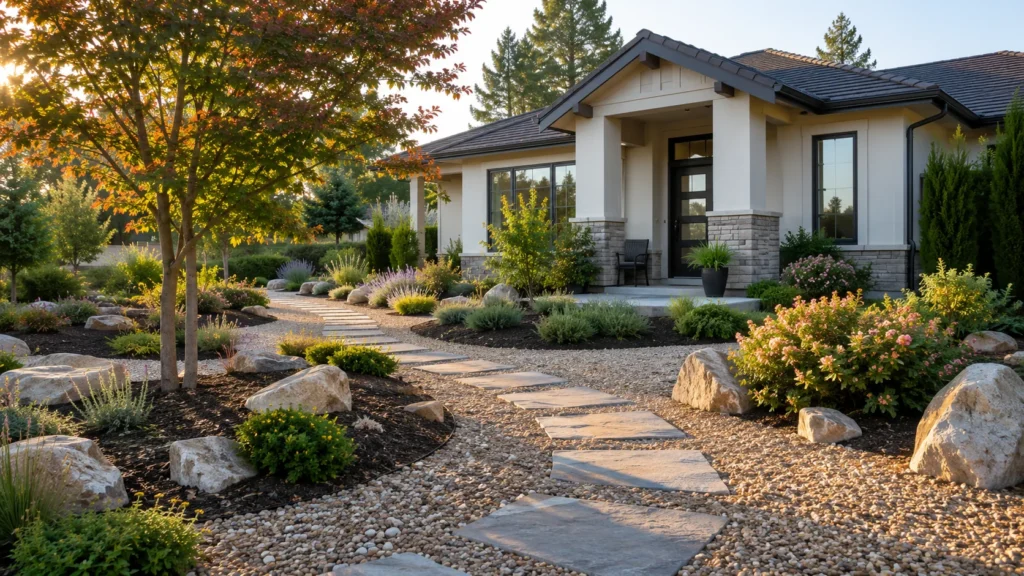
That is why front yards without grass have become an attractive option for people who want a landscape with more texture, more personality, and less time spent mowing.
A lawn free front yard can also make better use of awkward spaces. Narrow strips beside a driveway, steep slopes, dry corners, shady areas beneath trees, and hot spaces near sidewalks are often difficult places to maintain turf. Those same areas can become attractive planting beds, gravel gardens, pathways, or ground cover zones.
Some of the biggest advantages include:
- Less mowing and edging
- More room for shrubs, flowers, trees, and ground covers
- Greater flexibility in dry or shady locations
- More opportunities to use native plants
- Better definition around walkways and the front entrance
- More seasonal color and texture
- Easier ways to create a distinctive landscape style
- The ability to convert unused lawn into functional outdoor space
Native plants can be especially useful in a lawn replacement plan because plants native to a region are adapted to local environmental conditions and can provide food and habitat for native insects, birds, and other wildlife.
The goal, however, should not simply be to get rid of grass. Good no lawn landscaping replaces the visual job that the lawn once performed.
Grass creates continuity. When you remove it, something else must organize the space.
That is where good front yard design begins.
How to Plan a Front Yard Design Without Grass
The most successful front yard landscaping without grass usually starts on paper rather than at the garden center.
Before choosing plants or ordering gravel, look at the entire property as one composition.
Study Sun and Shade
Watch the yard during different parts of the day.
A south or west facing front yard may receive intense afternoon sun, while a yard shaded by mature trees may need an entirely different planting palette.
Mark the basic areas as:
- Full sun
- Partial sun
- Partial shade
- Deep shade
Do not choose plants based only on appearance. A beautiful plant in the wrong location quickly becomes a maintenance problem.
Watch How Water Moves
Pay attention during rainfall.
Notice whether water:
- Runs toward the house
- Collects in low areas
- Flows off the driveway
- Erodes a slope
- Pools near a sidewalk
- Drains quickly through sandy soil
- Sits in heavy or compacted soil
Drainage should influence where you place beds, pathways, gravel, and plants.
If one portion of the front yard naturally collects runoff, it may even be suitable for a properly designed rain garden. The United States Environmental Protection Agency describes rain gardens as shallow landscaped depressions that collect water from surfaces such as roofs, driveways, or streets and allow it to soak into the ground.
Identify the Main Walking Route
Every front yard needs a clear answer to one basic question.
How does a visitor get from the sidewalk, driveway, or street to the front door?
Do not make people guess.
Your main path should feel obvious, comfortable, and connected to the architecture of the house.
Once the primary route is established, planting beds and decorative areas can be designed around it.
Choose a Focal Point
A grassless front yard needs visual anchors.
Your focal point might be:
- A small ornamental tree
- A group of large boulders
- A front porch
- A statement planter
- A flowering shrub
- A sculptural plant
- A bench
- A water feature
- An attractive front door
- A wide entry path
Avoid trying to make every corner equally dramatic. One or two strong focal points usually create a calmer and more intentional design.
Repeat Materials
Too many materials can make a no grass front yard look fragmented.
If the home already has brick, limestone, concrete, timber, or another distinctive material, consider repeating it somewhere in the landscape.
For example, a house with warm stone details may look more connected to the yard when similar stone appears in edging, steps, boulders, or the walkway.
Repetition is what makes separate pieces feel like one landscape.
Best Front Yard Landscaping Ideas Without Grass
There is no single formula for a no lawn front yard. The right approach depends on the climate, architecture, budget, yard size, maintenance preference, and how you want the space to feel.
The following ideas can be used individually or combined.
1. Replace the Lawn With a Native Plant Garden
One of the most natural alternatives to grass in a front yard is a layered garden made primarily from native plants.
Instead of creating one flat carpet of turf, build the landscape vertically.
Use:
- Low ground covers near paths
- Perennials through the middle of beds
- Medium shrubs for structure
- Taller shrubs toward boundaries
- One or two small trees where space allows
The result can feel lush without depending on a conventional front lawn.
A native planting does not have to look wild. Clean edging, repeated plant groups, visible pathways, and a defined border can give even an informal planting scheme a polished appearance.
Choose native species based on your specific region rather than relying on a generic national plant list.
2. Create a Low Maintenance No Grass Front Yard With Shrubs and Mulch
For homeowners who want simplicity, shrubs and mulch are hard to beat.
Start with a few well chosen evergreen or structurally interesting shrubs. Add flowering shrubs and perennials for seasonal interest. Then cover exposed soil with an appropriate organic mulch.
This style works particularly well when you want a low maintenance no grass front yard that still looks soft and planted.
A simple layout may include:
- Foundation shrubs near the house
- A small tree at one corner
- Three or five repeated flowering shrubs
- Low perennials near the walkway
- Mulch across open soil
- Stone or metal edging along the boundary
Resist the urge to fill every empty spot immediately.
Plants grow.
Give them enough room to reach their mature size.
3. Use Ground Covers as Front Lawn Alternatives
If you like the visual softness of a lawn but do not want conventional turfgrass, low growing ground covers can fill portions of the yard.
Depending on climate and site conditions, possibilities may include:
- Creeping thyme
- Sedum
- Native violets
- Wild strawberry
- Moss in suitable shaded locations
- Low growing clover
- Creeping phlox
- Other regionally appropriate spreading perennials
Not every ground cover tolerates regular foot traffic. Use stepping stones or a defined path where people walk frequently.
Also research a plant before allowing it to spread freely. A ground cover that behaves beautifully in one region can become aggressive in another.
4. Design a Gravel Garden
Gravel is one of the most versatile materials for front yard no grass landscaping ideas.
It can be used to create:
- Garden paths
- Seating zones
- Open spaces between planting islands
- Modern geometric layouts
- Mediterranean inspired gardens
- Desert inspired landscapes
The key is to avoid treating gravel as a giant replacement carpet for grass.
A front yard covered from property line to property line with one type of stone can feel harsh. Break it up with plants, boulders, stepping stones, contrasting textures, or defined beds.
Gravel works best as part of a landscape, not as the entire landscape.
5. Try Front Yard Landscaping With Rocks and No Grass
Front yard landscaping ideas with rocks and no grass are especially useful for dry sites, slopes, contemporary homes, and properties where texture matters more than lushness.
You can work with:
- River rock
- Crushed stone
- Decomposed granite
- Pea gravel
- Large boulders
- Flagstone
- Local stone
Use large rocks first.
A few substantial boulders generally look more natural than dozens of small decorative stones scattered around the yard.
Then soften the rock with planting.
Shrubs, flowering perennials, succulents where climate permits, spreading ground covers, and small trees help the landscape feel alive.
6. Build a Xeriscape Front Yard
Xeriscaping is often misunderstood as landscaping with nothing but rocks and cactus.
It is actually a water conscious approach to landscape design that emphasizes planning, appropriate plants, efficient irrigation, soil management, mulch, and reduced dependence on high water use turf. Colorado State University Extension identifies principles such as thoughtful design, suitable plant selection, efficient irrigation, limiting turf, grouping plants with similar needs, and using mulch.
A xeriscape front yard can include:
- Native flowering plants
- Drought tolerant shrubs
- Gravel pathways
- Mulched planting beds
- Shade trees
- Ground covers
- Decorative stone
- Drip irrigation
It can be colorful and densely planted rather than barren.
Even drought tolerant plants generally need appropriate watering while becoming established, so no lawn should not be confused with no water at all.
7. Add Pavers With Planting Between Them
Large format pavers are an excellent choice for a modern front yard without grass.
Set them in:
- Gravel
- Low ground covers
- Decorative stone
- Planting strips
The spaces between the pavers soften the hardscape and prevent the front yard from looking like one continuous slab of concrete.
This treatment works especially well for:
- Contemporary homes
- Mid century modern houses
- Small urban front yards
- Wide entry paths
- Courtyard style landscapes
Where appropriate, permeable paving materials can also help allow water to enter the soil rather than immediately running across a hard surface. The EPA includes pervious pavers among landscape approaches that can help manage runoff.
8. Create a Front Yard Courtyard
If you are giving up lawn, you can gain something more useful in return.
A small courtyard turns part of the front yard into an outdoor room.
Depending on the property, include:
- Two comfortable chairs
- A small bench
- A compact table
- Large containers
- A small shade tree
- Paving or gravel
- Low planting around the edges
This works best when the seating area feels connected to the house rather than dropped randomly into the middle of the yard.
Position it near a porch, entry path, garden wall, or established planting bed.
9. Use a Dry Creek Bed as a Landscape Feature
A dry creek bed can turn drainage into a design element.
Use varying sizes of stone rather than one uniform gravel size. Add larger rocks along bends, and plant around the edges so the channel feels integrated into the landscape.
A dry creek can visually connect:
- A downspout area
- A rain garden
- A lower section of the property
- A planting bed
- A decorative drainage route
Do not use decorative drainage features to direct water toward neighboring properties or the home’s foundation. Where drainage is significant or complicated, professional advice may be worthwhile.
10. Build a Rain Garden
A low portion of the yard that receives runoff may become a planted rain garden rather than a soggy patch of lawn.
A rain garden can contain plants capable of handling periods of wet soil as well as drier conditions between storms.
It may also create a strong visual feature when combined with:
- Flowering perennials
- Native shrubs
- Decorative stone
- A defined edge
- A nearby pathway
Correct location and construction matter. Check drainage, underground utilities, local guidance, and the relationship between the rain garden and the house before digging.
11. Turn the Front Lawn Into a Pollinator Garden
A flower rich front yard can replace a conventional lawn while providing a completely different experience throughout the seasons.
Choose plants that bloom at different times and repeat each variety in noticeable groups.
A pollinator oriented design might combine:
- Spring flowering perennials
- Summer flowering plants
- Late season blooms
- Native shrubs
- Seed producing plants
- A small water source where practical
Keep a defined path and intentional edges.
Those simple design choices can make an abundant garden look cared for rather than accidental.
12. Create a Modern Front Yard With No Grass
Modern front yard ideas with no grass tend to rely on restraint.
Instead of using dozens of plant varieties, choose a smaller palette and repeat it.
A clean contemporary combination could include:
- Large concrete pavers
- Dark or neutral gravel
- Sculptural shrubs
- One specimen tree
- Simple rectangular planting beds
- Architectural containers
- Low ground cover
The architecture of the house should guide the geometry.
If the building is highly linear, crisp bed lines and rectangular pavers can reinforce that character. If the architecture is softer, rigid geometry may feel less natural.
13. Design a Cottage Style Front Garden Without Grass
A no grass front garden does not need to be minimalist.
For a cottage garden feel, create generous beds filled with overlapping plants and allow the pathway to become part of the experience.
Use:
- Flowering shrubs
- Perennials
- Herbs
- Ground covers
- Small flowering trees
- Climbers near fences or trellises
- Natural stone paths
The planting can be informal, but the circulation should remain clear.
That balance keeps the garden romantic without becoming chaotic.
14. Use Mulched Planting Islands
You do not have to create one enormous garden bed.
Several connected planting islands can make a large no grass front yard easier to design.
Repeat the same materials and plants from one island to another so they feel related.
For example:
- Planting island one contains a small tree and three shrubs
- Planting island two repeats the same shrubs with flowering perennials
- Planting island three uses the same ground cover along the walkway
The repeated plants create visual rhythm across the property.
15. Add a Front Yard Meadow or Prairie Style Planting
For a larger property, meadow inspired planting can replace a wide front lawn with movement, color, and seasonal change.
A good meadow design is more deliberate than simply allowing weeds to grow.
It requires:
- Suitable plant selection
- Thoughtful species balance
- Defined edges
- A maintenance strategy
- Clear paths or mown looking boundaries
- Attention to local invasive plant concerns
If the goal is a completely grass free front yard, use flowering native perennials and other non-grass meadow species rather than prairie grasses.
16. Use Containers in Difficult Spaces
Containers are particularly useful when the front yard has:
- Poor soil
- Limited planting area
- Extensive paving
- A narrow entry
- Rental restrictions
- An awkward porch
- Areas where you want seasonal flexibility
Use fewer, larger containers rather than scattering many tiny pots around the yard.
Large planters usually have more visual presence and make the entrance feel intentional.
Repeat one container material or shape to tie the arrangement together.
17. Create an Edible Front Yard
A front yard without grass can also grow food.
Depending on local rules and the amount of sunlight, integrate edible plants into ornamental beds.
Possibilities include:
- Culinary herbs
- Blueberries where conditions suit them
- Strawberries
- Compact fruit trees
- Attractive vegetables
- Edible flowers
- Raised beds
Keep the layout structured with defined paths and permanent shrubs or edging so the yard still has shape when seasonal crops are removed.
Cheap No Grass Front Yard Ideas
Removing a lawn does not mean you have to install an expensive designer landscape.
Some of the best cheap no grass front yard ideas are based on doing less, but doing it deliberately.
Convert the Yard in Stages
You do not need to remove every square foot of lawn at once.
Start with the areas that cause the most trouble:
- Narrow strips
- Dry corners
- Areas around trees
- Spaces beside the driveway
- Steep sections
- Awkward patches near the sidewalk
Expand the planting beds gradually.
This spreads both the labor and the cost over time.
Use Smaller Plants
Large nursery plants create instant impact, but smaller plants are usually easier on the budget.
Use one or two larger specimens where immediate scale matters, then fill the rest of the landscape with younger plants and allow them to grow.
Repeat Affordable Plants
You do not need twenty different species.
A handful of reliable plants repeated throughout the front yard often looks more cohesive and can be easier to maintain.
Reuse Existing Materials
Before buying new materials, look at what is already on the property.
Old bricks, stone, pavers, containers, or timber may be reusable for:
- Edging
- Stepping paths
- Small retaining features
- Plant stands
- Garden borders
Only reuse materials that are stable and suitable for the intended outdoor purpose.
Spend Money Where It Shows
If the budget is tight, prioritize the most visible parts of the landscape:
- Front entrance
- Main walkway
- Foundation planting
- One focal point
- Street facing bed edges
Less prominent areas can be filled in gradually.
Small Front Yard Landscaping Ideas With No Grass
Small front yards benefit enormously from removing visual clutter.
When every square foot is visible, too many materials and too many plant varieties can make the space feel even smaller.
A strong small front yard landscaping plan without grass might use:
- One walkway material
- One mulch or gravel material
- One small tree
- Three to five main plant varieties
- One focal planter
- A limited color palette
Use Diagonal or Offset Paths Carefully
A slightly offset path can create more visual depth than a straight line when the architecture allows it.
However, never force visitors to take an inconvenient route simply for appearance.
Function comes first.
Layer Plants From Low to Tall
Place lower plants near sidewalks and paths and taller plants farther back.
This keeps the space visually open while still creating depth.
Avoid Oversized Shrubs
One plant that grows far beyond its allotted space can overwhelm a small front garden.
Always consider mature plant size, not just the size of the plant at the nursery.
Keep the Entrance Visible
Your front door should remain visually easy to find.
Avoid creating a dense wall of plants that hides the entrance or blocks important sight lines.
Front Yard Landscaping With Rocks and No Grass
Rock heavy landscaping can look sophisticated, but only when the scale and materials are handled carefully.
A good rock landscape typically combines three elements.
Structural Stone
These are the largest pieces.
Examples include:
- Boulders
- Retaining stone
- Large slabs
- Stone steps
They provide weight and structure.
Surface Material
This covers broader areas.
Examples include:
- Gravel
- Crushed stone
- River rock
- Decomposed granite
Choose a material that complements the house rather than competing with it.
Plants
Plants keep rock landscaping from becoming visually flat.
Place them around boulders, beside paths, and in generous groups.
Think in layers rather than isolated dots.
A common mistake is placing one tiny shrub every few feet in a sea of stone. The plants look disconnected and the yard feels unfinished.
Instead, create planting pockets containing several compatible plants.
Choosing Plants for Front Yards Without Grass
There is no universal list of the best plants for a no grass front yard.
Climate comes first.
A plant that is effortless in one state may struggle constantly in another.
Use local extension resources, reputable native plant organizations, or knowledgeable local nurseries to narrow the choices.
Then evaluate each plant using the following factors.
Sunlight
Match the plant to the actual amount of light the site receives.
Water Needs
Place plants with similar water requirements together.
This practice is sometimes called hydrozoning and can make irrigation much easier to manage.
Mature Size
Read both mature height and mature width.
Planting too close together may look full on installation day but create pruning and crowding problems later.
Seasonal Interest
Think beyond flowers.
Plants can contribute through:
- Bark
- Berries
- Foliage
- Seed heads
- Branch structure
- Fall color
- Evergreen form
- Fragrance
A front yard should have something visually interesting even when nothing is blooming.
Maintenance Level
Ask what the plant actually requires.
Some plants need regular:
- Pruning
- Deadheading
- Dividing
- Staking
- Watering
- Cleanup
A plant is only low maintenance if those requirements fit the amount of work you want to do.
No Grass Front Yard Ideas for Full Sun
A sunny front yard gives you many options, especially in climates where drought tolerant planting is appropriate.
Consider combinations of:
- Drought tolerant flowering perennials
- Native shrubs
- Gravel
- Stone
- Succulents where climate appropriate
- Ground covers
- Small shade trees
Do not automatically cover every sunny surface with rock.
Strategically placed trees and shrubs can add shade, depth, and softness to an exposed landscape.
No Grass Front Yard Ideas for Shade
Shade can make traditional turf difficult, but it can create excellent conditions for a woodland style front garden.
Depending on your region, consider:
- Ferns
- Shade tolerant native perennials
- Woodland ground covers
- Shrubs suited to lower light
- Mulched paths
- Stepping stones
- Moss in naturally suitable conditions
Work with the shade rather than trying to force a sunny garden style into it.
No Grass Landscaping for a Sloped Front Yard
A slope needs more than good looks.
It also needs stability and safe access.
Depending on the grade and soil, possible approaches include:
- Dense ground cover planting
- Shrubs with substantial root systems
- Terraced beds
- Retaining walls where appropriate
- Stone steps
- Switchback paths
- Mulched planting
- Carefully positioned boulders
Steep slopes can also be difficult to mow safely, which makes alternative planting particularly practical in these areas. University of Minnesota Extension notes that steep slopes can be good candidates for alternative ground covers or low maintenance vegetation rather than routine mowing.
Significant retaining walls, drainage changes, or steep slope work may require professional design and local approval.
How to Make a No Grass Front Yard Look Intentional
This is the difference between removing a lawn and designing a landscape.
A successful front yard without grass usually has several visual signals that communicate intention.
Use Clean Edges
Define the boundaries between:
- Gravel and planting
- Mulch and paving
- Beds and sidewalks
- Ground cover and pathways
Crisp transitions make almost any planting style feel more finished.
Repeat Plants
Planting one of everything often creates visual noise.
Repeat important plants in groups or throughout the yard.
Leave Negative Space
Not every square foot needs a feature.
Open gravel, a clean walkway, mulch beneath a tree, or a simple mass of ground cover gives the eye somewhere to rest.
Create Layers
Think about height.
A balanced front yard might move from:
- Ground cover
- To low perennials
- To shrubs
- To a small tree
That variation creates depth that a flat lawn once provided in a different way.
Connect the Landscape to the House
Use the home’s architecture as your reference point.
A rustic cottage, Spanish revival house, modern home, traditional brick property, and desert contemporary residence should not automatically receive the same landscaping treatment.
The house and front yard should look like they belong together.
How to Remove Grass Before Landscaping
Once you have a design, the existing lawn has to be dealt with.
Several methods are commonly used, and the right one depends on yard size, timeline, grass type, soil condition, and what you plan to install afterward.
Sod Removal
A sod cutter or manual removal provides relatively fast access to bare soil.
It can be practical when you want to begin planting or hardscaping soon.
The downside is labor and the removal of some surface soil along with the sod.
Sheet Mulching
Some homeowners cover turf with layers of biodegradable material and organic mulch to suppress growth over time.
This method requires patience and should be planned carefully around existing trees and plant roots.
Solarization
In climates and seasons where conditions are appropriate, clear plastic can be used to trap solar heat at the soil surface.
Timing and effectiveness vary considerably by climate and grass species.
Targeted Removal
If you are not ready for a complete lawn conversion, remove turf only where new beds, pathways, or gravel zones will go.
This is often the most manageable approach for a gradual makeover.
Before digging deeply, locate underground utilities and check for irrigation lines.
Do You Need Landscape Fabric Under Gravel?
Landscape fabric is often presented as a permanent solution for weeds, but a front yard is a living system.
Over time, windblown dust, leaves, and organic matter can accumulate on top of gravel. Weed seeds may then germinate in that new material regardless of what sits underneath.
In permanent planted areas, Colorado State University Extension notes that weed barrier fabric can interfere with water and air exchange and does not permanently prevent weed growth.
The right base preparation depends on whether the area is a path, driveway, decorative gravel bed, or planted garden.
For load bearing surfaces such as driveways and heavily used paths, proper construction is especially important.
Low Maintenance No Grass Front Yard Design
No lawn does not automatically mean no maintenance.
Plants still grow. Leaves still fall. Weeds still appear. Gravel moves. Mulch breaks down.
The real goal is to replace repetitive lawn care with a smaller number of more manageable landscape tasks.
For a lower maintenance design:
- Use fewer plant varieties
- Choose plants appropriate for the site
- Avoid overcrowding
- Install defined edges
- Group plants with similar water needs
- Use mulch where appropriate
- Provide easy access to every planting bed
- Limit complicated hedges that require frequent shaping
- Choose paths wide enough to use comfortably
- Use permanent structural plants for year round form
New landscaping usually needs more attention during establishment than it will later.
Plan for that period.
Common Mistakes in No Lawn Front Yard Landscaping
Removing Grass Before Making a Plan
Bare soil creates urgency.
That urgency often leads homeowners to buy random plants, random stone, and random edging simply because the yard looks unfinished.
Design first.
Remove turf second.
Using Too Much Gravel
Gravel is useful, but a gravel covered yard without sufficient planting can feel stark.
Use plants and structural elements to add depth.
Choosing Plants Only for Flowers
A plant may bloom beautifully for three weeks and look ordinary for the other forty nine.
Consider the full year.
Ignoring Mature Plant Size
A small nursery shrub can become a very large landscape plant.
Give it room.
Creating Too Many Tiny Beds
Small disconnected planting beds can make a yard look chopped into pieces.
Larger, flowing beds usually produce a stronger composition.
Forgetting the Front Walk
The entry path is one of the most important pieces of a front yard.
Make it obvious.
Making Everything the Same Height
A flat layer of small plants can lack structure.
Vary plant height and include stronger vertical forms.
Assuming Drought Tolerant Means No Water
New plants need appropriate establishment care even when the mature plants are known for tolerating dry conditions.
Copying a Landscape From a Different Climate
A front yard photographed in Arizona, Oregon, Florida, or New England may be beautiful but completely wrong for your conditions.
Borrow the design principles, not necessarily the exact plants.
A Simple Formula for Front Yard Landscaping Without Grass
If the number of ideas feels overwhelming, use this simple framework.
Step 1. Establish the Main Path
Make the route to the front door clear.
Step 2. Choose One Focal Point
Select a tree, architectural plant, boulder, planter, or other strong feature.
Step 3. Build Two or Three Large Planting Areas
Avoid a collection of tiny beds.
Step 4. Choose a Limited Plant Palette
Select plants based on sunlight, soil, water needs, mature size, and climate.
Step 5. Add a Consistent Ground Material
Use mulch, gravel, ground cover, or a combination.
Step 6. Repeat Key Plants
Repetition creates unity.
Step 7. Add Detail Last
Containers, decorative stone, lighting, and small accents should support the larger design rather than replace it.
That formula works for many front yard designs without grass, whether the finished landscape is modern, cottage inspired, drought tolerant, native, or minimalist.
Is a No Lawn Front Yard Right for You?
A grass free landscape can be a great fit when you want to spend less time mowing, make better use of difficult spaces, introduce more plants, or create a front yard with more visual character.
It may be especially worth considering if your existing lawn:
- Struggles in deep shade
- Burns out in sunny areas
- Is difficult to irrigate efficiently
- Sits on an awkward slope
- Contains narrow hard to mow strips
- Occupies space you rarely use
- Does not fit the style you want for the home
You also do not have to choose between an enormous lawn and zero turf everywhere.
Some homeowners remove only the least useful portions of grass.
Others create a completely lawn free front yard.
The right amount is the amount that serves your property and lifestyle.
Conclusion
Front yard landscaping without grass is not really about what you remove. It is about what you put in its place.
A successful no grass front yard replaces the blank green surface of a lawn with structure, movement, texture, pathways, plants, and purpose. That may mean a native plant garden filled with seasonal color. It may mean a clean modern landscape with pavers and gravel. It could be a shaded woodland garden, a drought tolerant xeriscape, a rock garden, a pollinator friendly front yard, or a simple combination of shrubs and mulch.
Start with the site rather than a shopping list. Understand the sun, drainage, soil, circulation, architecture, and maintenance level you can realistically handle. Then choose a limited number of materials and plants and repeat them with intention.
For homeowners exploring no lawn front yard ideas, that approach is at the heart of what we focus on at Front Yard Landscaping Ideas: creating front spaces that look designed rather than merely decorated.
You do not need a rectangle of turf to give a house curb appeal.
You need a landscape with a clear plan.
Frequently Asked Questions
How do I landscape my front yard without grass?
Replace lawn with a combination of planting beds, native plants, shrubs, ground covers, mulch, gravel, stone, pavers, and clearly defined paths. Begin with your site’s sunlight, drainage, soil, and walking routes, then build the design around those conditions.
What can I put in my front yard instead of grass?
Common front yard lawn alternatives include ground covers, native plants, flowering perennials, shrubs, mulch, gravel, stone, pavers, rain gardens, courtyard areas, and xeriscape planting. The best choice depends on climate, sunlight, foot traffic, and the appearance you want.
What is the lowest maintenance alternative to grass?
There is no single lowest maintenance solution for every property. A simple combination of well adapted shrubs, properly spaced perennials, mulch, and clearly defined hardscape is often easier to manage than a complicated design with many plant varieties. Ground covers can also reduce open soil, but their maintenance requirements vary by species.
How can I make a no grass front yard look good?
Use intentional edges, repeated plants, varied plant heights, a clear walkway, one or two focal points, and a limited palette of materials. Avoid covering the entire yard with one material. A mix of plants and hardscape usually creates more visual depth.
What are some cheap front yard ideas without grass?
Expand planting beds gradually, remove grass in stages, buy smaller plants, divide existing perennials where appropriate, reuse suitable stone or pavers, use mulch in large areas, and concentrate your budget around the entrance and other highly visible spaces.
What are the best no grass ideas for a small front yard?
Keep the design simple. Use one main path material, a small tree or focal plant, a few repeated plant varieties, low ground covers, and one consistent mulch or gravel material. Limiting visual clutter can make a small front yard feel larger.
Can I replace my entire front lawn with rocks?
You can create a rock based landscape, but using only rock may produce a harsh or unfinished appearance. Combining stone with shrubs, perennials, ground covers, trees, or planting pockets usually creates a more balanced design. Also consider drainage, heat exposure, maintenance, and local landscaping rules.
Is gravel better than mulch for a no grass front yard?
Neither is universally better. Gravel can suit modern, desert inspired, or dry landscape designs and does not decompose quickly. Organic mulch has a softer appearance and is often useful around many trees, shrubs, and perennial beds. The best choice depends on the plants, climate, architecture, and maintenance goals.
What plants can replace a front lawn?
Possible alternatives include creeping thyme, native ground covers, wild strawberry, sedum, clover, low flowering perennials, and other spreading plants suited to your region. Some tolerate light foot traffic while others should be kept beside stepping stones or pathways.
Can a front yard without grass still have good curb appeal?
Yes. Curb appeal comes from composition rather than turf alone. A clear entrance, healthy plants, clean edges, attractive paths, thoughtful proportions, repeated materials, and a landscape that complements the house can create a strong street facing appearance without a conventional lawn.
What is the best low maintenance no grass front yard?
A strong low maintenance design usually combines a limited selection of climate appropriate shrubs and perennials with mulch or gravel, a simple path, one focal tree or feature, and efficient irrigation where required. Avoid plants that need frequent pruning and designs with many small, difficult to maintain spaces.
What is the difference between xeriscaping and simply removing grass?
Removing grass is only the elimination of turf. Xeriscaping is a broader landscape planning approach that considers plant selection, water use, irrigation, soil, mulch, design, and maintenance. A xeriscape may contain little or no turf, but the emphasis is on creating a functional, water conscious landscape rather than simply covering the former lawn with rocks.
Should I use native plants in a grassless front yard?
Native plants are worth considering because they are adapted to the environmental conditions of the regions where they naturally occur and can contribute food and habitat for local wildlife. Choose species native to your particular region and appropriate for the conditions in your yard.
How do I landscape a front yard with rocks and no grass?
Begin with large structural elements such as boulders or stone steps, then add gravel or another surface material in selected areas. Create planting pockets around the stone using shrubs, ground covers, and perennials. Keep the walkway visible and repeat the same rock materials throughout the landscape for consistency.
Is a no grass front yard really maintenance free?
No. A lawn free landscape still requires some weeding, pruning, watering, leaf cleanup, mulch renewal, plant care, or gravel maintenance. The advantage is that a well planned design can reduce repetitive lawn tasks such as mowing and edging while replacing them with less frequent garden maintenance.

Sara Bendrick believes your yard should be a place you actually look forward to coming home to. A licensed and bonded design-build contractor (C-27 #1006161), she founded Sarita Landscape Designs and has spent over twelve years designing residential outdoor spaces across Southern California with a real soft spot for curb appeal and low-water, no-lawn designs.
When she’s not on a job site, Sara’s on camera or on stage. She’s hosted yard-renovation shows including I Hate My Yard, Build It Like Bendrick, and Lawn & Order, written Big Impact Landscapes, given two TEDx talks, and serves as a spokesperson for Stihl. Her mission is simple, help people see the potential in the yard they already have.