
To landscape a front yard with succulents, start by studying the sunlight, drainage, soil, and available space. Build the design around a few larger architectural succulents, layer medium sized plants around them, fill open areas with low growing varieties, and finish the landscape with gravel, natural stone, boulders, or a simple pathway. Choose succulent plants suited to your local climate, give their roots fast draining soil, and leave enough room for each plant to reach its mature size.
A well planned succulent front yard can turn an ordinary patch of ground into something sculptural.
Agave leaves can create bold architectural lines. Echeveria adds compact rosettes. Sedum softens edges. Aloe can bring height and seasonal flowers. Gravel and stone connect everything without competing for attention.
The secret is not filling every empty space with plants. Good succulent landscaping depends just as much on shape, spacing, texture, drainage, and restraint as it does on the plants themselves.
At Front Yard Landscaping Ideas, we believe the strongest landscapes begin with the conditions already present in the yard rather than forcing a design onto the property. The following guide explains how to create a front yard succulent garden that works visually, horticulturally, and practically over the long term.
Table of Contents
Why Succulents Work So Well in Front Yard Landscaping
Succulents have an unusual advantage in landscape design. They behave almost like living architecture.
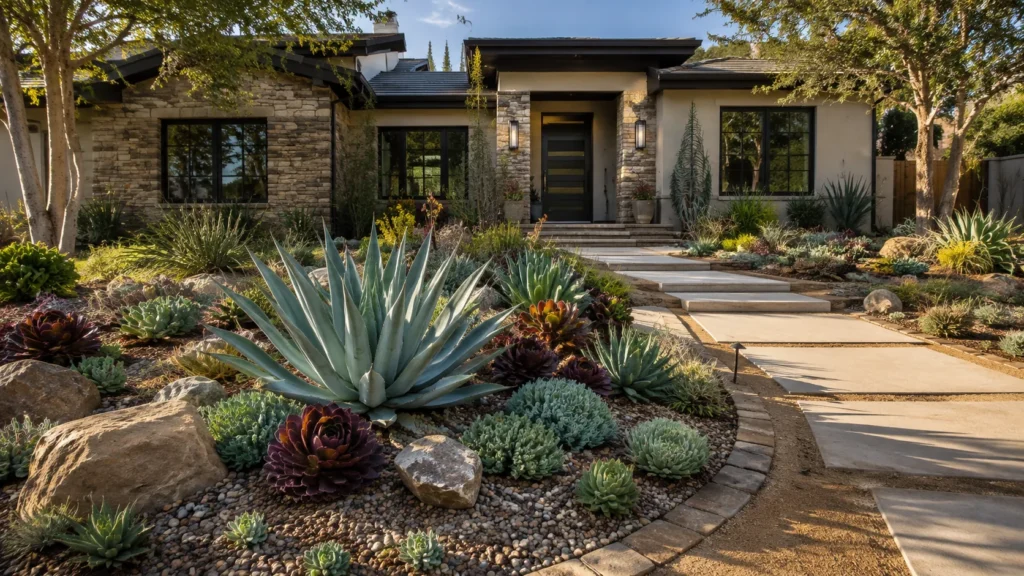
A traditional flower bed often relies heavily on blooms for visual interest. Succulent landscaping can remain attractive even when nothing is flowering because the plants themselves provide structure.
Their leaves may be pointed, rounded, ribbed, cascading, upright, silver, blue green, burgundy, lime, or nearly black. Combining these forms gives the landscape depth without requiring dozens of different species.
Succulents can also suit homeowners looking for a more water conscious and low maintenance landscape, provided the plants are appropriate for the local climate.
A thoughtfully designed succulent front yard can provide:
- Strong curb appeal throughout much of the year
- Interesting foliage, shapes, and textures
- Lower irrigation needs once suitable plants are established
- Less mowing compared with a conventional lawn
- Flexible designs for small and large front yards
- Attractive combinations with gravel, stone, and other hardscape
- Excellent opportunities for modern and contemporary landscaping
- A practical way to landscape sunny and dry areas
Low maintenance, however, should not be confused with no maintenance. Succulents still require suitable soil, occasional watering, seasonal cleanup, and enough room to grow.
Start With the Conditions in Your Front Yard
Before collecting succulent garden ideas, look at the yard you actually have.
The best succulent landscape design responds to its environment. A spectacular Agave in a photograph may be completely wrong for a shaded entrance or a climate with harsh winter freezes.
Spend a little time understanding the site before choosing plants.
Observe Sunlight
Most landscape succulents appreciate generous light, but their exact requirements vary.
Look at the front yard at several points during the day. Notice which areas receive strong afternoon sun, morning light, filtered light, or extended shade.
A hot south or west facing area may support very different plants from a protected bed beneath an overhang.
This matters because sunlight affects more than growth. It can influence leaf color, flowering, water use, and the overall shape of a succulent.
Check Drainage
Drainage is one of the most important considerations when landscaping with succulents.
Succulent leaves, stems, or roots are adapted to store moisture. That ability is useful in dry conditions but becomes a problem when roots remain constantly wet.
After rain or irrigation, notice where water collects.
If water regularly sits around the planting area, improve the drainage before installing a succulent garden. Depending on the site, that may mean modifying the soil, correcting grading problems, creating raised or mounded beds, or choosing another location.
A slightly raised planting area can also make the landscape more visually interesting.
Understand Your Soil
Do not assume that every succulent garden requires the same bagged cactus soil used for containers.
Landscape soil behaves differently because it interacts with the native ground beneath it.
The goal is generally a soil structure that allows excess moisture to move away from the root zone while still supporting healthy root development.
Heavy compacted soil may need more substantial preparation than loose, naturally well drained ground.
Avoid creating a small pocket of extremely porous material inside poorly draining soil. The surrounding soil still controls where the water eventually goes.
Consider Your Climate
Succulent is not another word for desert plant, and not every succulent tolerates the same weather.
Some species thrive in hot, dry climates. Others handle cold winters remarkably well. Some prefer mild coastal conditions. Others struggle when temperatures fall too low or summer humidity remains high.
Choose plants according to:
- Local winter temperatures
- Summer heat
- Rainfall
- Humidity
- Sun exposure
- Wind
- Soil conditions
- Your local hardiness zone
This one decision can save more frustration than almost any clever landscaping technique.
How to Plan a Succulent Front Yard Before Planting
A successful front yard succulent garden usually looks intentional from the street.
That requires a little planning.
Instead of purchasing plants one at a time and finding somewhere to squeeze them in, think about the yard as a complete composition.
Decide What You Want the Landscape to Do
Your front yard may need to accomplish several things at once.
Perhaps you want better curb appeal. Maybe you want to reduce the amount of lawn. You might need a clearer route to the front door, more privacy, or a low maintenance garden around a driveway.
Write down the priorities before designing.
A beautiful succulent yard that blocks a walkway or hides the house number is still a poorly functioning front yard.
Identify the Main Viewing Angles
Unlike a secluded backyard garden, the front yard is viewed from several directions.
Consider how it looks:
- From the street
- From the driveway
- From the sidewalk
- From inside the house
- While approaching the front entrance
- From neighboring properties
Place the most distinctive focal plants where they can be appreciated from important viewpoints.
Plan for Mature Plant Size
This is one of the most common mistakes in succulent gardening.
Young succulents look tiny, and a newly planted bed can feel unusually empty. The temptation is to crowd plants together for instant impact.
Resist it.
Agaves, aloes, aeoniums, and spreading groundcovers can become considerably larger with time. Some produce offsets and gradually form colonies.
Spacing plants according to mature size gives them room to develop and improves airflow while reducing the amount of pruning and transplanting required later.
The bare ground between young plants does not have to look unfinished. Gravel, stone, and small boulders can make that negative space part of the design.
Build the Design in Layers
A useful way to approach succulent landscape design is to think in layers rather than individual plants.
First Layer: Architectural Focal Plants
These are the plants that immediately catch the eye.
Agave is one of the classic choices because its strong geometric form gives a landscape structure. Large Aloe species can play a similar role where the climate allows.
Use these plants strategically.
A single handsome specimen surrounded by quieter plants often has greater visual impact than a row of unrelated statement plants competing for attention.
Architectural succulents work particularly well:
- Near an entrance
- At the corner of a house
- At a change in elevation
- Within a gravel bed
- Beside large landscape rocks
- At the end of an important sight line
Consider safety before placing sharp tipped plants beside sidewalks, driveways, children’s play areas, or frequently used paths.
Second Layer: Medium Sized Succulents
Medium plants create the transition between large focal specimens and ground level planting.
Depending on climate, this layer might include Aloe, Aeonium, Echeveria, compact Agave varieties, Crassula, or other locally appropriate succulents.
Rather than using one of everything, repeat selected plants in several locations.
Repetition creates rhythm and makes even an informal garden look deliberate.
Third Layer: Low Growing Succulents and Groundcovers
The lowest layer helps connect the composition.
Sedum and other spreading succulents can soften the edge of gravel, spill slightly over rocks, or create a transition beside pathways.
Low growing plants are particularly valuable in a small front yard because they provide texture without visually overwhelming the space.
Best Succulents for Front Yard Landscaping
There is no universal list of the best succulents for landscaping because climate matters enormously.
However, several groups regularly appear in successful succulent landscapes.
Agave for Architectural Structure
Agave is one of the most recognizable entities in modern succulent landscaping.
Its rosette form and strong leaves create instant visual structure. Some varieties remain relatively compact, while others grow into substantial specimens.
Agave works particularly well with:
- Boulders
- Gravel mulch
- Contemporary architecture
- Ornamental grasses
- Repeated low groundcovers
- Minimalist planting schemes
Before planting, check the mature width and whether the particular variety produces abundant offsets.
Also consider the placement of sharp leaves. A dramatic plant belongs where it can be admired without becoming a hazard.
Aloe for Height and Seasonal Flowers
Aloes bring a slightly softer architectural form and can produce striking flower spikes.
In suitable climates, they are useful for adding height and seasonal color without turning a succulent landscape into a conventional flower bed.
Different Aloe species vary greatly in size, so choose according to the proportions of the yard.
Echeveria for Rosette Form
Echeverias are loved for their neat rosettes and range of foliage colors.
They can look particularly effective planted in groups rather than scattered individually.
Because their tolerance for frost, moisture, and intense weather varies, Echeveria is most successful outdoors where local conditions suit the selected varieties.
In less suitable climates, homeowners can achieve a similar visual effect by featuring tender succulents in movable containers.
Sedum for Ground Level Texture
Sedum is an extremely diverse group, and many species are useful in landscape design.
Low growing forms can fill gaps, edge paths, and visually connect larger plants. Other types provide greater height and seasonal flowers.
Certain hardy Sedum varieties are especially useful where winters are too cold for many of the tender succulents commonly seen in warm climate landscaping.
Sempervivum for Colder Gardens
Sempervivum, commonly associated with hens and chicks, is worth considering for gardeners in colder regions.
These compact rosette forming succulents can work in rock gardens, along well drained edges, and between appropriately placed stones.
They allow the succulent garden concept to extend well beyond hot desert climates.
Aeonium for Sculptural Branching Forms
Aeonium can introduce an entirely different silhouette.
Instead of sitting close to the ground, many varieties develop rosettes on branching stems. This creates movement and vertical interest among lower growing plants.
They are particularly associated with mild climates and should be selected with local temperature conditions in mind.
Crassula for Variety and Structure
Crassula includes plants with an enormous range of shapes and growth habits.
Some develop shrubby forms that work well behind smaller rosettes. Others stay compact.
As with all succulent groups, confirm that the individual species is suitable for permanent outdoor use in your climate.
Front Yard Succulent Garden Ideas for Different Styles
Succulents are flexible enough to support several distinct landscape styles.
The key is deciding on a direction instead of combining every idea in one yard.
Modern Succulent Front Yard
Modern succulent landscaping usually succeeds through simplicity.
Think strong shapes, clean boundaries, limited materials, and repeated plant forms.
A modern succulent front yard might feature a large Agave as the focal point, several repeated rosette plants, dark or neutral gravel, rectangular stepping stones, and a restrained selection of ornamental grasses.
Keep the plant palette relatively limited.
The landscape becomes interesting through contrast in scale and texture rather than sheer variety.
For example, the sharp geometry of Agave can sit beside a soft mound of groundcover. Smooth concrete can contrast with rough natural stone. Fine gravel can emphasize the broad leaves of larger succulents.
That controlled contrast is what gives modern landscaping its polished appearance.
Succulent Rock Garden
A succulent rock garden feels convincing when the stones and plants appear to belong together rather than looking as though rocks were scattered around after planting.
Begin with the largest stones.
Partially settle them into the ground instead of leaving every boulder sitting completely on the surface. Vary their size and orientation while maintaining some visual relationship among them.
Then place succulents around the rocks.
A large specimen can anchor one side, while smaller rosettes and spreading plants occupy pockets around the base.
Good rock gardens use negative space.
Every opening does not need a plant.
Gravel can fill the remaining areas and visually connect stone, soil, and vegetation.
Choosing Rocks for a Succulent Garden
Try to keep the stone palette consistent.
Using several completely different rock colors and geological styles can make a small front yard look busy.
Consider:
- Local natural stone
- Large boulders
- Gravel
- Crushed stone
- Decomposed granite
- River rock in appropriate settings
The material should complement both the architecture of the home and the colors within the succulent planting.
Low Maintenance Front Yard Succulent Garden
A front yard low maintenance succulent garden starts with smart plant selection, not simply fewer plants.
Choose species that naturally suit the local environment. A plant constantly struggling with excessive rain, frost, or insufficient sunlight will never be genuinely low maintenance.
Simplify the design by using fewer varieties in larger repeated groups.
Then reduce unnecessary maintenance by:
- Giving every plant adequate mature spacing
- Installing suitable irrigation where needed
- Correcting drainage before planting
- Using an appropriate mineral mulch
- Keeping aggressive plants away from narrow paths
- Choosing plants that fit the available space
- Creating clear edging between gravel, beds, and walkways
Simple landscapes are often easier to maintain and stronger visually.
Front Yard Agave Landscaping
Front yard Agave landscaping deserves special attention because these plants can dominate a design.
Use them as punctuation rather than filler.
One large Agave near a broad gravel area can make a stronger statement than several specimens crammed into a narrow bed.
Pair Agave with lower forms that do not compete with its silhouette.
A combination of Agave, low Sedum, gravel, and carefully positioned rocks can create a remarkably complete landscape with relatively few components.
Near pedestrian routes, select less hazardous varieties or position sharp plants well beyond normal walking space.
Small Front Yard Succulent Landscaping
A small house landscape does not need tiny plants everywhere.
In fact, using too many miniature plants can make the garden appear cluttered.
Choose one moderate focal plant and support it with repeated smaller succulents.
Keep the number of materials under control. One primary gravel, one style of stone, and a coherent plant palette are usually enough.
A simple pathway leading toward the door can also make the yard feel larger by creating depth.
For very restricted areas, containers can provide another layer of interest without sacrificing planting space.
Succulent Garden Along a Walkway
Succulents can frame a front path beautifully, but practical clearance is essential.
Avoid allowing mature plants to narrow the walking area.
Place compact, soft edged, or low growing plants closest to the path. Keep large Agaves and other pointed forms farther back.
The result should guide visitors toward the entrance, not make them navigate an obstacle course.
Succulent Landscaping on a Slope
A sunny slope can be a natural setting for succulent landscaping if drainage and erosion are handled correctly.
Instead of planting on a completely uniform surface, use carefully planned stones, terraces, or gentle grade changes to create planting pockets.
Groundcover succulents can soften the spaces between larger forms, while deeper rooted companion plants may also play a role depending on site requirements.
Remember that water moves differently on slopes. Observe where runoff travels before deciding where and how to irrigate.
How to Make a Succulent Garden Step by Step
Once the design is clear, installation becomes much easier.
Step One: Mark the Layout
Use a garden hose, stakes, or another temporary marker to outline planting beds and pathways.
Walk back toward the street and look at the proportions.
A bed that seems large while standing inside it may look surprisingly small from across the road.
Step Two: Resolve Drainage Problems
Do this before buying plants.
Correct obvious low spots and determine where rainfall and irrigation water will move.
If raised planting areas or mounds are part of the solution, create them now.
Step Three: Prepare the Soil
Loosen compacted soil and make the necessary improvements based on local conditions.
The objective is not to create a tiny container mix outdoors. It is to establish a healthy root zone that drains appropriately within the larger landscape.
Step Four: Position the Largest Plants
Set containers in their proposed locations before removing any plants from their pots.
Start with the largest Agave, Aloe, or other structural specimens.
View them from the street, driveway, and front door.
Adjust until the composition feels balanced.
Step Five: Add Medium Plants
Arrange medium sized succulents around the structural layer.
Use repetition.
Three or five related plants often read more naturally than a collection of single specimens.
Avoid perfect spacing unless the design is deliberately formal.
Step Six: Add Low Growing Plants
Use smaller plants to connect the major groups and soften edges.
Leave intentional gaps rather than carpeting every square inch.
Step Seven: Plant at Appropriate Depth
Plant each succulent according to its root structure and previous soil level.
Avoid burying crowns or stems unnecessarily.
Keep loose mulch from collecting tightly around sensitive plant bases.
Step Eight: Install Gravel and Stone
Once the plants are positioned, add the finishing mineral layer.
Gravel can help unify the design and reduce the visual impact of exposed soil. It also makes the distinctive forms of succulents stand out.
Keep the depth and material appropriate to the specific site.
Step Nine: Water According to Plant and Climate Needs
Newly planted succulents still need attention while roots establish.
After establishment, many landscape succulents perform best with deeper, less frequent watering than shallow daily irrigation, although exact needs depend on climate, soil, species, and season.
Do not water simply because the calendar says so.
Check the soil and the plants.
Create Better Succulent Landscape Design With Color
One reason some succulent gardens look chaotic is that every plant was chosen for a different exciting color.
A more sophisticated approach is to develop a controlled palette.
For example, you might base the garden around blue green foliage and introduce burgundy plants as accents.
Or use mostly green plants and let silver foliage, pale gravel, and seasonal flowers provide contrast.
Consider how foliage works with the exterior of the house.
A dark modern facade may look striking beside silvery Agave and pale stone. Warm stucco can pair beautifully with green foliage, terracotta tones, and natural rock.
The goal is connection.
The garden and the house should look as though they belong on the same property.
Use Texture to Make the Landscape Feel Rich
Succulent plants provide unusually strong textural contrasts.
Combine broad and narrow leaves. Pair smooth rosettes with fine textured groundcovers. Set rigid shapes beside loose grasses where appropriate.
But give the eye somewhere to rest.
A landscape containing twenty competing textures can feel as unsettled as one containing twenty competing colors.
Gravel and open space provide that visual pause.
Hardscape Ideas for Landscaping With Succulents
Plants are only part of a successful succulent landscape.
Hardscape helps give the garden permanence and structure.
Useful materials include:
- Natural boulders
- Gravel
- Decomposed granite
- Concrete pavers
- Stepping stones
- Low retaining walls
- Steel or stone edging
- Raised planters
- Simple benches
- Large containers
Match hardscape materials to the architecture whenever possible.
A sleek concrete walkway can complement a modern home, while irregular natural stone may feel more appropriate beside rustic architecture.
Avoid adding materials simply because each one looks attractive individually.
Cohesion matters more.
Should You Replace Your Entire Front Lawn With Succulents?
Not necessarily.
A successful succulent yard does not require removing every existing plant.
You can begin with a single bed around the entry, convert a difficult lawn section, redesign a strip beside the driveway, or create a succulent rock garden as one feature within a mixed landscape.
Partial conversion can be especially sensible when parts of the front yard have different sunlight or moisture conditions.
Succulents can also be combined with other climate appropriate plants.
The strongest landscapes often contain a mixture of plant types selected for the same environmental conditions rather than a strict collection of succulents alone.
Companion Plants for a Succulent Landscape
Succulents pair well with plants that provide contrasting movement and texture.
Depending on your climate, suitable companions may include ornamental grasses, drought adapted perennials, flowering shrubs, or locally appropriate native plants.
The important point is water compatibility.
Do not place a succulent that prefers dry conditions directly beside a plant requiring constantly moist soil if both are served by the same irrigation zone.
Group plants according to similar needs.
This practice makes watering easier and creates a healthier landscape overall.
Watering a Front Yard Succulent Garden
Overwatering causes many problems in succulent gardens, but the advice to simply avoid water can also be misleading.
Plants need water.
The real issue is frequency, drainage, climate, soil, season, and species.
In many situations, established landscape succulents benefit from thorough watering followed by time for the root zone to dry appropriately.
Shallow watering every day can encourage poor root development and keep the upper soil unnecessarily wet.
If installing irrigation, drip systems can provide controlled water near individual plants when designed correctly.
Check the system periodically. A broken emitter or unnoticed leak can damage a plant long before the rest of the yard shows obvious symptoms.
During rainy periods, irrigation may need to be reduced substantially or turned off.
Maintaining a Succulent Front Yard
A well designed succulent landscape can be relatively easy to maintain, but it still changes over time.
Remove Dead Leaves
Older leaves naturally dry on many succulents.
Remove accumulated dead material when appropriate to keep plants tidy and allow you to inspect their bases.
Control Weeds Early
Weeds are much easier to remove when young.
Do not assume gravel prevents every weed from appearing. Wind, birds, water, and organic debris eventually introduce seeds.
Watch for Crowding
A beautifully spaced young garden can become congested several years later.
Remove offsets, divide spreading plants, or relocate specimens before they begin competing heavily.
Inspect Irrigation
Check emitters and watering patterns periodically.
Plants grow, roots expand, and irrigation systems change with age.
Look for Plant Stress
Discoloration, unusual softness, leaf damage, pests, or poor growth can indicate environmental problems.
Investigate the cause rather than automatically adding water or fertilizer.
Refresh Gravel Carefully
Mineral mulch can shift or become mixed with soil and organic debris.
Refresh it when necessary, but avoid gradually piling material against plant crowns.
Common Succulent Landscaping Mistakes
The difference between a polished succulent landscape and a frustrating one often comes down to a few avoidable errors.
Planting Too Close Together
Young plants make empty spaces feel enormous.
Give them time.
Crowding may produce quick visual impact, but it often creates maintenance problems as plants mature.
Ignoring Mature Agave Size
A small nursery Agave can eventually become the dominant feature of a bed.
Read the plant information before positioning it beside a walkway, window, driveway, or utility area.
Choosing Plants by Appearance Alone
A beautiful succulent is not automatically suitable for your front yard.
Climate compatibility comes first.
Mixing Too Many Colors and Materials
Too much variety makes it difficult for the eye to understand the landscape.
Repeat plants, stones, and colors.
Poor Drainage
No amount of beautiful styling compensates for roots sitting in unsuitable wet conditions.
Solve the site problem before planting.
Overwatering
Succulents should not automatically be added to the same frequent irrigation schedule used for thirsty lawn areas.
Create appropriate watering zones.
Using Only Tiny Plants
A landscape composed entirely of small rosettes can lack structure when viewed from the street.
Include plants or hardscape elements with enough scale to anchor the composition.
Forgetting the House
The front yard is the foreground of the home.
Choose shapes, colors, and materials that complement the architecture rather than designing the garden as an isolated display.
How to Make a Succulent Front Yard Look Expensive
An elegant landscape does not necessarily require rare plants or enormous quantities of them.
It usually requires discipline.
Start with fewer plant varieties. Buy appropriately sized focal specimens where they matter. Repeat supporting plants. Use one coherent rock palette. Create clean transitions around pathways and driveways.
Most importantly, leave some space.
Negative space makes individual plants visible.
It turns a cluster of succulents into a composition.
A carefully positioned Agave surrounded by gravel and three repeating groups of lower plants can look more considered than a bed containing thirty unrelated varieties.
Good landscape design is often less about adding and more about knowing when the design has enough.
How to Design a Succulent Garden That Looks Good Year Round
Plan around foliage first and flowers second.
Flowers are seasonal. Leaf shape and plant structure remain much longer.
Choose a combination of:
- Architectural evergreen forms
- Medium sized foliage plants
- Low growing groundcovers
- Seasonal flowering succulents
- Permanent stone or hardscape
- Selected companion plants
Think about how the landscape changes over several years, not simply how it looks the weekend after planting.
A young succulent garden can seem restrained. A mature garden should feel full without feeling overcrowded.
That balance comes from planning ahead.
Is Succulent Landscaping Right for Every Front Yard?
No.
And recognizing that is part of good landscape design.
A deeply shaded, consistently wet property may not be an ideal location for a traditional succulent garden. Extremely cold climates also limit the number of succulent species that can remain outdoors year round, although hardy groups such as Sedum and Sempervivum create useful options.
The better question is not whether succulents are fashionable.
It is whether suitable succulents can thrive in the conditions you have.
If the answer is yes, they can become one of the most distinctive elements in the front landscape.
If the answer is only partly yes, use them in the sunny, well drained areas where they make sense and allow other plants to handle the rest.
Front Yard Landscaping With Succulents: Final Design Checklist
Before completing your succulent garden plan, make sure you have considered the essentials.
- Study the amount of sunlight throughout the yard
- Check soil drainage before planting
- Select succulents suited to the local climate
- Plan around mature plant sizes
- Choose one or two strong focal points
- Repeat plants instead of using too many unrelated varieties
- Include low, medium, and architectural forms
- Keep sharp plants away from busy walkways
- Use gravel and stone to support the design rather than dominate it
- Match hardscape materials to the house
- Group plants with similar watering requirements
- Leave intentional open space
- Plan irrigation according to plant needs
- Review the design from the street before planting
- Allow the landscape time to mature
Conclusion
Front yard landscaping with succulents works best when the plants are treated as part of a complete landscape rather than as individual collectibles.
Begin with the site. Understand the sun, drainage, soil, climate, and available space. Then create a clear structure with a few architectural plants, repeated medium sized succulents, lower groundcovers, and carefully chosen hardscape.
Agave can provide drama. Aloe can bring height and flowers. Echeveria can introduce refined rosette forms. Sedum can soften the ground plane. Sempervivum can open possibilities for colder gardens. Gravel, boulders, and pathways can hold the whole composition together.
Whether you are exploring front yard succulent garden ideas, creating a succulent rock garden, planning a modern succulent front yard, or simply replacing one difficult section of lawn, the principle remains the same: choose plants for the conditions first and design for beauty second.
Fortunately, those goals are rarely in conflict.
When the right succulents are given the right place, the landscape becomes easier to maintain and more convincing to look at. Instead of a collection of plants sitting in a front yard, you get a front yard that feels designed.
That is the difference Front Yard Landscaping Ideas encourages homeowners to aim for: a landscape with enough structure to catch the eye, enough restraint to feel calm, and enough practical thinking to remain attractive long after planting day.
Frequently Asked Questions About Front Yard Landscaping With Succulents
How do you landscape a front yard with succulents?
Start by assessing sunlight, drainage, soil, climate, and available space. Position larger architectural succulents first, add medium sized plants around them, and use low growing varieties to soften edges and connect planting areas. Finish the design with gravel, stone, boulders, or pathways, while leaving sufficient room for plants to reach their mature size.
What are the best succulents for front yard landscaping?
The best succulents depend on your climate. Agave, Aloe, Echeveria, Aeonium, Crassula, Sedum, and Sempervivum are commonly used in landscape designs, but they have different tolerances for heat, cold, moisture, and sunlight. Select specific species and varieties according to local growing conditions.
How can I create a low maintenance succulent front yard?
Choose plants naturally suited to your climate, correct drainage problems before planting, avoid overcrowding, use a simple plant palette, install appropriate irrigation, and cover suitable open soil with gravel or another compatible mulch. A simpler design with repeated plants is usually easier to maintain than a crowded collection.
Are succulents good for a front yard?
Succulents can be excellent front yard plants where sunlight, temperature, and drainage suit them. Their distinctive foliage provides strong visual interest, and many varieties can require relatively modest irrigation after establishment. In unsuitable climates, hardy succulents or container grown specimens may be better alternatives.
How do I make a succulent rock garden?
Begin by arranging several large rocks or boulders to create the structure of the garden. Partially settle the stones into the landscape for a more natural appearance. Add architectural succulents around the main rocks, fill selected spaces with smaller plants and groundcovers, and use gravel to connect the composition. Leave some areas open rather than planting every gap.
Can I replace my front lawn with succulents?
Yes, if the growing conditions are suitable, but complete lawn replacement is not always necessary. You can convert the entire lawn, redesign selected sections, create a large succulent bed, or combine succulents with other climate appropriate plants. The best approach depends on sunlight, drainage, local climate, property use, and the overall landscape plan.
How do you design a modern succulent front yard?
Keep the design simple. Use a limited plant palette, strong architectural plants such as Agave, repeated groups of smaller succulents, clean edging, simple pathways, and a restrained selection of gravel or stone. Modern succulent landscaping usually relies on form, texture, repetition, and negative space rather than large numbers of plant varieties.
What type of rocks look best with succulents?
Natural boulders, crushed stone, gravel, decomposed granite, and other locally suitable stone can all complement succulents. The best choice depends on the architecture and color palette of the property. Using one main stone family generally creates a more cohesive appearance than mixing several unrelated rock styles.
Do succulent gardens need gravel?
Gravel is not mandatory, but it is commonly used because it visually connects plants, rocks, and pathways while giving the landscape a clean finish. Its suitability and depth depend on the site, soil, climate, and plant selection. Keep gravel from building up excessively around sensitive plant crowns.
How often should outdoor succulents be watered?
There is no single schedule for every outdoor succulent. Water requirements depend on plant species, temperature, rainfall, soil, drainage, season, and establishment stage. Many established succulents prefer deeper, less frequent watering rather than constant shallow irrigation. Check soil conditions instead of watering solely according to a fixed calendar.
Can succulents survive outside during winter?
Some can, while others cannot. Sedum and Sempervivum include many cold tolerant options, while numerous tender succulents are better suited to climates with mild winters. Always check the cold tolerance of the specific plant rather than assuming all succulents have the same hardiness.
How do I landscape a small front yard with succulents?
Use a restrained design with one main focal plant, repeated smaller succulents, a limited selection of materials, and clear pathways. Avoid filling a small yard with too many varieties. Keeping plants low around important sight lines and using negative space can make a compact landscape feel larger and more organized.
Can I plant Agave beside a front walkway?
It depends on the species and available clearance. Many Agaves have rigid or sharp tipped leaves, making them unsuitable immediately beside narrow or heavily used paths. Place sharp varieties farther from pedestrian areas or choose smaller, less hazardous plants near walkways.
What makes a succulent front yard look professionally designed?
Professional looking succulent landscapes usually have a clear focal point, repeated plant groups, variation in plant height, controlled color, consistent hardscape materials, appropriate spacing, and intentional negative space. They also account for mature plant size and practical requirements such as drainage, irrigation, visibility, and pedestrian access.

Sara Bendrick believes your yard should be a place you actually look forward to coming home to. A licensed and bonded design-build contractor (C-27 #1006161), she founded Sarita Landscape Designs and has spent over twelve years designing residential outdoor spaces across Southern California with a real soft spot for curb appeal and low-water, no-lawn designs.
When she’s not on a job site, Sara’s on camera or on stage. She’s hosted yard-renovation shows including I Hate My Yard, Build It Like Bendrick, and Lawn & Order, written Big Impact Landscapes, given two TEDx talks, and serves as a spokesperson for Stihl. Her mission is simple, help people see the potential in the yard they already have.