
To landscape a front yard with ornamental trees, start by choosing trees that match the available space, sunlight, soil, climate, and architectural style of your home. Position them where their mature canopy can frame the house, soften hard edges, create seasonal interest, and complement paths, flower beds, shrubs, and lawn areas without blocking windows or crowding the foundation. Finish the design by landscaping around the trees with mulch, compatible plants, defined borders, and enough open soil around the trunk and roots.
That sounds straightforward, but the difference between a front yard that simply has trees and one that feels thoughtfully landscaped comes down to placement, proportion, layering, and restraint.
Ornamental trees are especially valuable because they do more than provide greenery. A well-chosen specimen can produce spring flowers, colorful foliage, berries, textured bark, graceful branching, or an attractive winter silhouette. It can become the visual anchor that makes everything around it feel intentional.
Whether you are starting with an empty lawn or redesigning an established yard, this guide from Front Yard Landscaping Ideas explains how to use ornamental trees to create a balanced, welcoming, and practical front landscape.
Table of Contents
Why Ornamental Trees Work So Well in Front Yard Landscaping
Large shade trees have an important role in residential landscapes, but they are not always suitable for limited front yard spaces. Ornamental trees tend to offer a more manageable scale while delivering plenty of visual character.
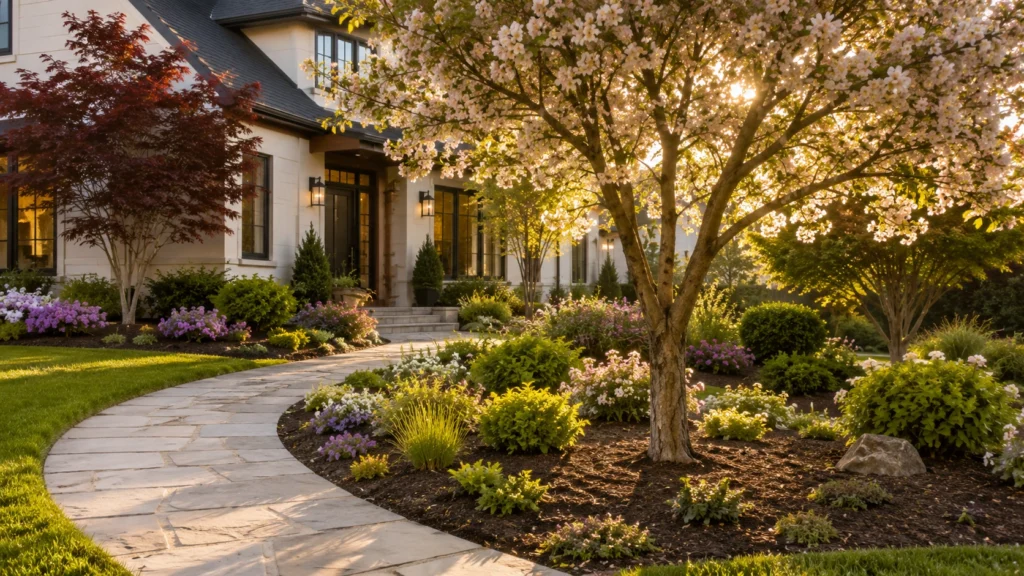
That makes them useful for everything from small suburban lots to wide front lawns.
In a thoughtful tree landscape design, an ornamental tree can serve several purposes at once.
It can:
- Create a focal point near the entrance
- Frame the house without hiding it
- Add height to otherwise flat planting beds
- Introduce spring flowers or colorful foliage
- Provide partial shade for lower growing plants
- Add privacy without creating a heavy visual barrier
- Soften driveways, sidewalks, walls, and property corners
- Connect separate areas of the front landscape
- Give the yard structure during winter
This is why landscaping with small trees often works particularly well around houses. Their scale helps bridge the visual gap between low shrubs and the height of the building.
The result feels layered rather than flat.
Start with the Architecture of Your Home
Before thinking about individual tree varieties, look at your house.
The best front yard tree landscaping ideas do not treat the building and garden as separate elements. Trees should make the architecture look better.
A symmetrical house may look polished with matching ornamental trees positioned on either side of the entrance. A cottage style house often benefits from a looser arrangement involving flowering trees, shrubs, and informal perennial beds. A modern home may look stronger with trees that have clean branching patterns and restrained planting beneath them.
Pay attention to:
- Roof height
- Window placement
- Front door location
- Driveway position
- Walkways
- Porch dimensions
- Exterior colors
- Architectural symmetry
- Existing planting beds
The ornamental tree should support these features rather than compete with them.
A beautiful tree planted directly in front of an important window, for example, may eventually create a maintenance problem. The same tree placed slightly toward a corner could frame the house beautifully.
Choose Ornamental Trees According to Mature Size
One of the easiest landscaping mistakes begins at the garden center.
Young trees look small.
That makes it tempting to plant them close to foundations, walkways, fences, or one another. A few years later, the landscape can become overcrowded.
Always design around the mature tree rather than the tree you are purchasing today.
Consider three dimensions.
Mature Height
Think about how tall the tree will eventually become.
A taller ornamental tree may work well near a two story house or toward the edge of a large lawn. Compact ornamental trees are often better near entrances, patios, sidewalks, and single story homes.
Mature Canopy Spread
Width can matter even more than height.
Imagine the mature canopy rather than the narrow nursery tree. Ask whether its branches will eventually reach the roof, driveway, road, neighboring property, or walkway.
Enough breathing room allows the natural shape of the tree to become part of the design.
Root Space
Roots also need room.
Avoid squeezing trees into narrow pockets surrounded by pavement. Healthy soil volume allows roots to establish properly and reduces competition for water.
When landscaping around tree roots, remember that roots are part of the living tree. The goal is not to bury, cut, or hide them at any cost.
Best Ornamental Trees for Front Yard Landscaping
The right species depends on your region, soil, available sunlight, mature space, and desired appearance.
Still, several ornamental tree groups are widely used in residential landscapes because they combine manageable size with strong seasonal character.
Japanese Maple
Japanese maples are valued for their elegant branching, finely textured foliage, and exceptional leaf color.
Depending on the cultivar, foliage may appear green, burgundy, red, orange, or combinations of several colors throughout the growing season.
They can work particularly well:
- Near an entry garden
- In a courtyard
- Beside a walkway
- Within a mixed shrub border
- As a lawn specimen
- In a partially sheltered front garden
Their refined appearance makes them effective focal points where people can appreciate the foliage and branching at relatively close range.
Different cultivars vary considerably in mature size, so selection matters.
Eastern Redbud
Redbuds are popular flowering landscape trees because spring flowers appear along the branches before or as new foliage develops.
Their natural branching and heart shaped leaves give them an informal character that fits cottage gardens, woodland inspired landscapes, and mixed residential plantings.
A redbud can be particularly effective near a front lawn corner, where its canopy can soften the transition between the house and surrounding landscape.
Flowering Dogwood
Flowering dogwoods have long been associated with layered residential and woodland style gardens.
Depending on the species and cultivar, they may provide spring flowers, attractive foliage, fruit, autumn color, and graceful branching.
Dogwoods can be used as specimen trees or incorporated into larger planting beds with shade tolerant shrubs and perennials.
Because growing conditions vary among dogwood types, choose one suited to your local climate and site.
Serviceberry
Serviceberry brings more than one season of interest to a landscape.
It can provide spring flowers, summer fruit, autumn foliage, and attractive branching after leaves fall.
Some forms grow as single trunk trees, while others develop multiple stems. That makes serviceberry useful for naturalistic landscaping with trees and bushes, especially when you want a softer transition between ornamental trees and shrubs.
Flowering Crabapple
Few small landscape trees create as much spring impact as a flowering crabapple.
Modern cultivars are available in different flower colors, fruit characteristics, mature shapes, and sizes.
A crabapple can work beautifully as a freestanding specimen in a lawn or as the central feature of a generous planting bed.
When selecting one, pay attention to disease resistance as well as flower color.
Ornamental Magnolia
Magnolias are known for bold flowers and strong visual presence.
Depending on the species, they may develop into compact flowering trees or considerably larger specimens. That means mature dimensions need careful consideration before planting one close to a house.
A magnolia often works best where it has enough room to become a genuine focal point rather than being repeatedly pruned into a space that is too small.
Crape Myrtle
In climates where they grow well, crape myrtles can provide long lasting summer flowers, attractive branching, and interesting bark.
Cultivars range significantly in size, so matching the mature height to the available space is essential.
They can be particularly effective along wider driveways, within lawn islands, or as accents around larger front planting beds.
How to Position Ornamental Trees in the Front Yard
Tree placement has more influence on the finished landscape than almost any decorative feature.
A good tree in the wrong location can make the yard feel cramped. A well-positioned tree can make even a simple planting scheme feel complete.
Use a Tree to Frame the House
You do not necessarily need trees on both sides of the property.
Sometimes one well-placed tree is more effective.
Place an ornamental tree toward one side of the house so its canopy visually frames the building rather than covering the facade.
This is particularly useful when:
- One side of the house appears visually empty
- The driveway dominates the opposite side
- The roofline needs visual balance
- You want to soften a tall exterior wall
The tree becomes part of the composition instead of an object sitting randomly in the lawn.
Create a Front Yard Focal Point
A specimen ornamental tree can become the main feature of the front garden.
This works especially well with trees known for noticeable flowers, colorful leaves, distinctive bark, or elegant branching.
Build a planting bed around the general area rather than leaving the tree isolated in a tiny circle.
A broader bed can include:
- Low shrubs
- Ornamental grasses
- Ground covers
- Perennials
- Spring bulbs
- Mulch
- Natural stone accents
Keep the planting closest to the trunk simple and avoid piling soil or mulch against the bark.
Use Trees to Guide the Eye Toward the Entrance
Good front yard landscaping should help people visually understand where to go.
Trees can support that movement.
For example, an ornamental tree placed near but not directly beside a walkway can attract attention toward the entrance. Repeating plants from the tree bed closer to the porch creates a visual connection.
The eye naturally moves from one repeated element to another.
This makes the landscape feel designed rather than assembled.
Soften the Driveway
Driveways often create one of the largest uninterrupted hard surfaces in a front yard.
A small ornamental tree can help reduce that visual weight.
Instead of lining the entire driveway with plants, consider one generously sized planting bed near a driveway corner.
Combine a small tree with lower shrubs and ground covers. The vertical shape of the tree breaks up the pavement while the lower planting keeps sightlines more open.
Plant for Privacy Without Creating a Wall
Front yard privacy requires balance.
You may want separation from the street, but completely hiding the house can make the property feel closed off.
Small ornamental trees provide a useful middle ground.
Their branches and foliage can partially screen:
- Front windows
- Porches
- Seating areas
- Side yards
- Neighboring properties
Unlike a solid hedge, a tree canopy can filter views while maintaining depth and light.
Front Yard Landscaping Around Trees
Once the trees are positioned correctly, the space beneath and around them needs just as much thought.
This is where many landscaping ideas around trees become either genuinely useful or unnecessarily complicated.
The tree should remain the main feature.
Everything around it should support its health and visual character.
Create a Generous Mulched Bed
A wider mulched area is usually more natural looking than a tiny ring immediately around the trunk.
Mulch can help reduce competition from turf and moderate changes in soil moisture and temperature.
Spread it over the root zone where practical, but keep it away from direct contact with the trunk.
Avoid building a mound of mulch against the bark.
A tree should visibly widen where the trunk meets the root system. Burying that area beneath deep mulch or added soil can create unhealthy growing conditions.
Build a Flower Bed Around the Tree
An around the tree flower bed can turn an ordinary lawn tree into a more integrated part of the landscape.
Choose plants according to the light conditions beneath the canopy.
A newly planted ornamental tree may allow plenty of sunlight at first. As the canopy grows, the same area may gradually receive more filtered shade.
Good planting categories may include:
- Low growing perennials
- Ground covers
- Spring flowering bulbs
- Shade tolerant foliage plants
- Compact ornamental grasses
- Small shrubs positioned farther from the trunk
Keep competition in mind. Avoid planting aggressive species directly against a young tree.
Use a Simple Tree Border
Tree border ideas range from subtle to highly decorative, but simple edges generally age better.
A clean border can separate the planting bed from the lawn and make maintenance easier.
Possible approaches include:
- A natural cut lawn edge
- Low profile metal edging
- Brick edging
- Stone edging
- Paver edging
The border should complement the materials already used around the house.
If the walkway is made from brick, for example, repeating a similar material around a tree bed can visually connect different parts of the yard.
Be Careful with Rocks Around Trees
Landscaping around trees with stone can create a clean appearance, particularly in modern or drought conscious landscapes.
However, avoid treating stones as an excuse to cover the trunk base or dramatically alter the soil level.
Large amounts of rock can also behave differently from organic mulch in hot conditions.
Use stone selectively and consider the tree species, local climate, drainage, and overall planting design.
Landscaping Around Existing Tree Roots
Mature tree roots can make landscaping more difficult because some roots naturally become visible near the soil surface.
Do not automatically cover them with deep soil.
Adding substantial amounts of soil over established roots can change the oxygen and moisture conditions around them. Cutting large roots simply to install edging, a flower bed, or decorative paving can also damage the tree.
Instead, work with the root structure.
Try these approaches:
- Expand the bed rather than forcing lawn beneath the canopy
- Apply an appropriate layer of mulch without burying the trunk
- Use small plants that require minimal digging
- Position new plants between major roots
- Avoid unnecessary excavation
- Keep heavy equipment away from the root zone
When major roots are creating structural, pavement, or safety concerns, an arborist can assess the situation before significant cutting or construction is done.
Layer Ornamental Trees with Shrubs and Perennials
The most attractive landscapes rarely rely on a single plant height.
Think in layers.
The tree creates the upper layer. Medium shrubs provide structure beneath and beside it. Perennials, ornamental grasses, and ground covers fill the lower layer.
A simple planting sequence may look like this:
- Ornamental tree as the vertical anchor
- Medium shrubs around the outer portion of the bed
- Perennials in front of the shrubs
- Ground covers along the edge
- Seasonal bulbs woven through open spaces
This method helps a garden with trees feel connected throughout the year.
It also prevents the common problem of having a beautiful tree floating above an unrelated collection of tiny plants.
Repeat Plants for a More Cohesive Landscape
More variety does not always mean better design.
When every corner contains a different plant, the front yard can start to feel visually noisy.
Repeating a few shrubs, grasses, or perennials around separate ornamental trees creates rhythm.
For example, if you use the same low flowering perennial beneath one ornamental tree and again along the walkway, the eye recognizes the repetition.
That subtle connection makes the entire landscape look more intentional.
Think About All Four Seasons
Spring flowers are attractive, but an ornamental tree occupies the front yard every day of the year.
Choose with the full calendar in mind.
Spring
Look for flowering trees, fresh foliage, or interesting new growth.
Summer
Consider canopy shape, leaf texture, shade, and the way the tree relates to surrounding flowers.
Fall
Trees with red, orange, yellow, burgundy, or bronze foliage can extend the ornamental season dramatically.
Winter
After the leaves fall, branching structure becomes visible.
Trees with attractive bark, interesting branch patterns, persistent fruit, or strong silhouettes can prevent the landscape from feeling empty.
The strongest front yard tree ideas often combine several types of seasonal interest instead of depending on one spectacular week of flowers.
Match Trees to Sunlight and Soil Conditions
Appearance should not be the only reason you choose a tree.
Growing conditions come first.
Before planting, determine:
- How many hours of direct sun the area receives
- Whether the soil drains quickly or remains wet
- Whether the site is exposed to strong winds
- How much growing space is available
- Whether irrigation is available
- Whether the soil is compacted
- Whether nearby pavement increases heat
- What conditions are typical in your climate
The most beautiful tree is the one capable of remaining healthy in the location you give it.
Trying to force a moisture loving tree into a consistently dry site or a shade preferring tree into intense afternoon sun usually creates more maintenance rather than better landscaping.
Consider Utility Lines Before Planting
Look above and below before choosing a planting location.
A tree that matures beneath overhead utility lines may require repeated pruning. Underground utilities can also affect where excavation is appropriate.
Before digging, have underground utilities properly located according to the services available in your area.
Also think about:
- Sewer and drainage lines
- Irrigation systems
- Lighting cables
- Driveway visibility
- Sidewalk clearance
- Street intersections
Good tree design includes what you cannot immediately see.
How to Plant an Ornamental Tree Correctly
Even an excellent landscape plan can fail if the tree is planted poorly.
Start with a planting hole wider than the root system but avoid making it unnecessarily deep.
The point where the trunk transitions into the main roots should remain at the appropriate level rather than being deeply buried.
After positioning the tree:
- Backfill primarily with the existing soil unless site conditions require a different approach
- Water thoroughly to settle the soil
- Mulch the surrounding area
- Keep mulch away from direct contact with the trunk
- Stake only when necessary
- Water consistently while the tree establishes
Avoid fertilizing simply because the tree is new. Planting and care should respond to actual soil conditions and the needs of the species.
Watering Newly Planted Ornamental Trees
New trees need consistent moisture while their roots establish beyond the original root ball.
Deep watering is generally more useful than repeatedly wetting only the soil surface.
How often you need to water depends on:
- Temperature
- Rainfall
- Soil texture
- Drainage
- Tree size
- Season
- Wind exposure
Check the soil rather than following an inflexible calendar.
The goal is moist soil around the developing root system without keeping it continuously saturated.
Prune for Structure, Not an Artificial Shape
Ornamental trees are often selected because of their natural form.
Allow that form to develop.
Early pruning should focus mainly on establishing healthy structure and removing damaged, dead, rubbing, or problematic branches when appropriate.
Avoid repeatedly cutting a naturally broad tree into a narrow shape simply because it was planted too close to a structure.
That is usually a placement problem disguised as a pruning problem.
Front Yard Landscaping Ideas with One Ornamental Tree
You do not need a collection of trees to make an impact.
For a small front yard, one carefully placed ornamental tree may be enough.
Try using it as the center of an asymmetrical planting bed.
Surround it with a restrained combination of shrubs, perennials, and ground covers. Extend the bed toward the walkway or foundation so that it feels attached to the rest of the landscape.
This approach creates visual depth without overcrowding the yard.
Front Yard Landscaping Ideas with Multiple Trees
Larger front yards can support several ornamental trees, but avoid spacing them like fence posts unless a formal avenue is intentional.
Natural groupings often work better.
Consider:
- One primary specimen tree
- Two smaller trees positioned farther back or to one side
- Repeating tree varieties for continuity
- Combining evergreen structure with deciduous ornamental trees
- Varying canopy heights slightly
Leave open areas between groups.
Negative space is part of landscape design. A patch of lawn, gravel, or low ground cover gives the eye somewhere to rest.
Landscaping with Trees and Bushes
Trees and shrubs should look related rather than randomly layered.
Start with the ornamental tree as the highest element.
Use shrubs to transition from its canopy toward the ground and to connect the tree with the architecture.
For example, a flowering tree may sit near the corner of the house, with medium shrubs between the tree and foundation planting. Low perennials can then soften the edge closest to the lawn.
This creates a gradual change in height.
The landscape becomes more believable because plant masses flow into one another.
Small Front Yard Tree Landscaping Ideas
Small yards benefit from editing.
Every plant occupies valuable visual and physical space, so choose trees with a mature size that fits comfortably.
Good strategies include:
- Use one distinctive ornamental tree as the main feature
- Keep the lower planting palette simple
- Avoid placing trees directly in front of important windows
- Connect tree beds with foundation beds where practical
- Use curved or gently flowing bed lines rather than multiple isolated circles
- Repeat two or three plant types
- Preserve some open ground around the composition
A small front yard does not need to look miniature.
It needs proportion.
Common Front Yard Tree Landscaping Mistakes
Several mistakes appear repeatedly in residential landscapes.
Planting Too Close to the House
The tree looks appropriately sized when young, but branches eventually press against siding, windows, gutters, or roofing.
Plan according to mature canopy spread.
Making Tiny Mulch Circles
A narrow ring can make the tree appear disconnected from the overall design.
Where space allows, create a more generous planting area that relates to nearby beds.
Piling Mulch Against the Trunk
More mulch is not automatically better.
Keep the trunk base visible and avoid building a deep mound around it.
Covering Existing Roots with Soil
Visible roots can be inconvenient, but burying them under substantial soil is not necessarily a safe solution.
Adapt the landscaping around the roots rather than automatically changing their soil depth.
Choosing Trees Only for Flowers
Flowers may last for a limited portion of the year.
Consider foliage, form, bark, fruit, mature size, and winter structure as well.
Ignoring Maintenance
A tree that constantly requires pruning to fit its location is probably not the right tree for that location.
Select according to the space available.
Using Too Many Focal Points
If every tree, shrub, planter, boulder, and flower bed demands attention, none of them truly stands out.
Choose one or two dominant features and let the remaining landscape support them.
How to Create a Natural Looking Tree Landscape Design
Natural does not mean random.
A well-composed landscape may appear relaxed while still following clear design principles.
Start with one visual anchor.
That may be a flowering ornamental tree.
Then build outward.
Add shrubs in small groups instead of scattering individual plants. Repeat selected perennials. Allow bed shapes to connect visually with the house and walkway. Leave enough open space for each plant to mature.
Most importantly, do not try to finish the landscape by filling every empty spot.
Plants grow.
A landscape with enough room to develop often looks better after several seasons than one that appeared completely full on planting day.
A Simple Front Yard Ornamental Tree Layout
For a typical residential front yard, a practical arrangement might include:
- One medium ornamental tree positioned toward an outer corner of the house
- A broad planting bed extending from the tree toward the foundation
- Several medium shrubs used as structural plants
- Repeated flowering perennials along the front of the bed
- A low ground cover around selected open areas
- Mulch surrounding the tree and plant groupings
- A second smaller planting bed near the walkway using some of the same plants
This type of layout connects the tree, house, and entrance without making the yard feel overly decorated.
How to Make Landscaping Around Trees Look Finished
The secret is usually not adding more features.
It is improving the relationships between the features already there.
A tree bed tends to look finished when:
- Its size matches the scale of the tree
- The border is clean
- Mulch depth is appropriate
- The trunk is not buried
- Plants are grouped rather than scattered
- Plant heights transition naturally
- Colors repeat elsewhere in the yard
- Weeds are controlled
- The tree retains enough open root space
- Materials coordinate with the house
Good landscaping rarely depends on novelty.
It depends on proportion, repetition, and care.
Conclusion
Front yard landscaping with ornamental trees works best when the tree is treated as part of the entire landscape rather than simply planted in an empty patch of lawn.
Start with the conditions of your property. Study the house, sunlight, soil, mature space, walkways, driveway, utilities, and existing plants. Choose an ornamental tree whose mature size fits the location, then use shrubs, perennials, ground covers, mulch, and carefully defined beds to connect it with the rest of the yard.
Whether you are exploring landscaping with small trees, redesigning an existing tree base, creating flower beds around trees, or developing a complete landscape plan with trees, the same principle applies.
Give the tree room to become what it was meant to be.
A successful front yard does not need dozens of dramatic features. Sometimes one beautifully placed flowering tree, surrounded by a few thoughtfully repeated plants, can change the entire character of a home.
That is the approach we value at Front Yard Landscaping Ideas: practical planting decisions first, decoration second, and a landscape that becomes better as it grows.
Frequently Asked Questions
What is the best way to landscape a front yard with ornamental trees?
Choose ornamental trees based on mature size, climate, sunlight, soil, and available root space. Position them to frame the house or create a focal point without blocking important views. Create a generous planting bed around the tree and combine it with shrubs, perennials, ground covers, or mulch while keeping the trunk base clear.
What are good ornamental trees for a front yard?
Popular choices include Japanese maple, redbud, flowering dogwood, serviceberry, flowering crabapple, magnolia, and crape myrtle in suitable climates. The best choice depends on your region and the specific growing conditions of your yard.
Where should I plant an ornamental tree in the front yard?
Good locations include an outer corner of the house, a lawn island, beside a front walkway, or near the driveway where the mature canopy has enough room. Avoid planting according to the tree’s current nursery size. Use its expected mature height and spread when choosing the location.
How do I landscape around a front yard tree?
Create a properly sized bed around the tree, apply mulch without piling it against the trunk, and add plants suited to the available sunlight and moisture. Use low ground covers, perennials, bulbs, grasses, or small shrubs while minimizing disturbance to major roots.
What can I put around a tree instead of grass?
Mulch, compatible ground covers, shade tolerant perennials, low ornamental grasses, and carefully positioned shrubs can replace difficult turf beneath a tree. Choose plants that suit the light and moisture conditions under the canopy.
Is it good to put rocks around trees?
Rocks can be used as part of landscaping around trees, but they should not be piled against the trunk or used to bury exposed roots. Consider heat, drainage, tree species, and local climate before using stone over a large portion of the root area.
Can I create a flower bed around an ornamental tree?
Yes. A flower bed around a tree can make the tree feel integrated with the rest of the landscape. Select plants according to the amount of sun beneath the canopy and avoid excessive digging around major roots.
Should I cover exposed tree roots with soil?
Generally, avoid adding a deep layer of soil over established roots without professional guidance. Significant changes in soil depth can alter oxygen and moisture conditions. Mulching and adjusting the surrounding landscape are often more practical approaches.
How large should a landscape bed around a tree be?
There is no single size that works for every tree. A broader bed that relates to the tree’s canopy and surrounding landscape usually looks more natural than a tiny circle around the trunk. Available space, existing roots, and the overall yard design should determine the final shape.
How do you landscape a small front yard with trees?
Use one or a few appropriately sized ornamental trees rather than trying to fit large species into limited space. Keep the planting palette simple, repeat plants throughout the yard, connect beds visually, and preserve open space so the landscape does not feel crowded.
How can ornamental trees improve curb appeal?
Ornamental trees add height, structure, seasonal color, flowers, foliage texture, and visual balance. Proper placement can frame the house, emphasize the entrance, soften driveways, and make foundation plantings feel connected to the broader yard.
Can ornamental trees be planted near a house?
They can, provided their mature height, canopy spread, roots, and maintenance needs are appropriate for the available space. Do not choose the planting distance based only on the size of a young tree. Consider what the tree will look like after years of growth.
What plants look good under ornamental trees?
The right plants depend on the amount of light and moisture available beneath the tree. Ground covers, spring bulbs, shade tolerant perennials, compact grasses, and small shrubs can all work. Choose plants that complement rather than compete with the tree.
Should front yard trees match each other?
Not necessarily. Repeating the same species can create a formal or cohesive look, while using different but compatible trees can produce a more natural landscape. The important factors are mature scale, form, color, and how the trees relate to one another.
How many ornamental trees should I plant in my front yard?
The number depends on the size of the property and the mature dimensions of each tree. A small yard may look best with one specimen tree, while a larger front landscape can support several trees arranged in balanced groups. Avoid adding trees simply to fill empty space.
What is the most important rule when designing a landscape with trees?
Design for mature growth. Give every tree enough space for its canopy and roots, position it in suitable environmental conditions, and allow surrounding plants to support rather than overwhelm it. A landscape designed around mature proportions is easier to maintain and usually becomes more attractive with age.

Sara Bendrick believes your yard should be a place you actually look forward to coming home to. A licensed and bonded design-build contractor (C-27 #1006161), she founded Sarita Landscape Designs and has spent over twelve years designing residential outdoor spaces across Southern California with a real soft spot for curb appeal and low-water, no-lawn designs.
When she’s not on a job site, Sara’s on camera or on stage. She’s hosted yard-renovation shows including I Hate My Yard, Build It Like Bendrick, and Lawn & Order, written Big Impact Landscapes, given two TEDx talks, and serves as a spokesperson for Stihl. Her mission is simple, help people see the potential in the yard they already have.