
Start by improving what you already have before buying anything new. Clean the yard, remove weeds, trim overgrown shrubs, define planting beds, refresh tired soil, and add a layer of affordable mulch. Then focus your money on a few plants that give the biggest visual impact, choosing native, drought tolerant, or low maintenance varieties that suit your local growing conditions. Reuse existing stones, containers, edging, and healthy plants whenever possible, and consider growing from seeds, dividing perennials, or trading plants with friends and neighbors. Instead of landscaping the entire property at once, divide the project into small phases. A simple pathway, fresh mulch, a small tree, attractive shrubs, and well placed ground cover can transform the appearance of a front yard without a large investment. The goal is not to spend more. It is to create structure, repetition, healthy planting, and strong curb appeal with every dollar you spend.
A budget friendly front yard does not have to look cheap. In fact, the most attractive landscapes often come from making a few deliberate decisions rather than filling every available space with expensive plants and hardscape.
That is the idea behind Front Yard Landscaping Ideas. A successful front yard starts with good planning, not a big shopping trip. Once you understand how to work with your existing space, soil, sunlight, plants, and architecture, you can make affordable improvements that feel intentional and complete.
Table of Contents
Start With a Simple Front Yard Landscape Plan
The easiest way to waste money on landscaping is to buy first and plan later.
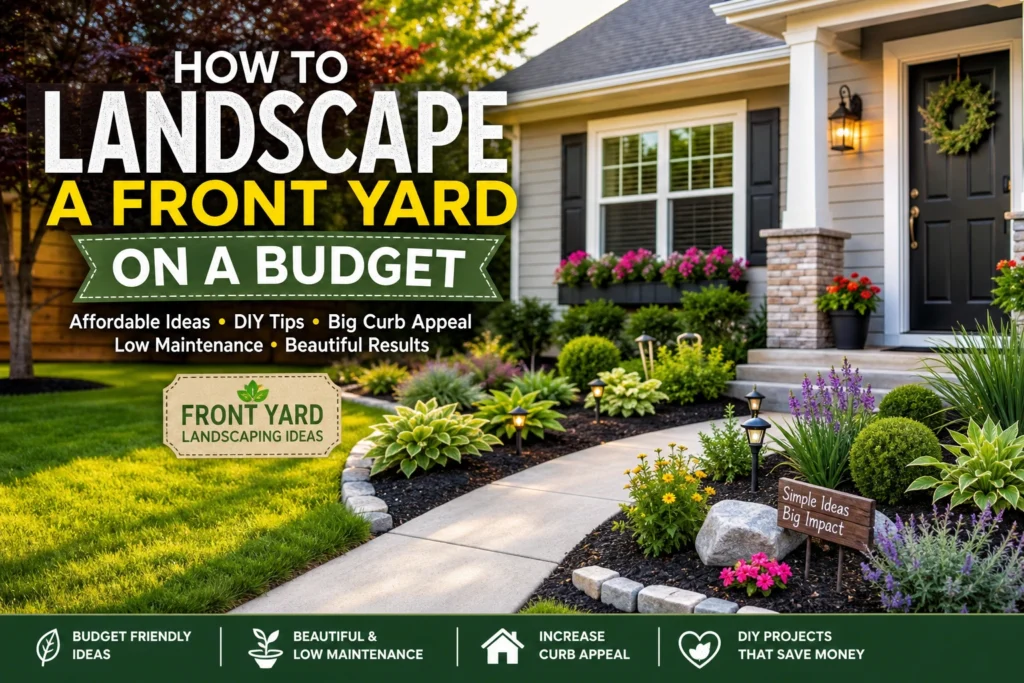
Before visiting a garden center, stand across the street and look at your property as a whole. Notice where the front door sits, how people naturally approach the house, where the lawn begins and ends, and which areas already look attractive.
Take a few photographs from different angles. Then make a basic sketch of the front yard.
You do not need professional landscape design software. A sheet of paper is enough.
Mark the driveway, walkway, front entrance, existing trees, utility features, planting beds, fences, and areas that receive full sun or shade. Also note slopes and places where water tends to collect.
This small planning exercise helps you avoid one of the most expensive landscaping mistakes, buying plants that do not suit the conditions. Professional garden designers commonly emphasize understanding sunlight, soil, climate, and the existing site before selecting plants.
Your plan should answer five basic questions.
Where should people walk?
Where should the main planting beds go?
What areas should remain lawn?
Where do you need height and privacy?
Which features deserve attention from the street?
Once those questions are answered, your budget has a purpose.
Clean Up the Existing Yard Before Spending Money
Cleaning is one of the cheapest ways to create a dramatic front yard transformation.
Remove weeds, dead branches, broken containers, unwanted volunteer plants, litter, and anything that makes the landscape look neglected. Cut back shrubs that have become too large for their location. Mow and edge the lawn. Rake leaves and remove old debris from planting beds.
Do not automatically remove every existing plant.
A healthy shrub can often be reshaped. An established perennial can be divided into several smaller plants. Existing stones can become edging. Old containers can be cleaned and reused.
Think of your current landscape as an inventory of materials you already own.
This approach is especially important on a small landscaping budget because mature plants can provide more visual impact than several newly purchased specimens.
A front yard does not become attractive simply because it contains more plants. It becomes attractive when the plants, lawn, pathways, and architectural features appear organized.
Define Your Planting Beds With Clean Edges
One of the most affordable front yard landscaping ideas is also one of the most effective.
Create clear boundaries between lawn and planting beds.
A sharply defined bed makes the entire yard look more finished. You can create curved or gently flowing borders, but avoid making every edge a different shape. Repeating similar curves creates visual rhythm and makes the landscape easier to maintain.
You do not necessarily need expensive metal or stone edging.
A properly cut natural edge can look excellent. Affordable plastic edging, bricks, reclaimed stone, or other suitable materials can also define a bed when installed carefully.
Keep the design consistent with the style of your home. A simple suburban house may look better with broad sweeping beds than with a complicated collection of tiny planting islands.
The objective is structure.
When the edges are clean, even inexpensive plants can look more intentional.
Use Mulch to Create an Instant Finished Look
Fresh mulch is one of the easiest ways to make a budget front yard look polished.
Mulch helps unify planting beds, suppresses weeds, helps the soil retain moisture, and creates visual contrast around plants. More importantly for a low cost landscape, it can make a recently renovated bed look complete even when the plants are still small.
Apply mulch evenly and keep it away from the direct contact of tree trunks and plant stems.
You can compare different mulch types in your area based on price, availability, appearance, and how often they need to be refreshed. Organic materials can also contribute to soil improvement as they break down.
Do not make the mulch layer excessively deep simply because more material appears more finished. Good installation matters more than creating a thick mound.
If your budget is limited, spend enough to create a consistent appearance across the most visible planting beds rather than covering every possible corner of the property.
Spend More on the Right Plants, Not More Plants
Plant shopping can quickly consume a landscaping budget.
The solution is not to avoid plants. It is to buy fewer plants with a clearer purpose.
Choose plants that perform well in your climate and site conditions. Native plants, drought tolerant plants, long lived perennials, and proven low maintenance shrubs can be especially useful because the right
can reduce replacement, watering, and maintenance costs over time.
Current gardening guidance also highlights perennials as a money saving choice because many return each year, while suitable native and drought tolerant varieties can reduce ongoing care.
Instead of buying ten different plants, consider a simple planting palette.
One structural shrub can be repeated several times.
One flowering perennial can be planted in groups.
One ground cover can connect the spaces between larger plants.
One evergreen or other year round plant can provide structure when seasonal flowers disappear.
Repetition makes inexpensive planting look designed.
Choose Plants for the Right Place
A beautiful plant in the wrong location is not a bargain.
Before purchasing anything, determine whether the site receives full sun, partial shade, or deep shade. Consider drainage, soil conditions, wind exposure, mature plant size, and the amount of maintenance you are realistically willing to provide.
A plant that needs constant irrigation will not be a low cost choice in a dry climate.
A large shrub planted beneath a low window may eventually require repeated pruning.
A species that dislikes wet soil may decline in a poorly drained planting bed.
Likewise, a plant that outgrows its space can eventually create an expensive removal problem.
Choose for the conditions you already have rather than trying to force your yard to become something it naturally is not.
That principle is one of the strongest ways to make a front yard both affordable and sustainable.
Buy Smaller Plants and Let Them Grow
Larger plants provide instant impact, but they usually cost more.
When your budget allows more patience than money, smaller plants can be an excellent strategy.
A young shrub or perennial can establish itself and gradually fill the landscape. It may take longer to create the finished appearance, but your initial investment can be significantly lower.
The key is to understand the mature size of the plant.
Buying small does not mean planting everything too close together. Leave enough room for the plants to reach their mature dimensions without crowding one another.
You are investing in the landscape over time rather than purchasing the final photograph on day one.
This is especially useful when landscaping a front yard in phases.
Propagate, Divide, Swap, and Grow From Seed
One of the best budget landscaping strategies is to create more plants from plants you already have.
Many established perennials can be divided. Some plants can be propagated from cuttings, while annuals and many flowers can be started from seed.
Ask friends, neighbors, gardening groups, or family members whether they have extra divisions from healthy plants.
Plant swaps can turn a very small budget into a surprisingly diverse garden. Gardening communities can also be a useful source of affordable plants, containers, compost materials, and local knowledge.
Current budget gardening advice continues to highlight plant propagation, seed sharing, plant swaps, and growing from inexpensive starts as practical ways to reduce garden costs.
Just make sure any plant you receive is suitable for your area and does not carry pests, diseases, or invasive characteristics.
Create a Simple Layered Planting Design
A front yard looks fuller and more sophisticated when plants are arranged in layers.
Start with the tallest elements.
These might include small ornamental trees, larger shrubs, or other plants that establish height.
Next, add medium sized plants.
Then use smaller perennials and ground covers near the front of the bed.
This creates depth without requiring dozens of species.
A useful approach is to think in terms of three visual levels.
Height creates structure.
Middle planting creates volume.
Ground level planting softens the edges.
The exact plants will depend on your climate and local conditions, but the design principle is widely applicable.
Avoid filling every gap immediately. Young plants often look too small at first, but the landscape changes as they mature.
Use Repetition to Make Cheap Landscaping Look Expensive
One plant repeated several times usually looks more intentional than a collection of unrelated plants.
Choose two or three main plant types and repeat them through the front yard.
For example, a simple planting bed might use evergreen shrubs as anchors, flowering perennials for seasonal color, and a low ground cover along the front edge.
Repeat the same combination near the walkway or another visible area.
This connects different parts of the property and creates a sense of continuity.
Professional landscape designers often warn against overplanting with too many unrelated species because excessive variety can make a yard visually cluttered.
Budget landscaping benefits from restraint.
You are not trying to display everything the garden center sells.
You are creating a composition.
Improve the Front Walkway Without Rebuilding Everything
A new walkway can be expensive, but improving the appearance of an existing walkway can be much cheaper.
Start by cleaning it thoroughly.
Remove weeds from cracks and edges. Repair minor defects where practical. Add planting beds along both sides if space allows. Use consistent edging or ground cover to give the path a stronger visual boundary.
If a completely new path is necessary, consider lower cost materials suited to your climate and site conditions.
Gravel, stepping stones, brick, or other simple materials can sometimes create an attractive route without the expense of a large custom hardscape installation.
The pathway should guide the eye toward the entrance.
Avoid making the path disappear behind oversized plants.
The front door should remain the visual destination.
Give the Front Door More Attention
The front door is one of the strongest focal points in a front yard.
You do not need an expensive renovation to improve it.
Create a clean approach.
Frame the entry with appropriately sized plants.
Keep steps and walkways clear.
Use containers where they make sense.
Refresh tired surfaces.
Make sure the address is easy to see.
Then look at the space from the street.
The goal is to create a visual progression from street to walkway to front door.
A few well placed plants around the entrance can have more impact than dozens scattered across the lawn.
Refresh the Lawn Instead of Replacing It
Replacing an entire lawn can become an expensive project.
When the existing lawn is reasonably healthy, start with basic maintenance.
Mow at the correct height for the grass type. Improve soil conditions where necessary. Address compacted areas. Reseed thin patches when appropriate. Remove weeds and maintain clean edges around beds and paths.
You can also reduce the amount of lawn over time.
Large expanses of grass require mowing and, depending on the climate, substantial water and maintenance.
Turning an awkward corner into a planting bed can reduce lawn area while making the front yard more interesting.
The goal is not necessarily to eliminate grass.
It is to make every part of the landscape serve a purpose.
Consider Ground Covers for Difficult Areas
Ground covers can be useful beneath trees, along bed edges, on slopes, or in areas where traditional lawn performs poorly.
The right ground cover can reduce exposed soil and help suppress weeds after establishment.
However, plant selection matters.
Some vigorous ground covers spread aggressively and may be inappropriate in certain regions. Always check local recommendations before planting.
Drought tolerant ground covers can be particularly useful in suitable climates, where they may provide color and foliage with less irrigation once established.
Use ground cover as part of a larger planting design rather than treating it as a universal solution.
Reuse Materials You Already Have
Budget landscaping becomes much easier when you stop thinking like a shopper and start thinking like a designer.
Old bricks can become edging.
Unused containers can become focal points.
Existing rocks can define planting beds.
An old bench can become a garden feature after cleaning and repair.
Wood from appropriate sources can sometimes be reused for simple garden structures.
Before buying something new, walk around your property and inspect what is already available.
A landscape does not need every component to match perfectly. It needs the overall composition to feel deliberate.
That difference is important.
Affordable does not have to mean temporary.
Add a Small Tree for Long Term Impact
A small tree can become one of the most valuable visual elements in a front yard.
Trees provide height, seasonal interest, shade, structure, and a sense of maturity.
But do not select a tree solely because it looks beautiful at the garden center.
Consider its mature height and width, root characteristics, proximity to structures and utility lines, sunlight requirements, and local climate.
One correctly chosen tree can contribute more to the long term character of a front yard than a large collection of temporary decorative plants.
Plant it where it has room to develop.
Think twenty years ahead, not just next spring.
Use Affordable Lighting Strategically
Outdoor lighting can dramatically improve a front yard after sunset, but you do not need to illuminate everything.
Start with safety and orientation.
A few appropriately positioned pathway lights can make a walkway easier to navigate.
A small number of accent lights can highlight a tree, architectural feature, or focal planting.
Warm lighting often creates a more welcoming residential atmosphere than harsh, overly bright illumination.
Keep fixtures simple and focus attention on the most important features.
Good lighting is about placement and restraint.
Lighting every shrub can increase both the initial cost and ongoing visual clutter.
Make the Front Yard More Wildlife Friendly
A budget friendly landscape can also support birds, pollinators, and other wildlife.
Choose locally appropriate flowering plants, provide varied vegetation, and avoid unnecessary chemical use.
A mixed planting design often provides more ecological value than a yard dominated by a single plant species.
Hedges can also serve as shelter and habitat for wildlife while helping define the property.
The Royal Horticultural Society recommends using planting areas, hedges, permeable materials, and otherwise unused spaces to make front gardens greener and more wildlife friendly.
You do not need to create a formal wildlife garden.
A few thoughtful choices can make a difference.
Build the Landscape in Phases
Trying to complete everything in one weekend is one of the fastest ways to overspend.
Instead, divide the project into phases.
Phase one should focus on cleanup, pruning, lawn care, bed definition, and mulch.
Phase two can introduce the main shrubs and structural plants.
Phase three can add perennials, ground cover, containers, or a small tree.
Phase four can improve lighting, decorative details, and other finishing touches.
This approach lets you evaluate the yard as it develops.
It also keeps mistakes inexpensive.
If a plant does not perform well, replacing one or two plants is far easier than redesigning an entire property.
Create a Budget Before You Shop
Give every landscaping dollar a job.
Start by deciding how much you can comfortably spend.
Then divide your budget between the elements that will have the greatest visible impact.
For many homeowners, the most useful priorities are cleanup, bed definition, mulch, structural plants, seasonal color, pathways, and lighting.
You do not need to follow one universal percentage.
The right allocation depends on the condition of your yard.
A neglected yard may benefit most from cleanup and soil preparation.
A relatively tidy yard may need only planting and a stronger focal point.
A small front garden may benefit more from containers and vertical planting than from expensive hardscaping.
Recent budget landscaping guides similarly emphasize simple improvements such as cleanup, planting, mulch, edging, gravel, and small curb appeal upgrades rather than complete high cost renovations.
A Practical Budget Friendly Front Yard Example
Imagine a small front yard with patchy grass, two overgrown shrubs, a plain concrete walkway, and an empty planting bed.
A sensible transformation does not begin with a full landscape renovation.
First, remove weeds and dead growth.
Next, reshape or remove the shrubs that have become too large.
Then define the planting bed with a clean edge.
Add a consistent mulch layer.
Plant a small group of repeating perennials and one or two suitable shrubs.
Refresh the walkway edges.
Add a simple focal point near the entrance.
Finally, improve the most visible area with subtle lighting.
The result may cost far less than a full professional redesign while still producing a noticeable improvement in curb appeal.
The important part is that every change reinforces the same design.
Common Budget Landscaping Mistakes to Avoid
The biggest mistake is buying plants without a plan.
The second is planting too many varieties.
The third is choosing plants based only on appearance rather than site conditions.
Another common problem is spending heavily on decorative features while neglecting basic cleanup, soil preparation, edging, and plant health.
Avoid creating narrow planting beds that are difficult to maintain.
Do not place large shrubs where they will eventually block windows, walkways, signs, or sight lines.
Do not cover every inch of the property simply because there is empty space.
And do not assume that the cheapest plant is the cheapest choice. A plant that dies, requires constant care, or becomes too large for its location can cost more over time.
Budget landscaping is about value, not merely low prices.
How to Make a Cheap Front Yard Look Expensive
The secret is consistency.
Use a limited plant palette.
Repeat important plants.
Keep edges clean.
Maintain healthy mulch beds.
Create a clear walkway.
Give the entrance a focal point.
Use plants at different heights.
Keep mature plant sizes in mind.
Hide unnecessary clutter.
Maintain the lawn and shrubs regularly.
These details create a finished appearance.
A small number of healthy, well placed plants usually looks better than a crowded garden filled with random purchases.
This is why thoughtful front yard landscaping ideas can outperform expensive materials when the overall design is strong.
Low Cost Front Yard Landscaping Ideas for Small Spaces
Small front yards can be easier to landscape on a budget because they require fewer materials.
Use narrow planting beds along the walkway.
Take advantage of vertical space near suitable walls and fences.
Choose compact shrubs that do not overwhelm the house.
Use containers where permanent planting is impractical.
Create one strong focal point instead of several competing ones.
A small tree or architectural plant can establish scale.
Ground covers can soften hard edges.
You can also use the area beside a driveway, beneath a window, or along a fence as planting space rather than leaving it completely unused.
The RHS recommends making use of otherwise overlooked planting areas and combining greenery with practical parking and access needs.
Low Maintenance Choices That Protect Your Budget
A beautiful landscape becomes expensive when it constantly demands watering, pruning, replacement, and pest control.
Choose plants that fit your lifestyle.
If you travel frequently, prioritize dependable low maintenance plants.
If water is limited, choose appropriate drought tolerant species.
If you dislike heavy pruning, avoid shrubs that require frequent shaping.
If you want seasonal color, combine flowering perennials with plants that provide foliage and structure outside the main bloom period.
The best low maintenance landscape is not necessarily the one with the fewest plants.
It is the one with the right plants in the right places.
Final Checks Before You Call the Project Finished
Stand at the street and take another photograph.
Look at the front yard from the same angle you used before beginning.
Ask yourself whether the entrance is easy to find.
Are the beds clearly defined?
Do the plants look balanced?
Is the lawn intentionally shaped?
Are there empty areas that need attention, or are they simply spaces that should remain open?
Are any plants likely to outgrow their locations?
Does the landscape look coherent rather than crowded?
This final step is valuable because homeowners often stop noticing problems when they spend too much time working inside the yard.
The street view tells the truth.
Conclusion
Learning how to landscape a front yard on a budget is less about finding the absolute cheapest materials and more about spending wisely.
Start with the landscape you already have. Clean it thoroughly, protect healthy existing plants, define planting beds, improve the soil, and use mulch to create a polished foundation. Then invest in a small number of plants that are well suited to your climate, sunlight, soil, and maintenance preferences.
Use repetition, layering, and clear sight lines to make the landscape feel intentionally designed. Reuse materials, propagate plants, buy smaller specimens when practical, and complete the project in phases rather than trying to finish everything at once.
A beautiful front yard does not require an enormous budget.
It requires a clear plan, suitable plants, thoughtful placement, and consistent maintenance.
That is the philosophy behind Front Yard Landscaping Ideas. The best landscape is not the one that costs the most. It is the one that makes the property feel welcoming, balanced, healthy, and cared for.
Frequently Asked Questions
What is the cheapest way to landscape a front yard?
The cheapest approach is usually to improve what you already have. Start with cleanup, pruning, lawn maintenance, bed definition, and mulch. Then add a small number of affordable plants suited to your growing conditions. Reusing existing materials and propagating or dividing plants can reduce costs further.
How can I landscape my front yard with very little money?
Focus on changes with a high visual impact. Clean the yard, create defined planting beds, add mulch, repair the lawn, prune overgrown shrubs, and use a few repeated plants. You can also grow plants from seed, divide existing perennials, swap plants, and reuse containers or hardscape materials.
What are the best low cost front yard landscaping ideas?
Some of the most practical ideas include adding mulch, defining bed edges, planting affordable perennials, using native plants, improving an existing walkway, reducing unnecessary lawn, adding ground cover, reusing containers, and placing a small number of lights around the entrance or pathway.
Is mulch cheaper than landscaping with rock?
The answer depends on local material and delivery prices. Mulch is often a practical budget choice for planting beds because it creates an immediate finished appearance and can be replaced or refreshed relatively easily. Rock may have a higher initial material cost but can have different maintenance characteristics. Compare local prices before deciding.
What plants are best for landscaping on a budget?
The best plants are those that perform reliably in your local conditions and do not require excessive maintenance. Native plants, long lived perennials, drought tolerant plants where appropriate, and proven low maintenance shrubs are often strong choices. Always consider mature size, sunlight, soil, drainage, and local climate before buying.
How do I make a small front yard look bigger?
Keep the layout simple, avoid excessive plant variety, and create clear sight lines toward the entrance. Use layered planting with taller plants toward the back and lower plants toward the front. Repeating a small number of plant types can also make the space feel more connected and organized.
Should I remove my front lawn to save money?
Not necessarily. If the lawn is reasonably healthy, improving and reshaping it may be cheaper than removing it completely. However, reducing lawn in areas that are difficult to mow, poorly drained, heavily shaded, or rarely used can make the landscape easier to maintain over time.
How can I make my front yard look expensive on a budget?
Focus on design rather than expensive materials. Keep planting beds clean and well defined, repeat a small number of plants, use mulch consistently, maintain healthy foliage, create a strong pathway to the entrance, and avoid visual clutter. Good proportions and maintenance often create more impact than expensive features.
How often should I update budget landscaping?
A good landscape should not need a complete redesign every year. Most changes can be made gradually as plants mature. Regular pruning, mulching, weeding, lawn care, and replacement of unsuccessful plants will keep the yard looking fresh while allowing larger improvements to happen over several seasons.
Can front yard landscaping increase curb appeal without costing much?
Yes. Simple improvements can make a noticeable difference. Current home and garden guidance frequently highlights low cost upgrades such as cleaning, planting, edging, mulch, walkway improvements, and other small exterior changes as effective ways to improve curb appeal.
What should I landscape first in my front yard?
Start with the areas that are most visible from the street and the areas that influence how people approach the home. Usually this means the front entrance, walkway, main planting beds, lawn edges, and any obvious problem areas. Fix the foundation first, then add decorative elements.
Is professional landscaping necessary for a budget front yard?
No. Many simple landscaping projects can be completed by homeowners when the work involves cleanup, planting, mulching, edging, and basic maintenance. Professional help becomes more valuable when the project involves major grading, drainage, complex retaining walls, extensive hardscaping, or large mature trees.

Sara Bendrick believes your yard should be a place you actually look forward to coming home to. A licensed and bonded design-build contractor (C-27 #1006161), she founded Sarita Landscape Designs and has spent over twelve years designing residential outdoor spaces across Southern California with a real soft spot for curb appeal and low-water, no-lawn designs.
When she’s not on a job site, Sara’s on camera or on stage. She’s hosted yard-renovation shows including I Hate My Yard, Build It Like Bendrick, and Lawn & Order, written Big Impact Landscapes, given two TEDx talks, and serves as a spokesperson for Stihl. Her mission is simple, help people see the potential in the yard they already have.