
The best landscape lighting ideas for front yards combine pathway lights, tree uplighting, architectural accent lighting, front door lighting, driveway lights, garden bed illumination, step lights, and soft downlighting to make the home safer, more welcoming, and more attractive after dark.
The secret is not simply adding more outdoor lights. A beautiful front yard lighting design uses different types of light at different heights and intensities. Pathway lights guide people toward the entrance. Uplights emphasize trees and architectural details. Soft accent lights add depth to flower beds and shrubs. Well placed porch and entry lights make the front door feel warm and inviting.
When these elements work together, your front yard does not look overly bright or staged. It simply looks finished.
At Front Yard Landscaping Ideas, we believe outdoor lighting should be treated as part of the landscape rather than an afterthought. Your plants, walkway, driveway, trees, exterior walls, steps, and front entrance all play a role in the nighttime view of your property.
This guide covers the best front yard landscape lighting ideas, along with practical tips for choosing fixtures, positioning lights, avoiding glare, and creating an exterior lighting plan that complements your home.
Table of Contents
Why Front Yard Landscape Lighting Matters
A carefully planned front yard may look beautiful during the day, but without outdoor lighting, much of that detail disappears after sunset.
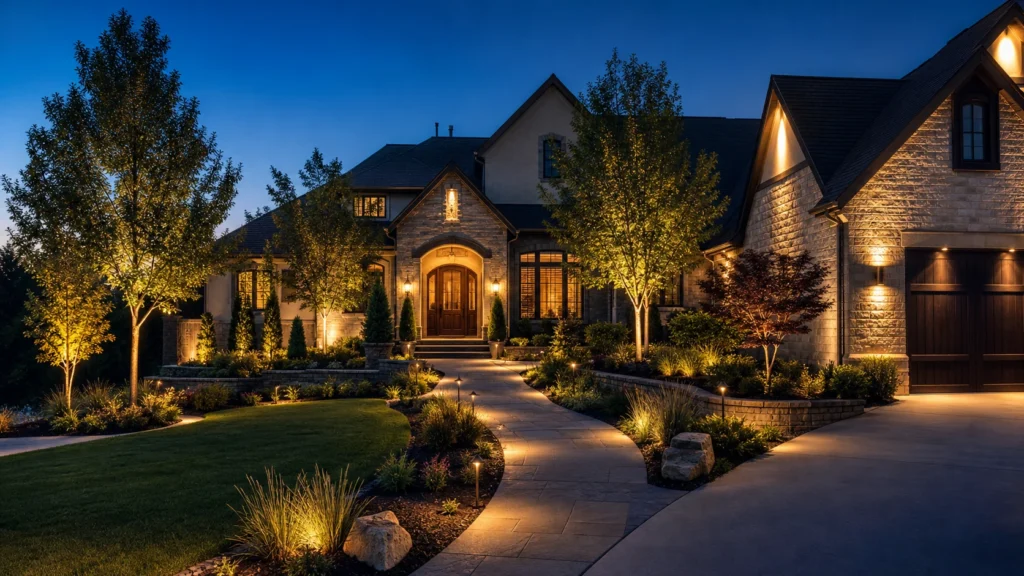
Landscape lighting allows you to create a second version of your yard for nighttime.
It can improve several aspects of the property at once.
- Highlight architectural features of the house
- Illuminate pathways and steps
- Improve visibility around the driveway and entrance
- Showcase trees, shrubs, garden beds, and ornamental plants
- Create a welcoming route toward the front door
- Add depth and dimension to the landscape
- Support home security without turning the yard into a brightly lit parking lot
- Improve nighttime curb appeal
The best results generally come from layered lighting rather than relying on one powerful porch light or floodlight. Designers often combine pathway lighting, accent lighting, uplighting, and other sources to create depth while keeping glare under control.
Best Front Yard Landscape Lighting Ideas
Every home has a different architectural style and landscape layout, so there is no single lighting arrangement that works everywhere.
However, the following front yard lighting ideas can be adapted to traditional, contemporary, cottage, farmhouse, Mediterranean, modern, and minimalist homes.
1. Use Pathway Lights to Create a Welcoming Entrance
Pathway lighting is one of the most practical places to begin.
Small outdoor path lights positioned beside the walkway provide enough illumination for visitors to see where they are going while also visually connecting the sidewalk, driveway, or gate with the front entrance.
Path lights work particularly well along:
- Stone walkways
- Concrete paths
- Paver paths
- Curved garden paths
- Stepping stones
- Front garden borders
- Walkways between a driveway and front porch
Avoid placing identical fixtures in a perfectly straight line on both sides of the path unless the formal appearance suits your landscape.
A slightly staggered arrangement often feels more natural. The goal is to illuminate the walking surface rather than create a row of visible bulbs.
Downward facing path lights can also reduce uncomfortable glare while directing light where it is actually needed. Path lights are commonly used to illuminate walkways while simultaneously accenting nearby landscaping.
2. Uplight Front Yard Trees
A mature tree can become one of the most dramatic nighttime features in a front yard.
Tree uplighting involves positioning a spotlight or well light near the base of the tree and directing the beam upward through the trunk and canopy.
The technique works beautifully with trees that have interesting bark, branching structures, or distinctive foliage.
Good candidates can include:
- Japanese maple
- Oak
- Olive tree
- Birch
- Magnolia
- Palm
- Crepe myrtle
- Ornamental cherry
- Multi trunk specimen trees
One uplight may be enough for a small ornamental tree. A large mature tree may look better with several fixtures positioned around it.
Changing the lighting angle can dramatically change the effect.
A narrow beam emphasizes height and trunk texture. A broader beam illuminates more of the canopy.
The important part is restraint. You want the tree to emerge naturally from the darkness rather than appear as though a stadium spotlight has been pointed at it.
3. Highlight the Architecture of the House
Your landscaping and house should feel like one composition.
Exterior house lighting can highlight architectural features that disappear at night, including:
- Stone walls
- Brickwork
- Columns
- Arches
- Gables
- Dormers
- Textured siding
- Chimneys
- Entry columns
- Interesting rooflines
Small landscape spotlights positioned near the foundation can direct light toward carefully selected sections of the facade.
The mistake is illuminating every square foot.
Instead, decide which parts of the architecture deserve attention and allow some areas to remain darker.
Contrast creates depth.
Without shadow, even an expensive house can look flat at night.
4. Make the Front Door the Visual Destination
When someone looks at your home from the street, the front entrance should be easy to identify.
Front door lighting can create that visual destination.
Wall sconces on either side of the entrance provide symmetrical illumination, while a pendant or ceiling fixture can work well on a covered porch.
Landscape lighting can then reinforce the effect.
For example, subtle uplights on porch columns or nearby shrubs can visually frame the entrance without competing with the door fixtures.
Think of the front door as the final point in a lighting journey.
The driveway brings people onto the property. Path lights guide them toward the house. Landscape accents establish atmosphere. The entry lighting tells them they have arrived.
5. Add Soft Lighting to Garden Beds
Flower beds should not disappear after sunset.
Small landscape lights positioned among shrubs and ornamental plants can reveal layers of foliage that would otherwise become a dark mass.
Instead of illuminating every plant, choose several focal points.
You might highlight:
- A flowering shrub
- Ornamental grasses
- Sculptural evergreen plants
- Large planters
- A garden sculpture
- A specimen plant
- Decorative rocks
- A small ornamental tree
Well lights can be especially useful because they sit close to ground level and remain visually discreet during the day.
The fixture should almost disappear.
The light is what people should notice.
6. Use Low Voltage Landscape Lighting
Low voltage landscape lighting is popular for residential front yards because it can support multiple path lights, spotlights, well lights, and accent fixtures from a landscape lighting system.
Many residential systems use a transformer to reduce standard household voltage to a lower voltage for the landscape fixtures. Twelve volt systems are common in residential landscape lighting.
A typical system can include:
- Transformer
- Low voltage cable
- LED path lights
- Spotlights
- Well lights
- Step lights
- Timers
- Photocells
- Smart controls
Low voltage LED landscape lighting also makes it easier to create several layers of illumination without depending on a few overly powerful fixtures.
For larger installations, complicated wiring, or areas affected by electrical codes, professional installation may be appropriate.
7. Illuminate Front Steps and Stairs
Beautiful landscaping becomes less useful if visitors cannot clearly see where they are stepping.
Front steps deserve dedicated lighting, especially where there is a change in elevation.
Possible solutions include:
- Recessed step lights
- Lights installed beneath stair edges
- Small wall mounted fixtures
- Low path lights beside the staircase
- Integrated hardscape lighting
- Downlights from nearby walls or columns
The objective is to reveal changes in elevation without directing harsh light into people’s eyes.
Step lighting is particularly valuable when a walkway rises toward an elevated porch or when landscape walls create multiple levels around the entrance.
8. Create Subtle Driveway Lighting
Driveway lighting needs balance.
Too little light makes the entrance difficult to identify. Too much can make a residential landscape feel commercial.
For many front yards, low level lighting works best.
Options include:
- Bollard lights
- Low path lights
- Recessed driveway lights
- Lights integrated into retaining walls
- Downlights mounted on nearby trees
- Accent lighting near driveway entrance columns
Instead of tracing every inch of the driveway, consider illuminating important areas such as its entrance, curves, parking area, and connection with the front walkway.
This creates visual guidance without producing an airport runway effect.
9. Try Moonlighting From Trees
Moonlighting is one of the most attractive landscape lighting techniques when the property has mature trees.
A fixture is installed above ground level in a tree and aimed downward.
The light passes through branches and leaves, creating soft patterns on the lawn, pathway, or garden below.
The effect can resemble natural moonlight.
Moonlighting works particularly well over:
- Front lawns
- Curved walkways
- Garden beds
- Driveways
- Large planting areas
Because the source is positioned above eye level, careful fixture placement and aiming are essential.
The objective is a gentle wash of light rather than an obvious beam.
10. Use Wall Washing for a Softer House Glow
Wall washing spreads light across a relatively broad exterior surface.
It can be effective when you want the front of the house to appear softly illuminated rather than dramatically highlighted.
This approach can complement:
- Smooth stucco walls
- Large contemporary facades
- Wide entry walls
- Privacy walls
- Garden walls
Place the fixture far enough from the surface for the beam to spread.
Wall washing is usually about smoothness and balance.
If you want to emphasize texture instead, wall grazing may be a better option.
11. Use Wall Grazing to Reveal Texture
Brick, natural stone, stacked stone, and other textured exterior materials can look completely different at night when illuminated from a close angle.
Wall grazing positions the light near the surface so shadows form around raised textures.
This can emphasize:
- Stone veneer
- Brick walls
- Rough masonry
- Architectural columns
- Textured retaining walls
The result is more dramatic than wall washing.
Because grazing creates stronger shadows, use it selectively on architectural elements you genuinely want to emphasize.
12. Add Hardscape Lighting to Retaining Walls
If the front yard includes retaining walls, raised beds, masonry steps, or seating walls, consider integrating lights directly into the hardscape.
Hardscape lights can provide discreet illumination without placing another visible fixture in the planting bed.
They work especially well beneath:
- Wall caps
- Stair treads
- Bench edges
- Raised planter edges
- Masonry ledges
Integrated lighting makes the landscape feel intentional because the fixtures appear to be part of the construction rather than something added afterward.
13. Highlight Columns and Entry Features
Front gates, stone pillars, mailbox columns, and porch columns can help define the visual structure of the property.
A narrow beam aimed upward can emphasize their height.
A downward fixture can create a softer pool of light around the base.
For a front gate or driveway entrance, lighting can also make the property’s entry point easier to identify after dark.
Keep the intensity modest.
These features should frame the home, not compete with it.
14. Illuminate Water Features
A small fountain, reflecting basin, or front yard water feature can become a striking nighttime focal point.
Lighting can emphasize moving water, reflections, surrounding stone, or nearby plants.
Rather than flooding the entire feature with light, experiment with a few directional sources.
Possible approaches include:
- Lighting the fountain from below
- Backlighting falling water
- Illuminating surrounding plants
- Casting light across textured stone
- Highlighting the water feature from a nearby garden bed
Water naturally reflects light, so a little illumination can produce a significant visual effect.
Always use fixtures specifically suitable for their intended outdoor or underwater location.
15. Use Bollard Lights in Modern Front Yards
Bollard lights have a clean architectural appearance that pairs particularly well with modern homes.
They can be used beside:
- Wide concrete walkways
- Driveways
- Minimalist planting beds
- Large entrance paths
- Contemporary garden borders
Choose fixtures with controlled light distribution whenever possible.
A bollard should illuminate the surrounding ground instead of shining directly toward neighboring properties or passing drivers.
For minimalist landscape design, a small number of carefully positioned bollards can make a stronger statement than dozens of decorative fixtures.
16. Add Solar Landscape Lights Where They Make Sense
Solar landscape lights can be useful when electrical wiring is inconvenient or when you want an easy installation.
They are commonly used around:
- Walkways
- Flower beds
- Mailboxes
- Garden borders
- Small decorative areas
Their performance depends heavily on exposure to sunlight, battery condition, fixture quality, and local weather. Solar fixtures placed in heavily shaded areas may not receive enough energy to perform consistently throughout the night.
For important safety lighting, front stairs, or major architectural accents, a wired low voltage system may provide more predictable illumination.
Solar lighting often works best as a supplementary element rather than the only lighting source in a heavily landscaped front yard.
17. Add Motion Sensor Lights for Practical Security
Not every exterior light needs to remain at full brightness all night.
Motion sensor lighting can provide stronger illumination when someone approaches a driveway, garage, side entrance, or other important area.
The key is choosing the correct position and sensitivity.
Poorly aimed security lights can create uncomfortable glare and repeatedly activate because of traffic, animals, or movement beyond the property.
Position motion activated lights where they support visibility without dominating your decorative landscape lighting.
Decorative lighting and security lighting can work together rather than behaving like two unrelated systems.
18. Use Smart Outdoor Lighting Controls
Smart lighting controls allow homeowners to change schedules or lighting zones without manually operating every fixture.
Depending on the system, you may be able to control:
- On and off schedules
- Dusk to dawn operation
- Different lighting zones
- Brightness
- Motion activated fixtures
- Seasonal lighting routines
A useful approach is dividing the landscape into zones.
For example, pathway and entry lighting might remain active longer while purely decorative garden accents turn off earlier.
This creates a more flexible lighting plan while reducing unnecessary illumination.
19. Downlight Shrubs and Planting Areas
Uplighting receives plenty of attention, but downlighting can produce a softer and more natural appearance.
A small fixture mounted above a garden bed can spread gentle light across shrubs, flowers, grasses, or groundcover.
It is especially effective when you want to illuminate an area rather than a single plant.
Downlighting also creates attractive shadows.
When positioned in a tree, light filtering through branches can add movement and texture to the ground below.
20. Use Silhouetting for Dramatic Plants
Some plants have shapes that deserve to be seen as silhouettes.
Place a light behind the plant and aim it toward a nearby wall.
The plant appears as a dark outline against the illuminated background.
This works particularly well with plants that have distinctive forms, such as:
- Ornamental grasses
- Palms
- Yucca
- Agave
- Sculptural shrubs
- Multi stem trees
Silhouetting introduces drama without requiring a bright spotlight directly on the plant.
It can be particularly effective in modern and desert inspired front yard landscaping.
21. Use Accent Lighting for a Single Focal Point
Not every feature needs equal attention.
Accent lighting allows one important object to become the visual focal point.
That could be:
- A specimen tree
- Garden sculpture
- Fountain
- Large planter
- Address sign
- Decorative stone
- Architectural feature
A narrow beam outdoor spotlight can isolate the focal point from darker surroundings.
This use of contrast is often more effective than increasing overall brightness.
22. Light the House Number or Address
Address lighting is practical, but it can also be part of the exterior design.
A well illuminated house number is easier for visitors, delivery drivers, and other guests to identify at night.
Depending on the home, the address may be incorporated into:
- A front wall
- Mailbox
- Driveway column
- Monument sign
- Porch wall
- Entry pillar
Keep the light even enough for the numbers to remain readable without overwhelming the surrounding landscape.
23. Use Warm White Lighting for a Welcoming Look
Color temperature has a major impact on how outdoor lighting feels.
Warm white light is widely used around residential landscapes because it complements wood, brick, stone, greenery, and traditional exterior materials.
For many homes, approximately 2700K to 3000K creates a warmer residential appearance. Cooler temperatures can create a crisper effect and may suit some modern materials or particular security applications.
Consistency matters.
Mixing noticeably different color temperatures throughout the same front yard can make the lighting design feel disconnected unless the contrast is intentional.
24. Combine Several Lighting Techniques
One of the strongest landscape lighting ideas for front yards is not a particular fixture.
It is layering.
Imagine a front yard where:
- Path lights guide visitors toward the entrance
- A large tree is softly uplighted
- A stone wall is grazed with warm light
- The front steps have discreet integrated lighting
- Porch sconces frame the front door
- A garden feature receives one subtle accent light
- Downlighting creates a soft wash across the lawn
No single fixture has to do everything.
Each light has a job.
That is what turns a collection of outdoor lights into a landscape lighting design.
How to Plan Front Yard Landscape Lighting
Before buying fixtures, walk through your front yard during the day and again after sunset.
Look at it from several viewpoints.
Start from the street.
Then stand at the driveway entrance.
Walk toward the front door.
Look out through your main front windows.
Ask yourself what deserves attention at each point.
Identify the Essential Lighting Zones
Most front yards can be divided into several zones:
- Front entrance
- Walkway
- Driveway
- Steps
- House facade
- Trees
- Planting beds
- Architectural features
- Property entrance
- Security areas
Not every zone needs the same amount of illumination.
Choose Your Focal Points
Pick a small number of features that deserve stronger visual emphasis.
Perhaps your house has a beautiful stone entrance.
Maybe the landscape contains an old oak tree.
Perhaps the front garden includes a Japanese maple or sculptural fountain.
Give these features more attention and allow supporting elements to remain quieter.
Think in Layers
A simple front yard lighting plan might contain three layers.
First is functional lighting for walkways, steps, entrances, and driveways.
Second is architectural lighting for walls, columns, stonework, and the facade.
Third is landscape accent lighting for trees, plants, sculptures, and garden beds.
Combining these layers prevents the landscape from appearing flat.
How Bright Should Front Yard Landscape Lighting Be?
More brightness does not automatically create better lighting.
In fact, excessive illumination can erase the very shadows that make landscape lighting interesting.
Start with the least amount of light necessary to achieve the intended effect.
A pathway needs enough illumination to help people walk confidently.
A specimen tree needs enough light to reveal its structure.
A wall needs enough illumination to show its texture.
None of them needs to look like daylight.
This is especially important when several fixtures overlap. Individually subtle lights can collectively create plenty of illumination.
How to Avoid Glare in Front Yard Lighting
Glare occurs when the light source itself becomes uncomfortable or distracting to look at.
A beautifully illuminated tree loses much of its appeal if visitors can see an intense exposed bulb beneath it.
To minimize glare:
- Aim fixtures away from normal viewing angles
- Use shields when appropriate
- Choose downward facing path lights
- Hide fixtures among landscaping where practical
- Avoid pointing spotlights toward windows
- Keep powerful fixtures away from eye level
- Use several subtle fixtures instead of one unnecessarily bright source
Good landscape lighting often feels mysterious because you notice what is illuminated before you notice the fixture creating the effect.
Low Voltage vs Solar Landscape Lighting
Both can work in a front yard, but they solve different problems.
Low Voltage Lighting
Low voltage landscape lighting is a strong choice when you want a permanent system with multiple lighting zones and predictable performance.
It works particularly well for:
- Pathways
- Architectural lighting
- Tree uplighting
- Garden accents
- Hardscape lighting
- Step lighting
Solar Lighting
Solar lighting is convenient when you want simple installation and the fixture receives sufficient sunlight.
It works well for:
- Secondary pathways
- Garden borders
- Decorative planting areas
- Temporary arrangements
- Areas far from existing wiring
Some homeowners use both.
A low voltage system handles the main landscape lighting while solar fixtures provide supplementary decorative illumination.
LED Landscape Lighting for Front Yards
LED landscape lights have become a common choice for outdoor residential systems.
Their compact size works particularly well for discreet fixtures such as:
- Well lights
- Small spotlights
- Step lights
- Hardscape lights
- Path lights
When selecting LED fixtures, consider more than brightness.
Look at:
- Color temperature
- Beam angle
- Light distribution
- Fixture construction
- Outdoor rating
- Dimming compatibility
- Replaceable versus integrated light sources
- Warranty
- Compatibility with the transformer and controls
The fixture is only part of the design.
Where the light goes matters more than how impressive the fixture looks in the box.
Common Front Yard Landscape Lighting Mistakes
Even expensive outdoor lights can produce disappointing results when they are poorly positioned.
Using Too Many Lights
Lighting every tree, bush, column, and wall removes contrast.
Darkness is part of good landscape lighting.
Making Everything Equally Bright
Your front door, specimen tree, driveway, and small shrub do not need the same visual importance.
Create hierarchy.
Creating the Runway Effect
Placing path lights directly opposite one another at equal intervals can make a walkway or driveway feel overly rigid.
Staggering fixtures often produces a softer result.
Using Harsh Floodlights Everywhere
Floodlights have practical uses, particularly for security and broad area illumination, but they should not replace an actual landscape lighting plan.
Ignoring the Daytime Appearance
Landscape lighting fixtures remain in the yard during daylight.
Select fixtures that do not become unwanted visual clutter.
Aiming Lights Into Windows
Always check the lighting design from inside the house.
A fixture that looks perfect from the street may shine directly into a bedroom or living room window.
Forgetting About Mature Plant Growth
Plants change.
A small shrub can eventually block a path light, while tree branches may grow around mounted fixtures.
Review the system periodically as the landscape matures.
Ignoring Neighbors and the Night Sky
Outdoor lighting should remain primarily on your own property.
Shielded, carefully directed lighting can reduce unnecessary glare, light trespass, and wasted illumination. Contemporary exterior lighting guidance increasingly emphasizes restrained, dark sky conscious designs rather than blanket brightness.
Front Yard Lighting Ideas for Different Home Styles
Modern Homes
Modern front yards often look best with simple fixtures and restrained lighting.
Consider:
- Minimal bollard lights
- Recessed step lighting
- Wall washing
- Linear hardscape lighting
- Narrow beam tree uplights
Keep fixture designs clean and avoid unnecessary ornamentation.
Traditional Homes
Traditional architecture pairs naturally with warm lighting and balanced symmetry around the entrance.
Consider:
- Classic porch sconces
- Path lights
- Tree uplighting
- Column lighting
- Soft facade illumination
Farmhouse Homes
Farmhouse landscaping often benefits from understated, warm exterior lighting.
Black or bronze fixtures can complement timber, white siding, stone, and natural planting schemes.
Cottage Front Yards
Cottage landscapes usually contain abundant planting, which gives you opportunities to hide fixtures within flowers and shrubs.
Use warm path lights and selective plant illumination rather than attempting to light every corner of the garden.
Mediterranean Homes
Warm stucco, stone, archways, and textured walls respond beautifully to grazing and uplighting.
Olive trees and sculptural plants can also become powerful nighttime focal points.
Simple Front Yard Lighting Ideas on a Budget
You do not need dozens of fixtures to improve your front yard.
Start with the areas that provide the greatest practical and visual impact.
A basic plan might include:
- Path lighting between the driveway and entrance
- One or two lights on the strongest landscape feature
- Existing porch lighting
- One architectural accent
- Lighting around steps or elevation changes
Add more only after seeing how the first layer performs at night.
One carefully positioned spotlight on a beautiful tree can contribute more to the landscape than a dozen randomly placed lights.
Front Yard Landscape Lighting Design Checklist
Before completing your outdoor lighting design, check the following.
- Is the route to the front door easy to see
- Are stairs and elevation changes visible
- Does the entrance feel welcoming
- Are the strongest architectural features highlighted
- Have you selected only the most important trees and plants as focal points
- Are fixtures hidden or visually discreet where possible
- Is glare controlled
- Are lights directed away from neighboring properties and windows
- Does the color temperature feel consistent
- Do the landscape and house feel connected
- Are security lights positioned intentionally
- Are timers, photocells, or smart controls configured appropriately
- Does the yard still contain areas of shadow
If the answer to most of these questions is yes, the lighting will usually feel considerably more deliberate.
Final Thoughts
The best front yard landscape lighting ideas are not about making your property as bright as possible. They are about deciding what deserves to be seen after sunset.
Start with the practical areas. Illuminate pathways, stairs, driveways, and entrances so the landscape is comfortable to navigate. Then introduce visual interest through tree uplighting, garden accents, architectural lighting, wall grazing, moonlighting, or hardscape lights.
Most importantly, leave room for darkness.
A front yard becomes more interesting when light and shadow work together. One tree glows while another recedes into the background. A softly lit path draws the eye toward a warm front entrance. Stone texture appears along one section of the facade while the rest remains quiet.
That is what good landscape lighting does. It does not simply illuminate the yard. It shapes the way people experience it.
Whether you are planning a complete lighting system or adding a few carefully placed fixtures, Front Yard Landscaping Ideas recommends beginning with purpose, layering the illumination, and letting your home’s strongest landscape and architectural features guide the design.
Frequently Asked Questions
What are the best landscape lighting ideas for front yards?
The best front yard landscape lighting ideas include pathway lights, tree uplighting, front door lighting, architectural accent lights, step lights, driveway lighting, garden bed lights, moonlighting, wall washing, hardscape lighting, and subtle security lighting. Combining several techniques usually creates a more balanced result than relying on one bright fixture.
How do I light my front yard without overdoing it?
Choose a few important focal points and use relatively subtle illumination. Light essential walking areas first, then highlight selected trees, plants, and architectural details. Avoid lighting every feature equally and preserve darker areas to create contrast.
Where should landscape lights be placed in the front yard?
Landscape lights should be positioned according to their purpose. Place path lights along walkways, step lights near elevation changes, spotlights near important trees or architectural features, accent lights within garden beds, and entry lighting around the front door. Fixtures should generally be positioned to minimize glare.
What type of lighting is best for a front walkway?
Low voltage LED path lights are a popular option for front walkways because they can direct light toward the walking surface while becoming part of a larger landscape lighting system. Solar path lights can also work in areas that receive adequate sunlight.
Should landscape lights be on both sides of a walkway?
Not necessarily. Staggering path lights from one side to the other can create a more natural appearance and prevent a rigid runway effect. The correct layout depends on the walkway width, fixture beam spread, landscaping, and overall design style.
Is warm white or cool white better for outdoor landscape lighting?
Warm white lighting, commonly around 2700K to 3000K, suits many residential landscapes because it produces a softer, more welcoming appearance. Cooler light may complement certain contemporary materials or practical security applications, but consistency across the front yard is important.
Are solar lights good for front yard landscaping?
Solar lights can work well for decorative areas, garden borders, and pathways with adequate sun exposure. However, their output and operating time can vary with sunlight, battery condition, fixture quality, and weather. For essential pathway or architectural lighting, a wired low voltage system can provide more predictable performance.
What is the difference between uplighting and downlighting?
Uplighting places a fixture below a feature and directs light upward. It is commonly used for trees, walls, and architectural elements. Downlighting places the source above the area being illuminated and directs the light downward. It can create a softer effect and is often used for pathways, garden beds, lawns, and moonlighting.
What is moonlighting in landscape design?
Moonlighting is a landscape lighting technique in which a fixture is installed above ground level, often within a mature tree, and directed downward. The light filters through branches and leaves to create soft shadows that resemble natural moonlight.
How can landscape lighting improve curb appeal?
Landscape lighting makes important exterior features visible after sunset. By emphasizing the entrance, architectural details, mature trees, paths, and carefully selected planting areas, lighting creates depth and gives the front yard a more deliberate nighttime appearance.
Is low voltage landscape lighting worth it?
Low voltage lighting can be a practical option for homeowners who want a permanent front yard system containing several path lights, spotlights, well lights, step lights, or other fixtures. It is particularly useful when you want consistent illumination and greater control over fixture placement than many standalone solar lights provide.
How many landscape lights do I need in my front yard?
There is no universal number. The right quantity depends on the size and layout of the property, fixture output, beam spread, architectural features, pathways, trees, and the effect you want to achieve. Start by lighting essential circulation areas and major focal points rather than selecting a fixture count first.
What should I light first in my front yard?
Start with areas connected to movement and visibility, including the walkway, front steps, driveway transition, and entrance. After those areas are comfortable to navigate, add lighting to important trees, garden beds, walls, or architectural features.
How can I make front yard lighting look expensive?
Use fewer fixtures more intentionally. Hide light sources when possible, control glare, maintain a consistent color temperature, illuminate architectural and landscape focal points selectively, and combine uplighting, downlighting, path lighting, and accent lighting rather than filling the yard with identical fixtures.
Can landscape lighting improve home security?
Exterior lighting can improve nighttime visibility around entrances, walkways, driveways, garages, and other parts of the property. Decorative landscape lighting can be combined with appropriately positioned motion sensor or security lights so practical illumination does not overpower the overall landscape design.

Sara Bendrick believes your yard should be a place you actually look forward to coming home to. A licensed and bonded design-build contractor (C-27 #1006161), she founded Sarita Landscape Designs and has spent over twelve years designing residential outdoor spaces across Southern California with a real soft spot for curb appeal and low-water, no-lawn designs.
When she’s not on a job site, Sara’s on camera or on stage. She’s hosted yard-renovation shows including I Hate My Yard, Build It Like Bendrick, and Lawn & Order, written Big Impact Landscapes, given two TEDx talks, and serves as a spokesperson for Stihl. Her mission is simple, help people see the potential in the yard they already have.