
To redo front yard landscaping, start by looking at the yard as a complete system rather than a collection of plants. Remove dead, damaged, overcrowded, or badly placed vegetation, then identify problems with drainage, compacted soil, patchy grass, uneven grades, and worn paths. Create a simple landscape plan that connects the driveway, walkway, front door, lawn, planting beds, and foundation. Keep healthy plants that still fit the design, reshape beds for cleaner lines, improve the soil, repair the lawn, and choose plants suited to your sunlight, climate, soil, and available space. Add structure with layered shrubs, perennials, groundcovers, edging, mulch, and a clear focal point near the entrance. Finish with practical details such as irrigation, outdoor lighting, and low maintenance materials. A successful makeover does not require replacing everything. It requires fixing the weak areas first and making every new element feel intentional, balanced, and easier to maintain over time.
A front yard makeover works best when you diagnose before you decorate.
A struggling lawn may actually be suffering from shade, drainage problems, compacted soil, or the wrong grass variety. An ugly planting bed may not need more flowers. It may need a stronger shape, fewer plant varieties, better spacing, and fresh mulch. An entrance that feels dull may simply lack a clear visual connection between the sidewalk and front door.
Current front yard landscaping guidance repeatedly emphasizes planning, site conditions, curb appeal, defined beds, plant selection, hardscaping, drainage, and low maintenance design rather than simply adding more plants.
This guide from Front Yard Landscaping Ideas walks through how to fix front yard landscaping that has become tired, how to improve front yard landscaping without wasting money, and how to completely redo the space when smaller changes are no longer enough.
Table of Contents
Why Front Yard Landscaping Starts Looking Tired
Landscaping rarely becomes unattractive overnight.
It usually declines one small decision at a time.
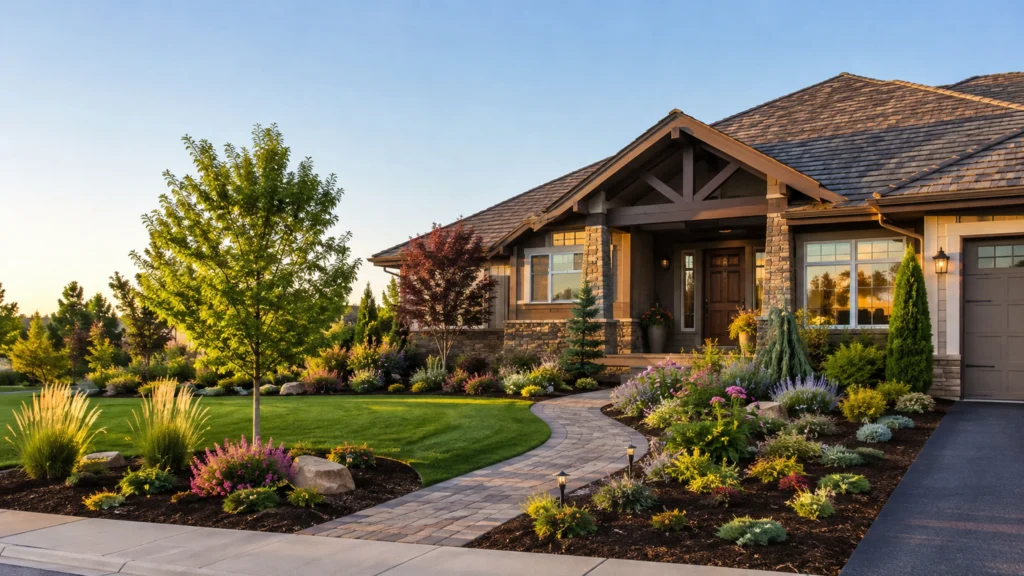
Shrubs grow wider than expected. Tree canopies create more shade. Grass becomes thin under those trees. Mulch disappears into the soil. Bed edges lose their shape. Plants that once looked appropriately sized begin covering windows or crowding a walkway.
Then homeowners respond by adding things.
Another shrub goes into an empty corner. A few annual flowers are squeezed beside an overgrown hedge. Decorative rocks are placed around a bare spot. A new plant is bought because it looked good at the garden center.
Eventually, the front yard contains plenty of landscaping but still looks unfinished.
The problem is often not a lack of plants. It is a lack of structure.
A well designed front yard creates visual order. The lawn, trees, foundation plantings, garden beds, walkways, driveway, front entrance, lighting, and hardscape should feel like parts of the same composition.
That is why a successful landscape renovation begins with assessment rather than shopping.
How to Fix Front Yard Landscaping Before Starting Over
If you are wondering how to fix front yard landscaping, resist the temptation to remove everything immediately.
Some yards need a complete redesign. Many do not.
A surprisingly large improvement can come from repairing the fundamental problems and keeping the healthy elements that are already working.
Look at Your Front Yard From the Street
Walk across the street and look back at the house.
This changes your perspective.
When you stand inside the yard, you notice weeds, bare soil, individual shrubs, and small imperfections. From the street, you notice the bigger picture.
Ask yourself where your eye goes first.
Ideally, the landscape should gently guide attention toward the house and front entrance. If the largest visual feature is an overgrown hedge, exposed utility box, patchy lawn, giant empty area, or crowded foundation bed, the landscape hierarchy is working against you.
Take photographs from the street, driveway, sidewalk, and front door. Pictures often reveal imbalance more clearly than standing in the space itself.
Decide What Is Worth Keeping
A front yard makeover does not automatically mean a blank slate.
Mature trees can provide valuable shade, scale, and character. Healthy evergreen shrubs may be reusable after selective pruning. Established perennials can sometimes be divided and repositioned. Existing pavers, natural stone, edging, or landscape lighting may work perfectly well in a revised design.
Evaluate every major element according to health, location, mature size, maintenance requirements, and its role in the new landscape.
A plant can be perfectly healthy and still be wrong for its location.
A shrub that naturally wants to become eight feet tall will remain a maintenance problem if it is planted beneath a three foot window. Constant pruning does not solve poor plant placement. It merely turns it into a recurring chore.
Remove Dead, Diseased and Badly Positioned Plants
Removing something can improve a landscape as much as adding something.
Start with dead plants, broken branches, diseased growth, invasive vegetation, heavily damaged shrubs, and plants that block doors, windows, pathways, lights, or important sightlines.
Then look for unnecessary repetition.
Three poorly placed shrubs are not automatically better than one properly positioned specimen. Ten unrelated perennial varieties do not necessarily create more interest than three varieties repeated confidently throughout a bed.
Editing creates breathing room.
That breathing room allows the house, lawn, pathways, trees, and stronger plant combinations to become visible again.
Fix Drainage Before Improving the Appearance
Few landscaping mistakes are more frustrating than spending money on new plants and mulch only to watch heavy rain expose the underlying drainage problem.
Standing water, washed out mulch, muddy lawn areas, erosion, soggy planting beds, and water collecting close to the foundation should be investigated before cosmetic improvements begin.
Watch the yard during rainfall if possible.
Notice where water comes from and where it travels. Look at roof downspouts, driveway runoff, slopes, low spots, compacted soil, bed edges, and hard surfaces.
The goal is not simply to make water disappear. It is to move, absorb, or manage it safely.
Depending on the site, improvements may involve correcting the grade, extending downspouts, improving soil infiltration, installing appropriate drainage, using permeable materials, creating a rain garden, or planting slopes with deeper rooted vegetation.
The United States Environmental Protection Agency notes that healthy soil can improve water infiltration, while aeration can help compacted ground absorb water more effectively. It also recommends considering deeper rooted plants on slopes where runoff and erosion are concerns.
Serious grading, foundation drainage, retaining wall, or persistent standing water problems may require a landscape professional, drainage contractor, or other qualified specialist.
Fix the water first. Beautify the space second.
Improve the Soil Before Buying More Plants
Plants cannot outperform the ground they are planted in.
If shrubs repeatedly decline, grass struggles despite regular watering, or new plants never seem to establish, soil conditions deserve attention.
Front yard soil can become heavily compacted through construction, foot traffic, vehicles, repeated mowing, and years of neglect. Depending on the property, you may also be working with heavy clay, fast draining sand, poor topsoil, unusual soil pH, or low organic matter.
A soil test can provide useful information before you start making amendments.
It is also important to understand that different parts of the same front yard can behave differently. The sunny strip beside the driveway may be hot and dry while a foundation bed beneath a roof edge remains shaded and moist.
Treating the entire yard as one growing environment leads to disappointing plant choices.
The Environmental Protection Agency recommends matching plants to actual site conditions, including soil, sun, wind, and moisture, rather than assuming the entire landscape has identical requirements.
Good landscaping begins underground.
Create a Front Yard Landscape Plan
Once the existing problems are understood, start designing.
You do not need professional drawing skills. A rough plan with accurate measurements is far more valuable than a collection of random inspiration images.
Mark the house, property boundaries, driveway, front walkway, utility areas, existing trees, major shrubs, slopes, drainage zones, windows, doors, and permanent hardscape.
Then consider how you actually use the space.
Where do visitors enter?
Where are trash bins moved?
Does anyone cut across the lawn because the walkway takes an awkward route?
Do children play on the grass?
Does a vehicle need extra clearance beside the driveway?
Is privacy important near a front window or porch?
Functional questions should shape the design before decorative choices do.
Recent landscape planning advice also recommends developing a master plan and completing larger renovations in phases when budget or time is limited.
That approach prevents a common mistake: spending heavily on one attractive section and later discovering that it conflicts with the rest of the yard.
Make the Front Door the Visual Destination
A front yard has a job that a backyard does not.
It introduces the house.
That means the route toward the front entrance should be visually understandable.
A walkway does not have to be perfectly straight, but visitors should not have to wonder where they are supposed to go. Plants should frame the entrance rather than hide it. Large shrubs should not create a tunnel around the pathway, and decorative features should not compete so strongly that the door disappears.
You can strengthen the entrance with coordinated planters, flowering shrubs, a small ornamental tree, restrained outdoor lighting, or repeated plant material leading toward the house.
Think of these elements as visual punctuation.
They should say, this is where you are going.
Redesign Overgrown Foundation Plantings
Foundation landscaping is one of the biggest reasons an older front yard starts looking dated.
A familiar pattern is a row of shrubs planted directly against the house. They were tiny when installed, so the spacing looked generous. Years later, they have merged into a solid wall of foliage.
The result can make the house feel shorter, darker, and partially hidden.
Improving foundation plantings starts with understanding mature plant size.
Do not choose a shrub based only on its size in the nursery container. Consider how tall and wide it is expected to become and whether that size works beneath windows, beside steps, near gutters, or along pathways.
Whenever space allows, widening narrow foundation beds can create a more natural transition between the house and lawn.
A deeper bed also gives you room to layer vegetation rather than planting everything in one rigid row.
Use Layered Planting for a Fuller Front Yard
Layering creates depth.
Instead of arranging plants like objects on a shelf, build the planting from larger structural forms toward smaller plants near the edge.
The tallest layer may include small trees, upright evergreens, or larger shrubs. The middle layer can contain compact shrubs and taller perennials. Lower perennials, ornamental grasses, groundcovers, and seasonal flowers can soften the front of the bed.
The goal is not to fill every inch immediately.
Plants grow.
A young landscape can look slightly open during its first seasons and become beautifully balanced as plants reach maturity. Packing plants together for an instant finished appearance can create overcrowding, poor airflow, and extra pruning later.
Good spacing is patience built into the design.
Repeat Plants Instead of Collecting Them
A common DIY landscaping mistake is buying one of everything.
One hydrangea. One ornamental grass. One flowering perennial. One evergreen. One plant with purple leaves because it looked interesting.
Individually, each plant may be attractive.
Together, they can make the landscape feel visually noisy.
Repetition brings order.
Using the same groundcover in several locations or repeating groups of the same perennial creates rhythm. Repeating a shrub from one side of the entry on the other side can create visual connection without requiring perfect symmetry.
You can still have variety. The difference is that the variety becomes intentional.
Think in groups, layers, shapes, textures, and repeated colors rather than individual plant specimens.
Choose the Right Plants for Sunlight and Climate
Plant selection should come after site analysis, not before it.
Start with sunlight.
A location receiving strong direct sun for much of the day requires different plants from a bed shaded by the house or a mature tree.
Then consider temperature, winter conditions, summer heat, rainfall, soil moisture, wind exposure, drainage, and available root space.
Native plants and regionally appropriate species can be particularly valuable because they are adapted to local environmental conditions. Depending on the species and location, they can also support pollinators and wildlife while reducing the need for intensive inputs.
WaterSense recommends regionally appropriate, low water using, and native plants and advises grouping plants with similar irrigation requirements together.
That does not mean every plant in your front garden needs to be native.
It means plant choice should begin with compatibility.
A beautiful plant in the wrong place becomes maintenance.
A suitable plant in the right place becomes landscaping.
Combine Evergreen Structure With Seasonal Interest
A front yard should not depend entirely on one month of flowers.
Flowering plants create excitement, but foliage, bark, branching form, evergreen structure, ornamental grasses, seed heads, and plant texture can carry the landscape through the rest of the year.
Use a mixture of plants that contributes something across different seasons.
Evergreen shrubs can provide structure during winter. Spring bulbs can create early color. Perennials can provide summer flowers. Ornamental grasses can introduce movement and autumn texture. Trees with interesting bark or branching can continue contributing when leaves disappear.
The strongest front yards have a skeleton beneath the flowers.
Repair a Patchy Front Lawn Instead of Hiding It
Patchy grass is often treated as a purely cosmetic problem.
Throw down seed. Add fertilizer. Water more.
Sometimes that works.
Sometimes the same patch returns because the cause was never addressed.
Thin turf may be connected to shade, compaction, poor drainage, unsuitable grass species, heavy foot traffic, irrigation problems, pet damage, pests, disease, or poor soil.
Start with diagnosis.
If compaction is the issue, aeration may help improve air and water movement into the soil. If the area receives insufficient sunlight for the turf species, repeatedly reseeding it may be a losing battle.
In that case, rethink the area.
A shaded section could become a planting bed, groundcover area, mulched tree zone, or another landscape feature better suited to the conditions.
This is one of the most useful principles in a front yard makeover: stop forcing a material to survive where the site does not support it.
Decide How Much Lawn You Actually Need
A lawn can be beautiful.
It can also provide useful space for children, pets, recreation, and a clean visual foreground.
The question is not whether lawns are good or bad.
The question is where turf serves a purpose in your particular front yard.
Grass on a steep slope, deep shade, extremely narrow strip, or awkward corner can demand significant maintenance without contributing much function.
Those areas may be better converted into planting beds, native landscaping, groundcovers, decorative gravel where appropriate, or other site suitable materials.
WaterSense similarly recommends using turfgrass strategically and matching it to the climate rather than automatically covering every open area with grass.
Keep the lawn where it earns its place.
Reshape Landscaping Beds for Instant Improvement
If you want to know how to improve front yard landscaping without replacing most of the plants, look at your bed lines.
Messy or disappearing edges can make even healthy landscaping look neglected.
Clean bed definition separates lawn from planting space and creates a stronger visual frame around the house.
The exact shape should suit the architecture and site.
Modern homes often work well with restrained geometric forms. Traditional or cottage influenced properties may accommodate softer curves.
Avoid creating random waves simply because curved beds are considered natural.
A curve should have confidence.
Broad, gradual lines generally look more intentional than a sequence of small bumps.
Before permanently enlarging a bed, mark the proposed edge and look at it from the street. This simple step can prevent hours of unnecessary digging.
Use Mulch as a Functional Design Element
Fresh mulch can produce one of the fastest visible improvements in a tired front yard.
It creates contrast, makes bed edges easier to read, suppresses some weed growth, protects the soil surface, and helps planted areas feel finished.
But mulch should not be treated like a mountain piled against every plant.
WaterSense recommends an appropriate mulch layer around garden plants to reduce evaporation, moderate soil temperatures, reduce erosion, and inhibit weeds. Its current landscaping guidance suggests roughly three to four inches for many situations while keeping organic mulch a few inches away from the trunks of trees and other woody plants.
The space around a tree trunk should not resemble a volcano.
Spread mulch outward across the root zone rather than piling it upward against the bark.
Improve Edging Without Overcomplicating It
Landscape edging has two jobs.
It creates definition and keeps materials where they belong.
The best edging is often visually quieter than homeowners expect.
Natural trench edging can work beautifully in traditional lawns and garden beds when maintained regularly. Metal edging offers a thin, clean line for contemporary landscapes. Brick or stone can suit homes where those materials already appear in the architecture.
Avoid choosing edging as an isolated decorative feature.
Connect it to the house.
If the property already uses brick, stone, concrete, or a particular architectural material, repeating that visual language can make new landscaping feel as if it belongs.
Upgrade the Walkway and Hardscaping
Plants are only part of landscape design.
Hardscaping creates permanent structure.
Walkways, steps, driveways, retaining walls, porches, edging, fences, gates, and small seating areas influence the front yard even when no flowers are blooming.
Begin with condition and safety.
Uneven pavers, cracked steps, loose stones, slippery surfaces, or poorly lit changes in elevation should be dealt with before decorative upgrades.
Then consider proportion.
A tiny walkway can look uncomfortable beside a substantial home. Oversized hardscaping can overwhelm a small garden.
Materials should relate to the house rather than fight it.
The goal is not to install every trending material. It is to create a believable connection between architecture and landscape.
Add a Focal Point Without Creating Clutter
Every decorative object does not need to become a focal point.
In fact, if everything demands attention, nothing gets it.
A front yard may need only one strong focal element.
That could be the front door, an ornamental tree, a specimen shrub, a large planter, a garden gate, an architectural feature, or a carefully positioned grouping of plants.
Once the focal point is established, surrounding elements should support it.
This is especially useful in small front yard landscaping, where too many ornaments, tiny beds, plant varieties, and decorative features can make limited space feel even smaller.
Restraint can make a yard feel more expensive than excess.
Improve Curb Appeal With Color and Texture
Color is powerful, but landscaping becomes more interesting when you stop thinking only about flowers.
Leaves can be glossy, matte, fine, broad, feathery, silver, blue green, deep green, burgundy, or variegated.
Plants can be upright, rounded, spreading, arching, columnar, or mounding.
Combining contrasting textures gives planting beds depth even when little is flowering.
When adding color, look at the house first.
Brick, siding, stone, trim, shutters, roof materials, and the front door already establish a palette. Landscaping does not have to match the house exactly, but it should communicate with it.
Repeated colors usually feel calmer and more deliberate than a different flower color in every corner.
Add Outdoor Lighting With Restraint
Landscape lighting can improve both appearance and nighttime usability.
Entry lighting can make the front door easier to identify. Path lighting can make changes in direction and elevation easier to see. Carefully positioned uplighting can reveal the form of a beautiful tree or architectural feature after dark.
But brighter is not automatically better.
A front yard should not resemble a commercial parking lot.
Use lighting to reveal the landscape rather than overwhelm it. Consider glare, nearby windows, neighboring properties, fixture placement, beam direction, and the amount of light actually needed.
Warm, controlled illumination usually creates more atmosphere than excessive brightness.
Fix the Irrigation System While the Yard Is Open
If you are renovating planting beds or removing lawn, it is a smart time to evaluate irrigation.
Check sprinkler heads for damage, leaks, poor alignment, blocked spray patterns, and overspray onto sidewalks or driveways.
Different plants also have different water requirements.
A lawn should not necessarily be irrigated on exactly the same schedule as shrubs or drought tolerant perennials.
Grouping plants according to similar water requirements, sometimes called hydrozoning, can make irrigation more efficient and reduce the chance of constantly overwatering one plant to satisfy another. The Environmental Protection Agency specifically recommends this approach as part of water smart landscape planning.
If practical for the design, drip or targeted irrigation can also help deliver water to planted areas more precisely.
How to Make Front Yard Landscaping Low Maintenance
Low maintenance does not mean no plants.
It means fewer recurring problems.
The easiest landscape to care for is one where plants fit their available space, lawn grows where lawn can actually thrive, bed edges are simple to maintain, irrigation matches plant needs, and high maintenance features have been deliberately limited.
Choose plants for their mature size instead of planning to prune them constantly.
Use groundcovers or mulch to protect exposed soil.
Reduce awkward pieces of lawn that are difficult to mow.
Avoid plant varieties that require conditions your yard cannot provide.
Leave sufficient access for pruning, weeding, irrigation repairs, and other routine work.
Most importantly, do not confuse an empty landscape with a low maintenance landscape.
Bare soil still grows weeds. Poorly placed gravel can collect debris. Oversized shrubs still need pruning. A poorly designed irrigation system still needs repairs.
Maintenance is reduced through good decisions, not simply through fewer plants.
How to Redo Front Yard Landscaping on a Budget
A tight budget does not prevent a meaningful front yard makeover.
It simply makes sequencing more important.
Start with cleanup.
Remove weeds, dead vegetation, broken edging, unnecessary decorations, and debris. Prune only what should legitimately be pruned. Define planting beds. Repair obvious lawn damage. Refresh mulch where necessary.
These changes can dramatically improve the appearance of a property before major purchases begin.
Next, concentrate spending where it creates permanent value for the design.
Correct drainage problems. Repair unsafe walkways. Improve soil. Save healthy mature plants. Establish the main bed shapes. Plant important trees and structural shrubs first.
Perennials, groundcovers, annual color, decorative planters, and smaller details can be added gradually.
Budget front yard landscaping becomes much easier when you stop trying to finish the entire property in one shopping trip.
A phased renovation also gives you time to observe how new plants grow and how the landscape performs through different seasons.
When a Complete Front Yard Redesign Makes Sense
Sometimes fixing individual pieces only prolongs the problem.
A complete redo may make sense when most plants are overgrown or unhealthy, drainage is fundamentally poor, the lawn repeatedly fails, pathways are badly located, the irrigation system needs major changes, or the existing landscape no longer matches how the property is used.
Starting over can also be reasonable after major construction, a substantial home renovation, storm damage, removal of a large tree, or years of accumulated landscaping changes with no unified plan.
Even then, complete redesign does not mean thoughtless demolition.
Inventory valuable existing materials first.
A mature tree, quality stone, reusable pavers, established specimen plants, or good topsoil may be worth integrating into the new plan.
The objective is not to make the yard new.
It is to make it work.
A Better Order for Your Front Yard Makeover
The order of work matters because later stages can easily damage earlier ones.
Start with the site itself.
Understand drainage, grading, utilities, soil, sunlight, existing trees, and circulation.
Then address demolition and removal.
After that, complete major drainage work, grading, construction, retaining walls, pathways, irrigation modifications, or other hardscaping.
Prepare planting areas next.
Install large trees and structural shrubs before smaller plants. Complete lawn renovation after heavy equipment and repeated foot traffic are finished. Add smaller perennials and groundcovers, then mulch, lighting, and finishing details.
This sequence keeps you from installing a perfect new lawn only to drive equipment across it two weeks later.
Landscape design is partly about beauty.
Landscape renovation is also about logistics.
Common Front Yard Makeover Mistakes
One of the most expensive mistakes is shopping before planning.
Garden centers are designed to make healthy plants look irresistible. That does not mean those plants belong in your landscape.
Another mistake is choosing everything at its current size. Young shrubs can look harmless in small nursery pots and become enormous when mature.
Homeowners also frequently ignore drainage until after planting, overcomplicate bed shapes, use too many unrelated plant varieties, crowd plants for instant fullness, and spread improvements randomly across the property instead of completing a coordinated plan.
Recent expert landscaping coverage similarly warns against redesigning without a clear vision, adding excessive plant variety, and choosing plants without understanding site conditions.
Finally, avoid copying another front yard exactly.
Inspiration is useful.
Duplication is not.
A landscape that succeeds on another property may have different sunlight, soil, rainfall, architecture, maintenance expectations, and available space.
Your yard needs a design response, not a costume.
How to Know Your Front Yard Makeover Is Working
A successful landscape should become easier to understand.
The front entrance is obvious.
Plants look appropriately scaled to the house.
There is enough variety to create interest but enough repetition to create unity.
The lawn exists where it can be maintained successfully.
Bed edges have purpose.
Drainage is controlled.
Walkways feel natural to use.
Plants have room to mature.
Seasonal color adds personality without carrying the entire design.
Most importantly, the landscape feels connected.
You should not look at it and see a tree, then a shrub, then a flower bed, then a path.
You should see a front yard.
That is the difference between owning landscaping and having a landscape.
Conclusion
A front yard makeover is most successful when you stop asking what you can add and start asking what the property needs.
Fix drainage before spreading mulch. Improve poor soil before installing expensive plants. Repair or replace lawn only after understanding why it failed. Keep mature plants that still serve the design and remove those that create permanent maintenance problems. Create clear planting beds, strengthen the route to the front entrance, use repetition and layering, and select plants according to sunlight, climate, soil, mature size, and water requirements.
If you are learning how to fix front yard landscaping, begin with the problems that make the entire space feel neglected. If you are deciding how to improve front yard landscaping, focus on structure, proportion, plant health, and curb appeal. If you are ready to redo the landscape completely, create the full plan before beginning demolition.
The best front yard does not have to contain the most plants, the newest materials, or the biggest budget.
It simply has to feel intentional.
That is the idea behind Front Yard Landscaping Ideas: create a landscape that suits the house, works with the site, welcomes people naturally, and still looks good after the excitement of makeover day has passed.
Frequently Asked Questions
How do I redo my front yard landscaping from scratch?
Begin by assessing the existing yard, including drainage, soil, sunlight, lawn health, pathways, mature trees, utilities, and plants worth keeping. Develop a complete landscape plan before removing everything. Complete major grading, drainage, irrigation, and hardscape work first. Prepare the soil next, followed by trees, shrubs, smaller plants, lawn areas, mulch, and finishing details such as lighting. Planning the entire landscape before installation helps prevent expensive changes later.
How can I make my front yard look better without spending a lot of money?
Start with cleanup and definition. Remove weeds and dead plants, prune suitable shrubs, create clean bed edges, repair small bare lawn areas, refresh mulch, and simplify unnecessary decorations. Reusing healthy plants and dividing established perennials can also reduce costs. Concentrate your budget on the most visible and permanent improvements instead of purchasing many small decorative items.
How do I fix front yard landscaping that looks messy?
First reduce visual clutter. Remove dead or badly placed plants, define the boundaries between lawn and planting beds, and identify overgrown shrubs that need pruning or replacement. Repeat fewer plant varieties instead of scattering many unrelated plants throughout the landscape. A clear focal point and stronger connection to the front entrance can also make a messy yard look more intentional.
What should I remove first when redoing a front yard?
Begin with obvious waste such as dead vegetation, invasive weeds, broken materials, damaged landscape edging, and plants that cannot realistically be saved. Before removing mature trees or large healthy shrubs, consider whether they can become part of the revised design. Large tree removal may require professional assessment and should not be treated like ordinary garden cleanup.
How can I improve curb appeal with landscaping?
Create a clear route to the front door, keep plants appropriately scaled to the house, maintain clean lawn and bed edges, and use a controlled mix of shrubs, perennials, groundcovers, and seasonal color. Refreshing mulch, improving the lawn, repeating plant groups, and adding restrained landscape lighting can also make the property feel cleaner and more welcoming.
What plants are best for a low maintenance front yard?
The best plants depend on your climate, sunlight, soil, water availability, and available space. Regionally appropriate and native plants can be excellent choices when properly matched to the site. Focus especially on mature size. A naturally compact shrub that fits beneath a window usually requires less maintenance than a large shrub that must continually be cut back.
Should I replace my front lawn with landscaping?
Not necessarily. Keep lawn where it provides useful open space and grows well. Consider replacing turf in locations where grass repeatedly struggles, such as deep shade, steep slopes, narrow strips, or difficult corners. Those areas may work better as planting beds, native gardens, groundcover areas, or another landscape treatment appropriate for the site.
How do I make a small front yard look professionally landscaped?
Simplify the design. Use fewer plant varieties, repeat them in deliberate groups, create a clear focal point, and avoid filling every available space. Make sure plants are proportional to the house and to the size of the yard. Strong bed lines and an obvious path to the entrance can make a compact yard feel organized and spacious.
Should I use mulch or decorative rock in my front yard?
The right material depends on climate, plant selection, drainage, maintenance, and the desired design. Organic mulch can help retain soil moisture, moderate soil temperature, and contribute organic material as it breaks down. Rock may suit some dry climate landscapes or specific design applications, but it can become hot in sunny locations. The Environmental Protection Agency advises considering plant needs and local conditions when selecting mulch materials.
When is the best time to redo front yard landscaping?
The ideal timing depends on your climate and the work involved. Major planning, drainage, and hardscape projects can often be scheduled separately from planting. Trees, shrubs, lawn seed, sod, and perennials each have establishment needs that vary by region and season. Plan the renovation backward from the best local planting period rather than selecting dates based only on convenience.
Can I redo my front yard landscaping in phases?
Yes. In fact, phased landscaping can be a sensible approach when the budget is limited. Create the complete design first, then divide the project into logical stages. Deal with drainage, grading, utilities, and hardscape before installing areas that could be damaged later. Trees and structural plants can follow, with smaller planting beds, lawn improvements, lighting, and decorative details completed as time and budget allow.
What is the most important part of a front yard makeover?
Plants, mulch, lighting, edging, and hardscaping are individual ingredients. A landscape plan determines how those ingredients work together. When circulation, drainage, soil, scale, mature plant size, maintenance, curb appeal, and the architecture of the house are considered from the beginning, the finished yard is more likely to remain attractive long after the initial makeover is complete.

Sara Bendrick believes your yard should be a place you actually look forward to coming home to. A licensed and bonded design-build contractor (C-27 #1006161), she founded Sarita Landscape Designs and has spent over twelve years designing residential outdoor spaces across Southern California with a real soft spot for curb appeal and low-water, no-lawn designs.
When she’s not on a job site, Sara’s on camera or on stage. She’s hosted yard-renovation shows including I Hate My Yard, Build It Like Bendrick, and Lawn & Order, written Big Impact Landscapes, given two TEDx talks, and serves as a spokesperson for Stihl. Her mission is simple, help people see the potential in the yard they already have.