To landscape a front yard for privacy, identify the exact views you want to block, then use a combination of evergreen shrubs, privacy trees, layered planting, ornamental grasses, hedges, fences, trellises, and raised planting beds to interrupt those sightlines without completely hiding your home. The most effective front yard privacy landscaping creates separation from the street and neighboring properties while keeping the entrance visible, preserving natural light, and maintaining strong curb appeal.
That distinction matters.
Privacy landscaping in a backyard can create an almost enclosed retreat. A front yard has a different job. It needs to feel private without looking defensive. You still want visitors to understand where the walkway begins. You want the architecture of the house to breathe. And you probably do not want to replace an exposed lawn with a towering green wall that makes the property feel smaller than it really is.
The better approach is selective screening.
A well-placed hedge can soften the view into a living room window. A small ornamental tree can interrupt the sightline between a porch and the street. Tall grasses can make pedestrians feel farther away. A low fence surrounded by shrubs can establish a psychological boundary without turning the front yard into a fortress.
At Front Yard Landscaping Ideas, this balance between privacy, beauty, and curb appeal is the foundation of a successful front landscape. The following ideas will help you create that balance in yards of almost any size.
Table of Contents
Start With the Sightlines Before Choosing Privacy Plants
One of the most common mistakes in front yard landscaping for privacy is starting with plants.
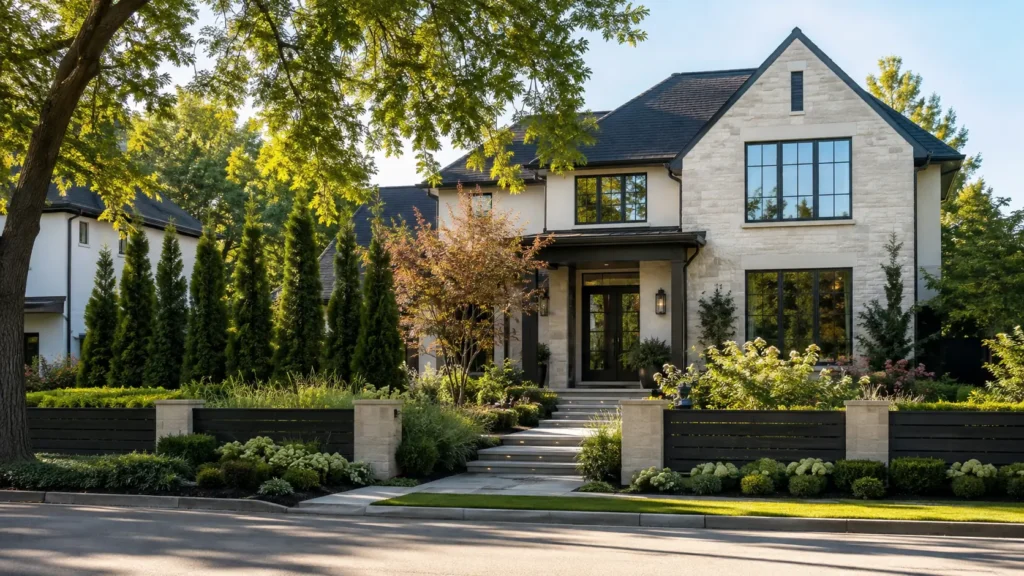
It sounds strange. After all, landscaping is about plants.
But privacy is really about sightlines.
Stand inside your living room and look toward the street. Sit on the front porch. Walk along the sidewalk. Stand near the driveway. Look toward neighboring windows.
Where exactly do you feel exposed?
You may discover that you do not need to screen the entire front property line. Perhaps the real problem is a narrow view between the sidewalk and your porch chairs. Maybe headlights from passing vehicles shine toward a front window. Perhaps a neighboring second-story window looks directly toward your favorite outdoor seating area.
Once you identify the uncomfortable viewing angles, landscaping becomes much easier.
Instead of planting twenty shrubs across the entire front yard, you might need five strategically positioned plants and one small tree.
That usually looks better, costs less, and requires less maintenance.
Create Layered Landscaping Instead of a Single Green Wall
Layered planting is one of the most effective ways to create natural privacy in a front yard.
Rather than planting one straight row of identical shrubs, use plants with different heights, forms, textures, and seasonal characteristics.
A layered privacy border might begin with lower perennials or ornamental grasses near the lawn. Behind them, medium-sized flowering shrubs create density. Taller evergreen shrubs or small trees provide the main screening layer.
This creates depth.
It also makes the landscape feel intentional rather than purely functional.
Imagine a straight six-foot hedge running across the front of a house. It certainly provides privacy, but it can feel heavy.
Now imagine a similar area with a small multi-stem tree, several evergreen shrubs, flowering viburnums, wispy grasses, and lower groundcover. Your eye moves through the planting rather than stopping at a wall.
You still gain privacy, but you also gain texture, movement, flowers, foliage, shade, and seasonal interest.
Layered landscaping is particularly useful when you want privacy from the street without completely blocking the front elevation of the home.
Use Evergreen Hedges for Year-Round Front Yard Privacy
Evergreen shrubs remain popular privacy plants for a simple reason. They keep their foliage through the seasons.
A deciduous hedge may provide wonderful privacy during summer, only to become almost transparent after its leaves fall. If your goal is year-round privacy, evergreen plants should usually form at least part of the screening structure.
Arborvitae for Tall and Narrow Privacy Screening
Arborvitae is one of the best-known landscape plants for living privacy screens.
Its upright growth makes it useful along property lines, beside driveways, and in areas where horizontal space is limited. Depending on the variety, arborvitae can form anything from a relatively compact vertical accent to a substantial evergreen screen.
The important word is variety.
Different arborvitae cultivars can have dramatically different mature dimensions. Before planting, consider mature height and width rather than choosing plants based only on their current nursery size.
A plant that looks pleasantly small today can become far too large for a front yard several years later.
Yew for Formal Evergreen Hedges
Yew works particularly well in more traditional landscapes.
Its dense evergreen foliage responds well to pruning, making it suitable for clipped hedges around formal entry gardens and structured front yards.
Yew can also work where a softer, less rigid screen is desired. Allowing the plant to develop a more natural shape can create privacy without the highly manicured appearance of a formal hedge.
Holly for Dense Privacy and Seasonal Character
Many holly varieties create thick evergreen foliage that can help screen windows, sidewalks, and neighboring properties.
Holly also brings stronger visual character than some purely green screening plants. Depending on the species and cultivar, foliage shape, berries, and branching patterns can add seasonal interest to an otherwise simple privacy border.
Plant selection should always match your local climate, sunlight, soil conditions, and available space.
Mix Evergreen and Deciduous Shrubs for a Softer Privacy Screen
A completely evergreen front yard can sometimes feel static.
Mixing evergreen and deciduous shrubs allows you to maintain a privacy framework while introducing flowers, berries, fall color, fragrance, and changing textures.
Viburnum is a good example of a shrub frequently used in mixed privacy planting. Different species offer different foliage habits, flower forms, mature sizes, and growing requirements.
Hydrangeas can also contribute substantial summer volume, especially when combined with evergreens that maintain structure during winter.
Lilac can create beautiful seasonal screening in suitable climates, while flowering shrubs such as ninebark, abelia, or native alternatives can soften the rigid appearance of a traditional privacy hedge.
The goal is not to collect as many plants as possible.
Choose a restrained plant palette and repeat key species throughout the landscape. Repetition makes mixed planting feel cohesive rather than random.
Plant Privacy Trees Where Height Matters Most
Sometimes shrubs simply cannot solve the problem.
If the view you are trying to block comes from a taller window, raised porch, neighboring property, or elevated road, you may need privacy trees.
Trees are especially useful because their screening occurs higher in the landscape.
They can intercept a view without creating dense foliage at ground level.
Small Ornamental Trees for Front Yard Privacy
A smaller ornamental tree can be more useful than a massive evergreen planted directly along the property boundary.
Think about placement rather than sheer size.
A multi-stem tree positioned between the street and a front window can filter a surprisingly wide viewing angle. Its canopy creates privacy while its trunks allow some visibility underneath.
This works beautifully in front yards where you want screening without completely enclosing the lawn.
Columnar Trees for Narrow Front Yards
Columnar trees and narrow evergreen varieties are useful where planting space is tight.
They can provide vertical screening beside a driveway, between neighboring homes, or along a narrow property line without consuming the amount of ground space required by broad-canopied trees.
Again, mature width matters.
Do not assume that a tree described as narrow will remain pencil-thin forever.
Use Ornamental Grasses for Soft and Airy Privacy
Privacy does not always need to be solid.
Sometimes you simply want enough visual movement between your home and the street to stop the yard from feeling exposed.
Tall ornamental grasses are excellent for this.
Their upright leaves and flower heads filter views without creating the visual weight of a dense hedge. They also move in the wind, bringing life and softness to front yard landscaping.
Feather reed grass is commonly used where an upright form is needed. Switchgrass can provide height and seasonal color in suitable conditions. Other clumping ornamental grasses may work depending on your climate and landscape style.
The word clumping is important.
Some grasses and grass-like plants spread aggressively. Choose species appropriate for your region and avoid planting anything considered invasive locally.
Ornamental grasses work especially well near front patios, sitting areas, porches, and pedestrian-facing portions of the yard where complete screening would feel excessive.
Combine a Low Fence With Privacy Planting
A fence does not need to be six feet tall to make a front yard feel more private.
In many landscapes, a low fence combined with shrubs can be more attractive than a tall solid barrier.
The fence establishes a clear boundary.
The planting provides additional height and visual filtering.
Together, they create more privacy than either element might provide alone.
A low wood fence, metal fence, or open picket-style boundary can be paired with evergreen shrubs, flowering plants, grasses, or climbing vines.
This approach is particularly effective where local regulations restrict front yard fence height.
Before installing any fence, wall, or permanent screening structure, check your local zoning requirements, homeowners association rules if applicable, easements, visibility requirements near driveways, and property boundaries.
Front yard regulations can vary considerably from one location to another.
Add a Trellis or Lattice Screen for Targeted Privacy
You do not always need to screen the entire yard.
If one small section of your porch or patio feels exposed, a trellis can solve the problem with far less material.
A freestanding trellis positioned beside a seating area creates vertical privacy almost immediately. Add an appropriate climbing plant and the structure becomes part of the landscape.
Lattice panels can perform a similar job.
Because they are partially open, they allow light and air to pass through while still disrupting direct views.
Trellises are particularly useful in small front yard landscaping where there is not enough room for a wide hedge.
They also allow privacy to be placed closer to the area where it is actually needed.
That can be far more effective than trying to block the same viewing angle from the distant property line.
Use Climbing Plants to Create Vertical Privacy
Vines can turn a fence, trellis, arbor, or screen into a living privacy feature.
Depending on your climate, options may include star jasmine, clematis, climbing hydrangea, honeysuckle, or other locally appropriate climbing plants.
Evergreen climbers can provide longer-lasting coverage, while flowering vines offer more seasonal drama.
There is one practical consideration that should not be ignored.
Understand how the vine climbs.
Some vines twine gently around supports. Others attach themselves to surfaces. Vigorous species can overwhelm lightweight structures or require frequent pruning.
Choose the plant for the structure rather than planting first and worrying about control later.
Build Privacy Around the Front Porch
Front porch privacy requires a slightly different strategy from property-line screening.
The goal is usually not to make the porch invisible.
You simply want enough separation to sit outside without feeling like you are on display.
Planting near the porch is often more effective than planting at the street.
Medium-height shrubs can partially screen seating while keeping the front steps visible. Tall grasses can filter views between porch columns. A trellis at one end of the porch can block the strongest sightline while leaving the remaining sides open.
Large planters can also help.
Containers filled with upright shrubs, grasses, or suitable small trees create flexible screening and can be repositioned as your needs change.
The result should feel like an outdoor room, not a bunker.
Add Raised Planters for Instant Height
Plants take time to grow.
Raised planters provide a shortcut.
By lifting the root zone above ground level, a three-foot shrub can create the visual effect of a taller screen almost immediately.
Raised beds also add structure to a flat front yard.
Stone, brick, rendered masonry, wood, or other materials can be coordinated with the architecture of the home, turning a privacy solution into a deliberate design feature.
Raised planting is particularly useful near patios and front walkways where you want significant screening without planting very large shrubs.
Make sure the planter provides adequate soil volume and drainage for whatever you intend to grow.
Use a Berm to Create Natural Separation From the Street
A berm is a gently raised mound of soil incorporated into the landscape.
When designed properly, a berm can provide subtle elevation for shrubs, grasses, and trees. That additional height increases their screening effect while making the planting look more natural than a flat row of vegetation.
Berms can work particularly well on larger front lawns.
They help create separation from busy streets, soften broad open spaces, and provide an opportunity for layered planting.
Avoid creating a steep artificial mound that looks disconnected from the surrounding grade. A successful berm should appear to belong to the landscape.
Drainage must also be considered before changing the grade around a home.
Create Privacy in a Small Front Yard
Small front yards require restraint.
Trying to fit a full-sized privacy hedge into a narrow landscape can consume valuable space and make the house feel crowded.
Instead, focus on precise screening.
A narrow evergreen beside one window may be enough. A small tree placed slightly off-center can interrupt views from the sidewalk. A trellis beside a front seating area may provide more useful privacy than a property-wide hedge.
Choose plants with upright or compact mature forms.
Layering still works in a small yard, but the layers need to be tighter and simpler.
You might combine one small tree, three compact shrubs, ornamental grasses, and low groundcover rather than building a deep mixed border.
Negative space matters too.
Leaving parts of the yard open helps the planting feel intentional and keeps the front elevation from disappearing behind vegetation.
Landscape for Privacy Along a Driveway
Driveways create unusual privacy challenges because they also require visibility.
Dense planting near the street can make it difficult for drivers to see approaching pedestrians, bicycles, or vehicles.
That means driveway privacy planting should generally become taller farther away from critical visibility areas.
Narrow evergreens can screen neighboring windows farther up the driveway. Shrubs can soften the boundary between two adjacent driveways. Ornamental grasses may reduce the feeling of exposure while maintaining a lighter appearance.
Keep mature plant size in mind so branches do not continually spill onto the driveway.
Plants should improve the space, not create a permanent pruning battle.
Use Mixed Privacy Screens for a More Natural Look
A mixed privacy screen combines several plant types instead of relying on a single species.
This approach has both aesthetic and practical advantages.
Visually, mixed screens feel more like gardens than walls.
You can combine evergreen foliage for winter coverage with deciduous shrubs for flowers and fall color. Small trees provide upper-level screening. Grasses and perennials soften the base.
There is also value in avoiding complete dependence on one plant species.
If a pest, disease, weather event, or changing site condition affects one type of plant, the entire privacy screen is less likely to fail at once.
A mixed screen also gives you more opportunities to select native plants suited to local conditions.
Choose Native Plants When They Suit the Privacy Goal
Native shrubs and trees deserve serious consideration in privacy landscaping.
Plants adapted to your region can often integrate naturally with local soils, seasonal conditions, and wildlife.
The best native choice depends entirely on where you live.
Wax myrtle may be an excellent screening plant in some warmer regions. Serviceberry can play a completely different role in other climates. Native viburnums, hollies, grasses, conifers, and small trees can all contribute to privacy depending on regional growing conditions.
Your local extension service, native plant society, or reputable nursery can help identify plants suited to your specific location.
Privacy landscaping lasts for years. Choosing species based on local conditions is more important than choosing whatever plant happens to be trending online.
Design Front Yard Privacy Without Sacrificing Curb Appeal
Privacy and curb appeal are not competing goals.
The strongest landscapes achieve both.
Keep the front door readable from the street. Frame important architectural elements rather than hiding the entire facade. Repeat plants and materials already used around the property. Allow some open lawn, planting gaps, or lower vegetation to provide visual breathing room.
Think about what people see from outside and what you see from inside.
A shrub may look perfectly positioned from the sidewalk but completely block a favorite view from your living room.
Good landscaping works in both directions.
It screens what you do not want to see while preserving what you do.
Consider Light Before Creating Dense Privacy
More privacy usually means less light.
That tradeoff is easy to overlook when plants are young.
A dense hedge planted directly outside a window may eventually darken the room. Large evergreens placed on the wrong side of the house can cast significant shade over smaller plants.
Before planting, imagine the landscape at mature size.
Consider how the sun moves across the property.
In some situations, an airy tree canopy or partially open screen is better than solid evergreen foliage because it provides privacy while allowing filtered light through.
Plan for Mature Plant Height and Width
One of the simplest ways to reduce future landscaping problems is to stop designing around the size of plants at the garden center.
Design around their mature size instead.
A tiny shrub in a nursery container may eventually become eight feet wide.
If three are planted tightly together because the initial spacing looks empty, you may spend years trying to force oversized plants into an undersized bed.
Proper spacing can look sparse at first.
That is normal.
Use smaller perennials, annuals, grasses, or groundcover to create temporary fullness while structural shrubs develop.
Patience usually produces a better privacy landscape than overcrowding.
Make Front Yard Privacy Landscaping Low Maintenance
Privacy landscaping can become surprisingly labor intensive if every plant requires constant trimming.
For a lower-maintenance front yard, choose plants whose natural mature dimensions fit the available space.
A shrub that naturally reaches approximately the height you need is usually easier to manage than a much larger plant that must be repeatedly cut back.
Use mulch to reduce weeds and moderate soil moisture. Group plants with similar water requirements. Avoid overly complicated planting schemes with dozens of species requiring different care.
Allow enough room behind hedges and screens for maintenance where possible.
That small detail is easy to forget until you need to prune the back of a mature hedge.
Avoid Common Front Yard Privacy Landscaping Mistakes
The biggest mistake is trying to block everything.
Complete enclosure can damage curb appeal, reduce light, create maintenance problems, and make a small front yard feel even smaller.
Another common mistake is planting directly on a property line without considering mature spread or future access.
Fast-growing plants can also become a problem when speed is prioritized over suitability. A plant that grows rapidly may require equally rapid maintenance.
Ignoring seasonal changes is another issue. A beautiful deciduous hedge may provide excellent summer privacy but little screening in winter.
Finally, avoid choosing plants solely because they appeared on a list of the best privacy plants.
There is no universally perfect privacy shrub or tree.
Sun exposure, climate, soil drainage, mature size, local regulations, deer pressure, water availability, maintenance expectations, and the actual sightline you need to block all influence the right choice.
How to Create a Front Yard Privacy Landscape That Feels Natural
The best privacy landscaping rarely announces itself.
It simply makes the yard feel more comfortable.
Start with the view that bothers you most. Place the tallest screening element where it can interrupt that view efficiently. Add medium-height shrubs around it. Soften the edges with ornamental grasses, perennials, and groundcover.
Then stop.
You do not need to fill every empty space.
Give plants room to grow and let portions of the house remain visible.
If more privacy is needed later, you can add another layer.
This gradual approach tends to produce a front landscape that looks as though it was designed for beauty first, even though every plant is quietly doing a job.
Conclusion
Front yard landscaping for privacy is not about hiding your home behind the tallest hedge you can find. It is about controlling the right views while keeping the landscape open, attractive, practical, and connected to the architecture of the house.
Begin by identifying the actual sightlines that make your yard feel exposed. Then decide whether those views are best managed with evergreen shrubs, privacy trees, ornamental grasses, mixed planting, a low fence, trellis, raised planter, berm, or a combination of several elements.
Whenever possible, use layers instead of one solid barrier.
Evergreens can provide year-round structure. Flowering and deciduous shrubs introduce seasonal character. Small trees create upper-level screening. Grasses soften boundaries. Fences and trellises provide immediate structure while plants mature.
Most importantly, plan for the landscape you will have in five or ten years, not just the plants sitting in front of you today.
At Front Yard Landscaping Ideas, we believe the most successful privacy landscapes are the ones that do not look like privacy solutions at all. They look like beautiful front gardens that happen to make the home behind them feel calmer, more comfortable, and more personal.
Frequently Asked Questions
How to Landscape Front Yard for Privacy Without a Fence?
Use layered planting with a combination of evergreen shrubs, small trees, ornamental grasses, and taller flowering shrubs. Place plants according to the specific sightlines you need to block instead of creating a continuous wall along the property line. A berm, raised planting bed, or trellis covered with vines can provide additional height without a traditional fence.
What Are the Best Plants for Front Yard Privacy?
The best privacy plants depend on climate, sunlight, soil, available space, and desired screening height. Common options include arborvitae, yew, holly, viburnum, wax myrtle, selected junipers, ornamental grasses, and regionally appropriate small trees. Native shrubs and trees are also worth considering when they fit the required height and density.
How Can I Make My Front Yard More Private From the Street?
Identify the direct sightline between the street and the area you want to protect. Use medium-height shrubs, layered planting, ornamental grasses, a small tree, or a low fence combined with vegetation to interrupt that view. Screening closer to a porch or window can sometimes be more effective than planting along the street itself.
How Can I Create Privacy in a Small Front Yard?
Use narrow plants and targeted screening rather than large hedges. Columnar evergreens, compact shrubs, trellises, vertical planting, ornamental grasses, and small multi-stem trees can create privacy without consuming too much ground space. Leave some open areas so the landscape does not feel cramped.
What Is the Fastest Way to Add Front Yard Privacy?
A fence, decorative screen, trellis, or large raised planter provides immediate screening. Combining one of these structures with established shrubs or climbing plants can create a softer appearance while providing privacy before smaller plants mature.
Are Hedges Good for Front Yard Privacy?
Yes. Hedges can provide effective screening, define property boundaries, soften street views, and improve the feeling of separation between a home and public space. Evergreen hedges offer the strongest year-round coverage, while mixed or deciduous hedges can provide flowers, seasonal color, and a more informal appearance.
How Tall Should Front Yard Privacy Landscaping Be?
The right height depends on the view you are trying to block. Privacy for a seated porch may require a different height than screening a standing pedestrian or neighboring second-story window. Instead of automatically choosing the tallest plants possible, determine the height at which the unwanted sightline crosses your landscape. Also check local regulations before installing tall fences, walls, or structures in a front yard.
Can Ornamental Grasses Be Used for Privacy?
Yes. Tall ornamental grasses can create a soft visual screen while allowing light and air to move through the landscape. They are especially useful around porches, patios, sidewalks, and mixed borders. Choose clumping varieties appropriate for your climate and avoid species considered invasive in your region.
How Do I Get Privacy Without Making My Front Yard Look Closed Off?
Use partial screening rather than complete enclosure. Keep the front door and main walkway visible while placing plants around windows, seating areas, and exposed corners. Combine different plant heights and leave intentional gaps. Small trees with elevated canopies, mixed shrub borders, low fences, and airy grasses can all create separation without making the property feel walled in.
Is a Fence or Hedge Better for Front Yard Privacy?
A fence provides immediate and predictable screening, while a hedge offers a softer, greener appearance but requires time to mature. Combining the two can be particularly effective. A lower fence can establish the boundary while shrubs and grasses add height, texture, and natural screening. The right option depends on local regulations, available space, maintenance preferences, budget, and the level of privacy required.

Sara Bendrick believes your yard should be a place you actually look forward to coming home to. A licensed and bonded design-build contractor (C-27 #1006161), she founded Sarita Landscape Designs and has spent over twelve years designing residential outdoor spaces across Southern California with a real soft spot for curb appeal and low-water, no-lawn designs.
When she’s not on a job site, Sara’s on camera or on stage. She’s hosted yard-renovation shows including I Hate My Yard, Build It Like Bendrick, and Lawn & Order, written Big Impact Landscapes, given two TEDx talks, and serves as a spokesperson for Stihl. Her mission is simple, help people see the potential in the yard they already have.