
To hide an ugly house with a desert landscape front yard, shift attention away from weak architectural features and toward layered planting, strong hardscape lines, and a few bold focal points. Start by softening blank walls with upright desert plants such as ocotillo, desert spoon, agave, or columnar cactus, while placing lower shrubs and flowering perennials in front to create depth. Use decorative gravel, decomposed granite, boulders, and a defined walkway to give the yard a finished structure. If the facade feels flat, add a small courtyard wall, trellis, large planter, or specimen tree near the entrance to create visual interest. Keep plants away from windows and utility access, and choose species suited to your local heat, soil, and water conditions. A limited color palette and repeated plant groupings will make the property feel intentional, helping the landscape become the first thing people notice instead of the aging house itself.
That same principle is at the heart of successful desert front yard landscaping. You are not simply filling empty ground with cactus and gravel. You are shaping views, directing attention, managing intense sun, reducing water use, controlling drainage, and creating a front yard that feels connected to the home.
The best desert landscapes often look effortless, but there is usually plenty of thought behind them.
A strong design balances drought tolerant plants with open space. It combines soft foliage with stone. It considers how the yard will look in July as carefully as it considers how it will look during spring bloom.
Whether you have a small suburban front yard, a sloped property, an exposed corner lot, or a large Southwestern style home, these desert front yard landscaping ideas can help you build an outdoor space that feels attractive, practical, and suited to its climate.
Table of Contents
What Makes a Good Desert Front Yard Landscape
A good desert landscape works with the environment rather than trying to disguise it.
Traditional lawns often demand frequent irrigation, mowing, fertilizer, and maintenance in hot, dry regions. Desert landscaping takes a different approach. It uses drought tolerant and native plants, efficient irrigation, mineral ground covers, shade, and hardscape to create beauty with fewer resources.
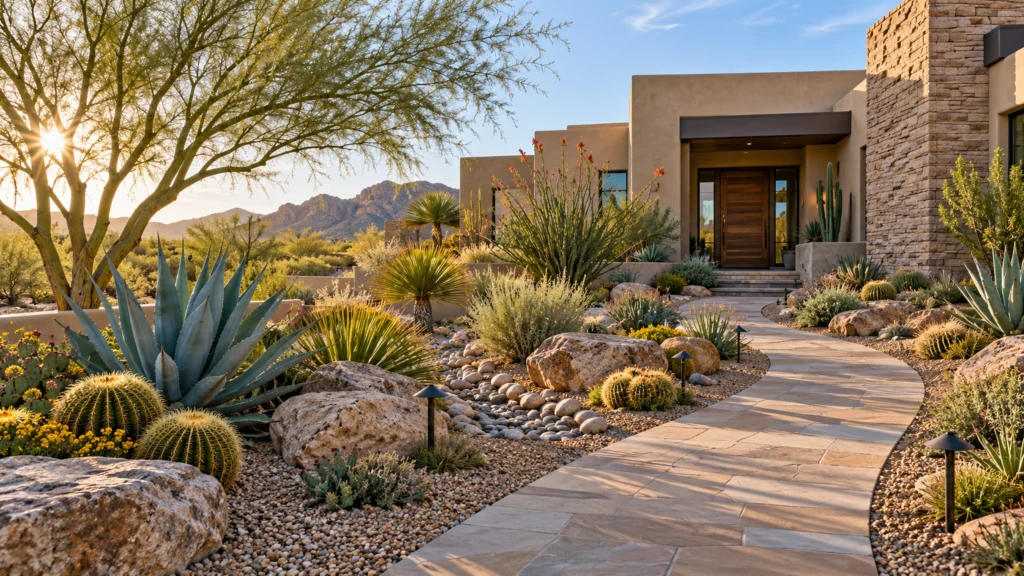
That does not mean covering the entire yard with rocks.
In fact, one of the most common mistakes in desert landscaping is treating gravel as the landscape rather than as one part of it.
A well-designed desert front yard normally includes several layers.
- Structural plants such as small desert trees, large agaves, yuccas, ocotillos, or substantial shrubs.
- Mid-sized shrubs and ornamental grasses that provide body and movement.
- Low-growing plants and flowering perennials that soften edges.
- Gravel, decomposed granite, or stone that covers exposed soil.
- Hardscape features such as pathways, steps, retaining walls, patios, or courtyard walls.
- Carefully positioned focal points that draw attention toward the entrance or another attractive part of the property.
The spaces between those elements matter too.
Desert landscapes benefit from visual breathing room. Plants do not need to touch one another from property line to property line. Allowing individual specimens to stand out can make the yard feel more natural and less crowded.
Start With the Architecture of Your House
Before choosing a single plant, look at your home.
The landscape should support the building instead of competing with it.
A Pueblo Revival or adobe-style property can look beautiful with native desert plants, warm gravel, sculptural agaves, rustic stone, and weathered steel accents.
A modern house may work better with cleaner planting beds, repeated rows of desert grasses, architectural succulents, large-format pavers, and a restrained material palette.
A Mediterranean or Spanish-style home can pair naturally with desert-adapted trees, terracotta-colored materials, flowering shrubs, ornamental grasses, and courtyard walls.
Even a fairly ordinary ranch or suburban house can become much more appealing when the landscape gives it a stronger visual identity.
Look at the facade from the street and ask where your eye naturally goes.
If it lands on the garage door, utility box, blank wall, exposed foundation, or another unattractive feature, the landscape can redirect that attention.
If the front door disappears into the architecture, the landscape can guide people toward it.
This relationship between house and landscape is something we emphasize throughout Front Yard Landscaping Ideas because curb appeal is rarely created by plants alone. It comes from the way the entire front yard frames the home.
Create Layers Instead of Scattering Plants
Randomly placing one plant here and another there can make a desert yard feel unfinished.
A layered planting design feels much more intentional.
Start with the tallest elements toward the back or at strategic corners. These might include desert willow, palo verde, mesquite, ocotillo, large yucca, or another plant appropriate for your climate.
Move forward with medium-height shrubs and grasses.
Then place smaller flowering plants, ground covers, compact succulents, or accent grasses near pathways and bed edges.
The result should resemble a landscape with foreground, middle ground, and background.
Repeating several plants is often more effective than buying one of everything at the nursery.
For example, a single agave may look isolated.
Three or five agaves positioned through a planting area create rhythm.
One ornamental grass can look accidental. A repeated group can create movement and cohesion.
Plant repetition also makes the landscape easier for the eye to understand.
Use Desert Trees to Add Shade and Scale
Trees can transform a desert front yard more dramatically than almost any other element.
They create shade, soften architecture, provide vertical scale, and offer habitat for birds and other wildlife.
Depending on your region, possible desert-friendly trees may include:
- Palo verde.
- Desert willow.
- Mesquite.
- Texas mountain laurel.
- Acacia species suited to the local climate.
- Desert-adapted native trees recommended for your area.
Do not choose a tree simply because it is labeled drought tolerant.
Mature size matters.
A small tree planted beside a walkway may eventually block access. A large tree planted against the foundation can create maintenance problems. Roots, thorns, litter, canopy spread, and proximity to power lines should all be considered.
Where possible, place shade where it serves a purpose.
A tree positioned to shade a west-facing wall, sitting area, walkway, or part of the driveway can improve comfort while also creating depth in the landscape.
Choose Drought Tolerant Plants With Different Forms
A desert garden becomes much more interesting when plant shapes contrast.
Imagine a round barrel cactus beside the long blades of a desert spoon.
Place that combination near the upright stems of an ocotillo and the loose foliage of a flowering shrub.
Suddenly the landscape has texture.
Useful plant forms include:
- Rosette forms such as agave and yucca.
- Upright forms such as ocotillo and columnar cactus.
- Rounded forms such as barrel cactus.
- Mounding forms created by shrubs and flowering perennials.
- Fine-textured forms such as ornamental grasses.
- Canopy forms supplied by desert trees.
Instead of relying only on flower color, use these differences in shape, height, foliage, and texture to make the yard visually interesting throughout the year.
Flowers may last several weeks.
Plant form lasts much longer.
Agave as a Desert Front Yard Focal Point
Agaves are among the most recognizable architectural plants in Southwestern landscaping.
Their symmetrical leaves and strong silhouette make them particularly effective near entrances, large rocks, walls, or contemporary hardscape.
However, placement matters.
Many agaves have sharp leaf tips, so avoid positioning large varieties immediately beside narrow sidewalks, driveways, children’s play areas, or places where people regularly pass.
Allow room for mature growth.
A small nursery plant can become substantially wider over time.
Agaves generally look strongest when they are treated as intentional accents rather than squeezed into every available corner.
Use Cactus Carefully Rather Than Everywhere
Cactus can absolutely belong in a desert front yard, but an attractive desert landscape does not have to become a cactus collection.
Mix cactus with shrubs, grasses, trees, and soft-textured plants.
This contrast prevents the yard from feeling harsh.
Barrel cactus can provide rounded shapes and strong structure. Prickly pear can create broad pads and seasonal flowers. Columnar species can introduce striking vertical lines.
Species selection should always reflect local temperature extremes and growing conditions.
A cactus that thrives in a low desert climate may struggle in a high desert region with prolonged freezes.
Add Desert Grasses for Movement
Stone and succulents create strong visual structure, but too much of both can make a front yard feel rigid.
Ornamental grasses can soften that effect.
Their narrow leaves move with the wind and introduce a lighter texture around boulders, walkways, walls, and large architectural plants.
Choose non-invasive grasses adapted to your region.
Native grasses are especially valuable because many are suited to local rainfall patterns and can provide habitat while requiring less intervention once established.
Use them in repeated groups rather than isolated single plants for a more natural appearance.
Bring Color Into a Desert Landscape
Desert landscaping does not need to be beige.
Depending on your region, flowering plants might include desert marigold, penstemon, salvia, globe mallow, brittlebush, fairy duster, chuparosa, red yucca, or other native and desert-adapted flowering species.
Choose plants with different bloom periods.
One species might flower heavily in spring, another through warmer months, and another later in the season.
This creates changing interest throughout the year.
Flowering plants can also support pollinators such as native bees, butterflies, hummingbirds, and other wildlife.
For a cohesive appearance, limit the number of dominant flower colors rather than combining every available shade.
A restrained color scheme often looks more intentional.
Use Decorative Gravel as a Background, Not the Main Attraction
Gravel is practical in arid landscapes because it covers bare soil without demanding irrigation.
It can also help visually connect separate planting areas.
But acres of uninterrupted gravel rarely create a memorable front yard.
Think of gravel as the background of the picture.
Plants, boulders, pathways, trees, and architectural features create the composition.
Choose gravel that complements the house and surrounding environment.
Warm tan or brown gravel can work well with Southwestern architecture. Gray materials may suit contemporary homes. Decomposed granite can create a softer and more natural appearance.
Avoid using too many different rock colors in one small yard.
Multiple decorative stones can quickly make the landscape feel fragmented.
Add Boulders for Natural Structure
Boulders are especially effective in desert landscaping because they provide permanent structure without requiring water or maintenance.
The trick is making them look as though they belong there.
A boulder sitting alone in the center of a perfectly flat gravel bed can appear artificial.
Instead, partially settle larger stones into the ground and connect them visually with plants, smaller rocks, changes in grade, or dry creek beds.
Groups of rocks with different sizes often look more natural than identical stones arranged at equal distances.
Place plants around some boulders so the landscape gradually grows into them.
Build a Walkway That Leads the Eye
A front walkway serves two purposes.
It physically moves people toward the entrance, and it visually tells them where to look.
If your current path is narrow or unattractive, consider emphasizing it with large pavers, natural stone, concrete slabs, gravel borders, low-growing plants, or lighting.
A subtle curve can make a large front yard feel inviting.
A straight walkway can provide a powerful modern look.
The best shape depends on the architecture and available space.
Whatever style you choose, make the entrance obvious.
Visitors should never have to wonder whether they are walking toward the front door or the side yard.
Create a Desert Dry Creek Bed
A dry creek bed can turn drainage management into a landscape feature.
It usually consists of an intentionally shaped channel lined with rocks or gravel. Larger stones can be placed along the edges, with drought tolerant plants nearby.
A well-designed dry creek can visually break up a large gravel area and create the impression of a natural desert wash.
It may also help direct stormwater when properly graded.
However, drainage design needs to be functional, not merely decorative.
Water should move away from foundations and toward an appropriate drainage location rather than being redirected onto a neighboring property or trapped beside structures.
Where drainage conditions are complicated, professional grading advice may be worthwhile.
Design Around a Front Yard Courtyard
A small courtyard can make a plain facade feel much more substantial.
A low stucco, masonry, or stone wall creates another architectural layer between the street and the house.
Inside, you can create a small seating area surrounded by desert plants.
The courtyard wall itself can become a backdrop for agave, ornamental grasses, flowering shrubs, or a specimen tree.
This approach is particularly useful when the front of the house has awkward proportions or large areas of blank wall.
Instead of trying to cover the entire facade with vegetation, you give the eye something more attractive to focus on.
Add Large Containers Near the Entrance
Containers are one of the simplest ways to make a desert front entry feel finished.
Choose pots large enough to match the scale of the house.
Tiny containers can disappear against a wide facade.
A pair of substantial planters may frame the doorway, while one oversized container can serve as an asymmetrical focal point.
Use plants suited to container conditions and local temperatures.
Remember that pots often dry much faster than surrounding soil, so container plants may require different watering schedules.
Container color can also connect the landscape with the house.
For example, a terracotta pot can echo warm roof tiles, while a charcoal-colored container may suit modern architecture.
Use Low Walls to Define the Landscape
A low landscape wall can provide more than privacy.
It can divide planting zones, create elevation changes, frame the entrance, hold back soil, or provide a background against which desert plants become more visible.
Materials might include:
- Stucco.
- Natural stone.
- Concrete masonry.
- Brick.
- Other locally appropriate hardscape materials.
Repeat materials already found on the house when possible.
That visual connection can make the landscape feel as though it was designed with the architecture rather than added years later.
How to Landscape a Hill in Desert Front Yard
Landscaping a hill in a desert front yard requires more attention to erosion, runoff, plant establishment, and soil stability than landscaping flat ground.
The first goal is not simply to make the slope attractive.
It is to keep water and soil where they belong.
Understand How Water Moves Down the Hill
Watch what happens during heavy rain.
Even desert regions can receive intense storms, and water moving quickly down bare soil can create channels, expose roots, wash away gravel, and deposit sediment at the bottom of the slope.
Identify natural drainage paths before changing the grade.
Do not create berms, walls, or planting beds that accidentally send runoff toward the house.
Create Contours Rather Than Fighting the Slope
Instead of trying to make an entire hill perfectly flat, work with its natural contours.
Curved planting zones can slow water movement and create visually softer lines.
Small terraces may be appropriate on steeper slopes.
Retaining walls can also create usable planting levels, but they must be constructed correctly.
Wall height, drainage, soil pressure, local building regulations, and engineering requirements should be considered before construction.
Use Rocks to Visually Anchor the Slope
Boulders can make a sloped desert front yard look more natural while breaking up large areas of gravel.
Set rocks into the slope rather than balancing them visibly on top of the soil.
This gives the landscape a more established appearance.
Smaller stones and plants can then transition around them.
Choose Plants With Appropriate Root Systems
Plants on slopes need to tolerate both drought and fast-draining conditions.
Native shrubs, grasses, ground covers, and other locally adapted species can help provide root structure while reducing the appearance of bare ground.
Plant choice varies dramatically by desert region, elevation, frost exposure, and soil type, so local native plant resources can be particularly useful.
Plant in Groups
A few isolated plants scattered across a large hill often look sparse.
Instead, establish repeated groups that follow the contours.
Place larger plants or shrubs in strategic positions, then connect them visually using smaller plants and grasses.
This creates both rhythm and a stronger sense of coverage.
Consider Drip Irrigation Placement
Water behaves differently on slopes.
Apply too much too quickly and it may run downhill before soaking into the root zone.
Drip irrigation or low-flow emitters can allow moisture to enter the soil more gradually.
Separate irrigation zones may be useful when different plants have different water needs.
The aim is deep, appropriate watering rather than frequent shallow watering.
Use Drip Irrigation Instead of Watering Everything Equally
Efficient watering is one of the foundations of desert landscaping.
Different plants have different moisture requirements.
A newly planted tree may need more regular irrigation while establishing than a mature native shrub. A container plant may dry out much faster than an agave growing in the ground.
Putting every plant on the same watering schedule can result in either overwatering or underwatering.
Drip irrigation can deliver water directly to root zones and reduce unnecessary evaporation compared with broad overhead irrigation.
As plants mature, emitter placement may also need to change.
Tree roots spread outward over time, so irrigation should not remain concentrated permanently against the trunk.
Group Plants by Water Needs
Hydrozoning means placing plants with similar water needs together.
It is a simple idea that can make a desert front yard much easier to manage.
For instance, very low-water succulents can occupy one planting zone while slightly thirstier flowering plants are grouped elsewhere.
This prevents you from repeatedly soaking drought-loving plants simply because one neighboring species needs more water.
Thoughtful grouping can improve plant health and reduce waste.
Replace Lawn Without Creating a Gravel Desert
Removing a struggling lawn can dramatically reduce the maintenance demands of a desert front yard.
But replacing every blade of grass with one continuous layer of gravel is not your only option.
Create a combination of:
- Native or drought tolerant planting beds.
- Shade trees.
- Gravel or decomposed granite.
- Walkways.
- Boulders.
- Dry creek features.
- Small seating areas.
- Ground covers suited to your region.
- Mulched planting zones where appropriate.
- Open negative space.
These elements make a lawn-free landscape feel deliberate and comfortable rather than empty.
If you want to retain some lawn, consider keeping a smaller functional area instead of treating turf as the default surface for the whole front yard.
Small Desert Front Yard Landscaping Ideas
A small front yard benefits from restraint.
Too many plant varieties, rock colors, pots, and decorative objects can make limited space feel even smaller.
Choose a few strong materials and repeat them.
For example, you might combine decomposed granite with three plant groups, a specimen agave, and large stepping stones.
Use vertical plants where floor space is limited.
An ocotillo, narrow yucca, or another upright plant can provide height without consuming the same visual footprint as a broad shrub.
Keep mature plant size in mind.
A plant that looks charming in a nursery container can overwhelm a narrow walkway several years later.
Small yards often look better when every plant has a reason to be there.
Modern Desert Front Yard Landscaping Ideas
Modern desert landscapes rely heavily on clean geometry, repetition, negative space, and architectural plants.
Consider combining:
- Large concrete pavers.
- Simple gravel beds.
- Repeated agave or yucca plantings.
- Ornamental grasses.
- One sculptural specimen tree.
- Straight or gently offset walkways.
- Limited rock colors.
- Simple landscape lighting.
Avoid overdecorating.
A modern desert front yard often becomes stronger when the number of different materials is reduced.
Contrast is created through form and texture rather than ornament.
Desert Landscaping Ideas for Privacy
Privacy can be challenging in desert environments because homeowners may not want dense, water-hungry hedges.
Instead, think in layers.
A low wall can block views near ground level.
Strategically positioned shrubs can soften the wall.
A small tree can filter views toward upper windows or neighboring properties.
Architectural screens or trellises can add additional coverage where permitted.
Rather than building one massive visual barrier, combine several lighter elements.
This often feels more comfortable from both the street and the house.
Make sure plants used for screening have enough room to reach their mature width.
Constantly shearing oversized shrubs into narrow spaces creates more maintenance and rarely produces the natural desert look people want.
Hide Utility Boxes Without Blocking Access
Utility equipment can interrupt an otherwise attractive front yard.
Plants can help, but do not permanently block access.
Use shrubs, grasses, or a strategically placed architectural plant to soften views from the street while maintaining the required working clearance around electrical, gas, water, communication, or other utility equipment.
Never assume that decorative screens or permanent structures are allowed around service equipment.
Access and safety requirements vary.
The objective is visual screening from important viewpoints, not complete enclosure.
Make the Front Door the Focal Point
Your landscape should quietly tell visitors where to go.
Create a visual path toward the entrance using repetition.
For example, similar grasses can run beside the walkway. Two larger plants can frame the approach. A specimen plant, large pot, or accent tree can draw attention toward the door.
Landscape lighting can reinforce the route after dark.
If the garage is currently the dominant feature, avoid placing the yard’s strongest focal plant directly beside it.
Pull visual interest toward the pedestrian entrance instead.
Add Landscape Lighting for Nighttime Curb Appeal
A desert landscape can look completely different after sunset.
Low-voltage lighting can reveal plant forms, highlight textured walls, illuminate pathways, and create shadows across boulders.
Use lighting selectively.
More fixtures do not necessarily create a better result.
Focus on:
- Steps and changes in elevation.
- Primary walkways.
- Important architectural features.
- One or two specimen plants.
- Large trees.
- Entry areas.
Avoid positioning excessively bright fixtures where they shine directly into windows or neighboring properties.
Where dark-sky regulations apply, choose compliant fixtures and direct light downward where appropriate.
Think About Desert Soil Before Planting
Desert soils are not all the same.
Some are sandy and drain extremely quickly. Others contain heavy clay or compacted caliche that can restrict drainage and root growth.
Before installing expensive plants, understand what you are working with.
Drainage problems can be particularly damaging to drought-adapted plants that dislike sitting in wet soil.
Do not automatically amend every planting hole with rich organic material.
Planting recommendations vary by species and soil conditions.
Local cooperative extension programs, native plant organizations, knowledgeable nurseries, and landscape professionals like Sara Bendrick can provide region-specific guidance.
Design for Mature Plant Size
One of the easiest ways to make a new landscape look impressive is to pack plants closely together.
It is also one of the easiest ways to create a maintenance problem a few years later.
Plants grow.
A five-gallon shrub can eventually become several feet wide. Agaves can produce offsets. Trees spread canopies. Cactus may develop into large clumps.
Read mature dimensions rather than judging spacing by nursery size.
Giving plants enough room may make the landscape look slightly open during its first season, but it usually produces a healthier and more natural result later.
Avoid Placing Spiky Plants Beside Walkways
Sharp plants are visually perfect for desert landscapes but physically unpleasant when poorly positioned.
Agave, cactus, yucca, and similar plants should generally have sufficient clearance from areas where people walk, park, open vehicle doors, retrieve mail, or move trash bins.
This becomes even more important as plants mature.
Use softer shrubs, grasses, or ground covers at immediate pedestrian edges when possible.
Save the dramatic spines for locations where their form can be appreciated without creating an obstacle.
Use Native Plants Where They Make Sense
Native plants can make a desert yard feel connected to its surroundings.
Because they evolved within regional conditions, appropriate native species may offer benefits including habitat value, seasonal interest, and adaptation to local weather.
But the word desert covers an enormous range of environments.
A plant native to the Sonoran Desert may not perform identically in the Mojave Desert, Chihuahuan Desert, Great Basin, or a high-elevation desert community.
Choose plants based on your specific region rather than simply buying anything marketed as a desert plant.
Temperature minimums, summer heat, elevation, rainfall, soil, wind, and exposure all matter.
Create Wildlife Value in the Front Yard
A desert front yard can be visually attractive while also supporting wildlife.
Flowering native plants can provide nectar.
Seed-producing grasses and shrubs may support birds.
Trees can offer shelter.
Different plant heights create different types of habitat.
If wildlife value is important to you, choose plants strategically rather than relying heavily on sterile hardscape.
Even a modest front yard can become a small ecological stepping stone when plants provide flowers, seeds, shelter, or nesting opportunities.
Add Seating to Make the Front Yard Feel Lived In
A front yard does not have to exist solely for curb appeal.
If the layout allows it, create a small sitting area.
A bench under a shade tree, two chairs inside a courtyard, or a compact paved area near the entrance can make the landscape feel connected to everyday life.
Position seating where it receives useful shade.
In hot desert climates, an exposed west-facing bench may look attractive but remain practically unusable for much of the day.
Consider morning and afternoon sun when choosing the location.
Use Hardscape to Reduce Maintenance
Hardscape gives a desert yard permanent structure.
Useful elements include paths, retaining walls, steps, patios, edging, courtyard walls, boulders, and seating areas.
Hardscape is not maintenance free, but it does not require the same routine care as a lawn or densely planted garden.
The key is balance.
Too little structure can make a xeriscape feel loose and unfinished.
Too much paving can make the front yard feel hot and severe.
Combine hard materials with shade and vegetation to soften them.
Consider Heat Around Pavement and Gravel
Desert landscaping should reduce water use without ignoring heat.
Large expanses of exposed stone and pavement can become extremely hot in direct sun.
Shade trees, planting islands, permeable areas, and thoughtful material placement can make outdoor spaces feel more comfortable.
This is another reason the strongest desert landscapes are not simply rock yards.
Plants play an important role in creating shade, texture, habitat, and seasonal change.
Use hardscape where it is useful and vegetation where it can provide meaningful environmental and visual benefits.
Keep Your Material Palette Simple
A front yard can quickly become visually noisy when it combines red gravel, white gravel, black river rock, tan boulders, brick edging, concrete pavers, timber, metal borders, and several types of decorative pots.
Choose fewer materials.
Repeat them intentionally.
For example, one gravel color, one primary paving material, and one boulder type may be enough.
If you introduce metal, stone, or another accent material, give it a clear purpose.
A restrained palette helps individual plants become more noticeable and makes the landscape appear professionally coordinated.
Low Maintenance Desert Front Yard Landscaping
Low maintenance does not mean zero maintenance.
Even drought tolerant landscapes require attention.
Plants may need pruning.
Gravel collects leaves.
Weeds can appear.
Irrigation systems need inspection.
Trees may require structural care.
The difference is that a well-designed desert front yard can reduce repetitive tasks by choosing plants and materials suited to the site.
To reduce future work:
- Select plants that fit the available space at maturity.
- Avoid species known to become invasive in your region.
- Group plants according to water needs.
- Install efficient irrigation.
- Keep plants away from narrow walkways.
- Use appropriate ground cover to reduce exposed soil.
- Address drainage before planting.
- Limit unnecessary lawn.
- Avoid overly complicated hardscape patterns.
- Leave enough access for maintenance.
Good design prevents problems instead of creating prettier versions of them.
Common Desert Front Yard Landscaping Mistakes
Using Too Much Gravel
Gravel is useful, but an almost empty rock yard can feel harsh and unfinished.
Include enough plants to create shade, height, texture, and seasonal interest.
Buying One of Every Plant
A collection of unrelated specimens can feel chaotic.
Repeat important plants to establish visual rhythm.
Ignoring Mature Size
Overcrowding may look attractive initially but creates pruning and access problems later.
Overwatering Desert Plants
More water is not always better.
Some desert-adapted species can decline when soil remains consistently wet.
Placing Thorny Plants Near Traffic Areas
Sharp plants need room.
Keep them away from doors, driveways, narrow pathways, and frequently used spaces.
Ignoring Drainage
A beautiful front yard can fail quickly if water collects around plant crowns, structures, or retaining walls.
Choosing Plants Only for Flowers
Flowering seasons are temporary.
Evaluate foliage, form, mature size, and texture as well.
Making Every Feature a Focal Point
If the mailbox, fountain, cactus, wall, pot, boulder, and tree are all competing for attention, nothing feels important.
Choose one or two dominant focal points and allow other elements to support them.
A Simple Desert Front Yard Design Formula
If you are struggling to decide where to begin, use a basic structure.
Start with one shade or specimen tree if space allows.
Add one or two large architectural plant types.
Repeat a medium shrub or grass through the planting beds.
Introduce a smaller flowering plant for seasonal color.
Use one primary gravel or decomposed granite material.
Add several well-positioned boulders.
Create a clear walkway to the entrance.
Finish with restrained landscape lighting and efficient irrigation.
This formula is flexible enough to suit many architectural styles while preventing the landscape from becoming cluttered.
How to Plan Your Desert Front Yard Step by Step
Given are the steps for planning desert front yard:
Step 1: Measure the Yard
Record property boundaries, walkways, utility locations, windows, doors, driveway edges, and existing plants.
Step 2: Study Sun Exposure
Identify areas receiving full sun, afternoon heat, reflected heat, or substantial shade.
Step 3: Check Drainage
Observe slopes and determine where stormwater naturally moves.
Step 4: Identify Views
Look at the house from the street, driveway, sidewalk, and front entrance.
Decide what you want to emphasize and what you want to soften.
Step 5: Choose Major Structural Elements
Position trees, walls, paths, patios, retaining walls, dry creek beds, or major boulders before filling the yard with small plants.
Step 6: Create Planting Layers
Combine tall, medium, and low plants while considering mature dimensions.
Step 7: Repeat Key Plants
Repetition creates unity and prevents the yard from looking like a collection of unrelated species.
Step 8: Plan Irrigation
Group plants according to water requirements and design irrigation around those zones.
Step 9: Select Ground Cover
Choose gravel, decomposed granite, mulch where suitable, or another material appropriate for the planting area.
Step 10: Edit the Design
Remove anything that does not contribute.
Desert landscaping often improves when you resist the temptation to fill every open space.
Conclusion
The best desert front yard landscaping ideas do more than replace grass with gravel. They create a landscape that belongs to its climate and makes the house look better in the process.
Start with structure.
Use trees to provide shade and scale. Add architectural plants such as agave, yucca, ocotillo, desert spoon, or regionally appropriate cactus. Layer those plants with softer shrubs, native grasses, flowering perennials, boulders, gravel, and clearly defined walkways.
If the house itself is unattractive, use the landscape strategically. Frame the entrance, soften blank walls, screen distracting features, and create one strong focal area that pulls attention toward the best part of the property.
Sloped yards require additional thought. Drainage, erosion, terracing, retaining walls, rocks, plant roots, and efficient irrigation should all work together rather than fight the terrain.
Above all, resist the idea that desert landscaping has to look empty.
A successful desert front yard can be colorful, textured, shaded, wildlife friendly, low water, and full of character.
At Front Yard Landscaping Ideas, we believe the most convincing landscapes are not the ones with the most plants or the most expensive hardscape. They are the ones where every element feels as though it belongs exactly where it was placed.
FAQs
What Is the Best Landscaping for a Desert Front Yard?
The best desert front yard landscaping combines drought tolerant plants, native or climate-adapted species, efficient irrigation, gravel or decomposed granite, boulders, shade trees, pathways, and appropriately sized hardscape.
A successful design also considers mature plant size, sun exposure, drainage, soil, local temperature extremes, and the architectural style of the house.
How Can I Make My Desert Front Yard Look Better?
Start by giving the yard more structure.
Create a clear walkway, introduce one strong focal point, plant in repeated groups, add vertical and low-growing plants, and use boulders or hardscape to define planting areas.
Avoid scattering isolated plants throughout a large bed.
Layering and repetition usually create a more polished appearance.
How Do I Hide an Ugly House With Desert Landscaping?
Use taller desert plants, shrubs, small trees, courtyard walls, large containers, trellises, and layered planting to soften unattractive architectural features.
At the same time, draw attention toward the front door or another attractive feature with a clear walkway, specimen plant, landscape lighting, or focal tree.
Do not completely cover windows, ventilation, utility equipment, or required access areas.
What Are Good Low Maintenance Plants for Desert Front Yards?
Suitable plants depend on your specific desert region, but common landscape categories include agave, yucca, desert spoon, native grasses, drought tolerant flowering perennials, desert shrubs, cactus, and desert-adapted trees.
Choose species based on local temperatures, soil, mature size, water requirements, and sun exposure rather than appearance alone.
Is Gravel Good for a Desert Front Yard?
Yes. Gravel can cover exposed soil, complement drought tolerant plants, and reduce the need for lawn.
However, gravel works best as one component of a landscape rather than the entire landscape.
Combine it with trees, shrubs, grasses, succulents, boulders, pathways, and planting areas to avoid creating a bare rock yard.
How Do You Landscape a Sloped Desert Front Yard?
Begin by understanding drainage and erosion.
Work with the natural contours of the slope and consider grouped plantings, native grasses, shrubs, boulders, dry creek beds, terraces, or properly designed retaining walls.
Use irrigation methods that allow water to soak into the soil rather than immediately running downhill.
Steep or structurally complicated slopes may require professional landscape, drainage, or engineering advice.
How Can I Landscape a Desert Front Yard Without Grass?
Replace lawn with a balanced combination of gravel, decomposed granite, native plants, drought tolerant shrubs, shade trees, ornamental grasses, succulents, boulders, pathways, dry creek beds, and seating areas.
The goal should be to create layers and usable space rather than simply covering the former lawn with rocks.
How Can I Add Color to a Desert Landscape?
Use regionally appropriate flowering plants such as penstemon, salvia, desert marigold, globe mallow, fairy duster, brittlebush, chuparosa, or red yucca where suitable.
You can also create color through foliage, containers, stone, walls, and architectural materials.
Choose plants with different bloom periods so the landscape changes through the seasons.
How Do I Make a Small Desert Front Yard Look Bigger?
Keep the design simple.
Use a limited material palette, repeat a small number of plant varieties, maintain clear sight lines, and avoid filling every available space.
Vertical plants can provide height without consuming excessive ground area, while a clearly defined walkway can create visual depth.
Are Desert Landscapes Really Low Maintenance?
They can be lower maintenance than conventional lawns, but they are not maintenance free.
Desert landscapes still need weed control, irrigation inspection, occasional pruning, plant replacement, debris removal, and tree care.
Choosing appropriately sized plants and installing them in suitable locations can significantly reduce future work.
How Much Space Should Be Left Between Desert Plants?
Spacing depends on the mature width of each species.
Do not rely on the size of a plant at the nursery.
Check its expected mature dimensions and provide enough room for healthy growth, air circulation, walkway clearance, and access.
Desert landscapes often look better when plants have some visible space around them.
Should Desert Plants Be Planted Close to the House?
Not usually.
Plants should be positioned according to their mature size while maintaining appropriate access around the building.
Large shrubs, trees, cactus, and sharp succulents can create maintenance or safety problems when planted too close to walls, windows, pathways, or utility equipment.
What Is the Cheapest Way to Improve a Desert Front Yard?
Work with what you already have.
Remove unhealthy or poorly positioned plants, redefine bed edges, prune existing vegetation appropriately, simplify the rock palette, improve the walkway, and group new plants strategically rather than buying dozens of different species.
A few well-positioned plants and boulders can often have more impact than filling the entire yard at once.
What Is the Difference Between Xeriscaping and Desert Landscaping?
Xeriscaping is a broader landscape approach focused on efficient water use through appropriate plant selection, irrigation, soil management, practical turf areas, and thoughtful design.
Desert landscaping describes a landscape aesthetic and plant palette associated with arid environments.
A desert front yard can use xeriscaping principles, but the two terms are not necessarily identical.
What Should Be the Main Focal Point in a Desert Front Yard?
In most residential front yards, the landscape should ultimately support the entrance.
A specimen tree, architectural agave, large boulder grouping, courtyard, attractive container, or flowering planting can serve as a focal point, but its position should help lead the eye toward the home rather than compete with it.
One strong focal point is usually more effective than several unrelated decorative features.

Sara Bendrick believes your yard should be a place you actually look forward to coming home to. A licensed and bonded design-build contractor (C-27 #1006161), she founded Sarita Landscape Designs and has spent over twelve years designing residential outdoor spaces across Southern California with a real soft spot for curb appeal and low-water, no-lawn designs.
When she’s not on a job site, Sara’s on camera or on stage. She’s hosted yard-renovation shows including I Hate My Yard, Build It Like Bendrick, and Lawn & Order, written Big Impact Landscapes, given two TEDx talks, and serves as a spokesperson for Stihl. Her mission is simple, help people see the potential in the yard they already have.